


Mackenzie Investments and FactSet launched a new Global Green Revenue Index to fill the gap between narrowly defined clean tech sector indices and overly inclusive ones.
Low-volatility equity as a core allocation can reduce drawdowns while maintaining meaningful equity participation through a disciplined investment framework.
Active extension strategies can unlock alpha potential, improve risk-adjusted returns, and bridge the gap between traditional long-only and hedge fund portfolios.
Canada may be late to the Liquefied Natural Gas (LNG) party, but newly opened facilities and planned investments can thrust the country into a leadership position in the LNG export game. The question is, from a sustainability, affordability and energy security perspective, will it be worth it?
Sustainable investing has changed considerably from its early days as a niche strategy focused on exclusionary screening. It has shed the generic “ESG” label and matured into a more sophisticated and nuanced landscape, offering a wide range of strategies.
An ESG framework for fixed income investing that integrates sustainability risks into credit analysis and portfolio construction. Sector-specific models and valuation tools help assess how non-financial factors impact issuer performance and long-term returns.
Low tracking error strategies provide a disciplined active management approach, emphasizing diversified alpha sources and tight risk controls.
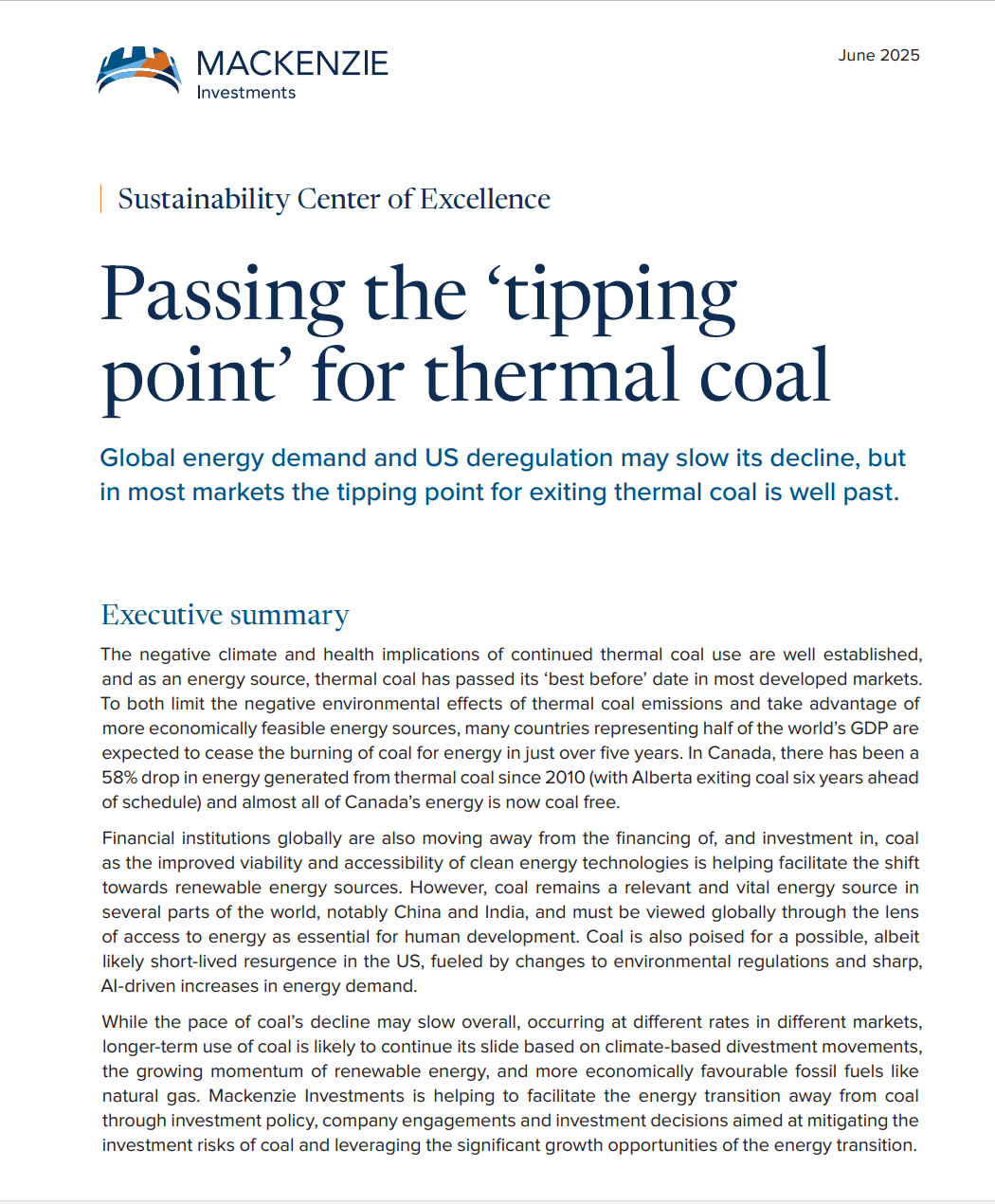
Global energy demand and US deregulation may slow its decline, but in most markets the tipping point for exiting thermal coal is well past.
For decades, investors seeking to expand the influence of their capital beyond the generation of financial returns to enable non-financial impact, have been challenged by the perception of a zero-sum game: having to choose between doing well financially or doing good for society and the planet.
A holistic approach to quantitative investing could enhance the opportunity for more consistent alpha across a wide array of market environments.
Emerging market equity, as an asset class, is often overlooked for the wrong reasons. Learn about a quantitative approach to this critical component of the equity allocation puzzle.
