.svg)
.svg)
Building equity portfolios for changing markets

About the author

About the author

About the author

About the author

About the author
IN THIS ARTICLE
Key takeaways
A diversified portfolio may still be concentrated. Even if your portfolio holds hundreds of stocks, its returns may depend on a small number of companies or investment factors. Looking beyond holdings can reveal hidden risks.
Market leadership changes over time. Different investment styles have led markets at different points. A balanced core portfolio is designed to participate across changing market environments rather than rely on one style to outperform.
Stress testing helps uncover hidden exposures. Reviewing both stock and factor concentration can help investors understand whether their core equity allocation is positioned to remain resilient as markets evolve.
A resilient core needs breadth, balance and discipline. A broader opportunity set, diversified return drivers and disciplined portfolio construction can help investors navigate changing market leadership.
Your core may be more concentrated than it looks—not necessarily in the stocks it owns, but in the handful of factors quietly driving its returns.
As market leadership has become increasingly concentrated, many core equity strategies have become more dependent on the same drivers of return. That doesn’t mean they own the wrong stocks. It means investors should look beyond holdings and recent performance to understand what is really driving returns and whether those exposures are intentional, balanced and aligned with the portfolio’s long-term role.
What is a core equity allocation supposed to do?
A core equity allocation should provide broad participation in global equity markets while remaining resilient as market leadership changes. Rather than expressing a single investment view, it should capture multiple sources of return across styles, sectors, regions and market environments.
That requires more than owning a broad collection of stocks. A resilient core should be built on a balanced mix of return drivers, with disciplined portfolio construction that helps manage unintended concentrations as leadership rotates. The objective is not to outperform in every environment, but to hold its role across many of them.
Why factor balance matters
Market leadership can shift sharply, and different environments reward different characteristics. Growth, value, quality, equal-weighted and market cap-weighted approaches have each behaved differently across major regimes, reinforcing that no single style or factor leads in every environment.
Figure 1: Market leadership shifts across styles and regimes
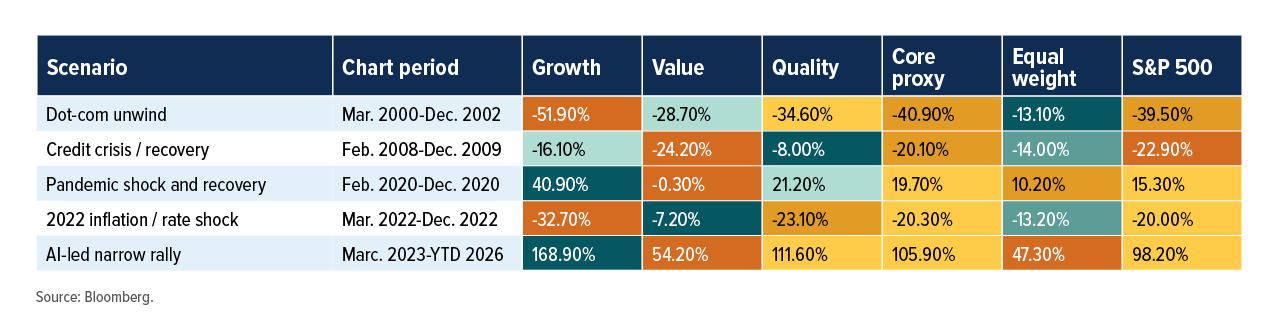
This is why balance matters. A core strategy is not designed to lead in every environment, but to participate across regimes while reducing reliance on any single style or factor. When growth dominated, a balanced core participated meaningfully in market gains; when growth leadership reversed, exposure to other drivers, including value, helped cushion the impact.
A balanced core approach does not require predicting the next leadership cycle. It aims to hold its role across more than one market outcome.
How to stress test your core equity allocation
A core allocation can look diversified by holdings but still behave like a concentrated portfolio if similar factors are driving returns. That is why stress testing should ask: what is the portfolio really depending on?
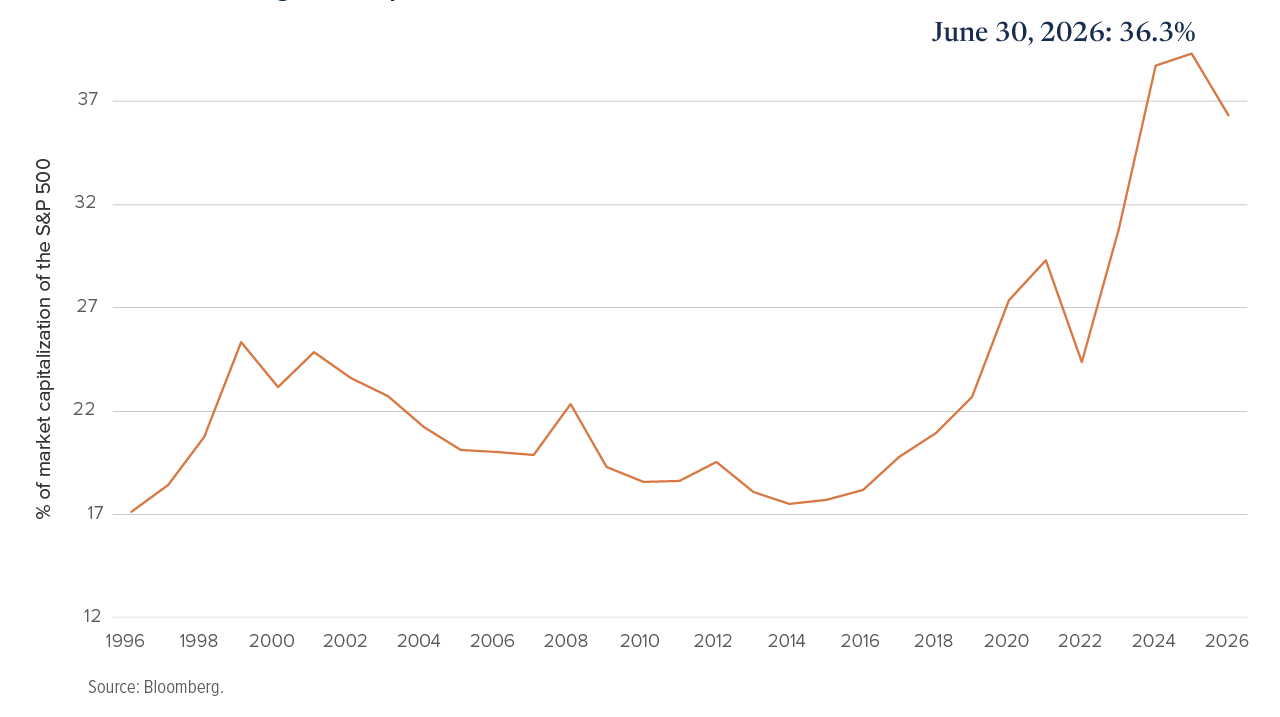
Market concentration is most visible at the holdings level. As Figure 2 shows, the top 10 stocks in the S&P 500 reached a historical high of 36.3% as of June 30, 2026, making the broad benchmark more dependent on fewer companies.
Figure 2: Weight of top 10 stocks in S&P 500
Holdings concentration is only one layer of the stress test. The next is style concentration: whether returns are driven by a balanced mix of factors or by a narrower set of exposures. As shown in Figure 3, a 24-month rolling return-based analysis attributes roughly 58% of recent S&P 500 performance to high beta and momentum exposures. The implication is important: a core allocation may look diversified by holdings, while still relying on a narrow set of factors to keep working.
Figure 3: Looking beneath the index: style drivers of S&P 500 returns
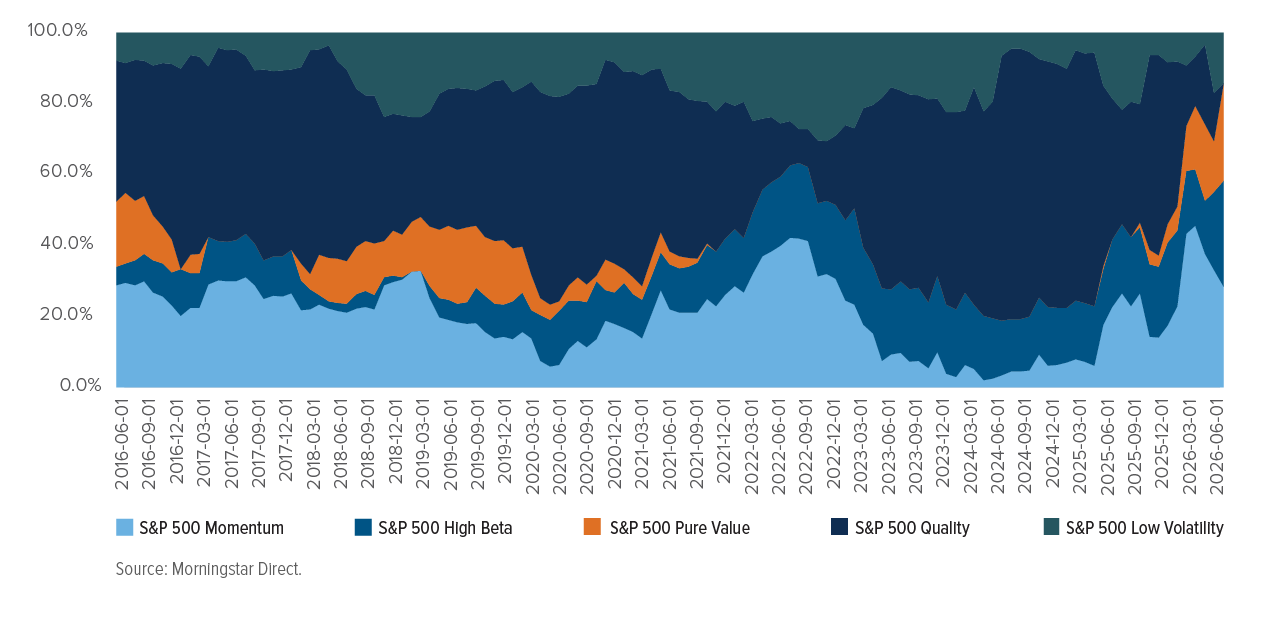
By looking beyond holdings to factor drivers, investors can better assess whether a core allocation is supported by multiple sources of return or increasingly dependent on one market environment. A multi-factor approach can help manage unintended factor risks and create a more diversified path to potential alpha as leadership changes.
What a stronger core process should deliver
A resilient core is not built by choosing one factor and hoping it leads. It recognizes that different return drivers are rewarded at different points in the cycle and creates a process that can source alpha from many of them. A multi-factor approach shifts the focus from a single theme to systematically evaluating a broad universe of securities across evolving investment signals.
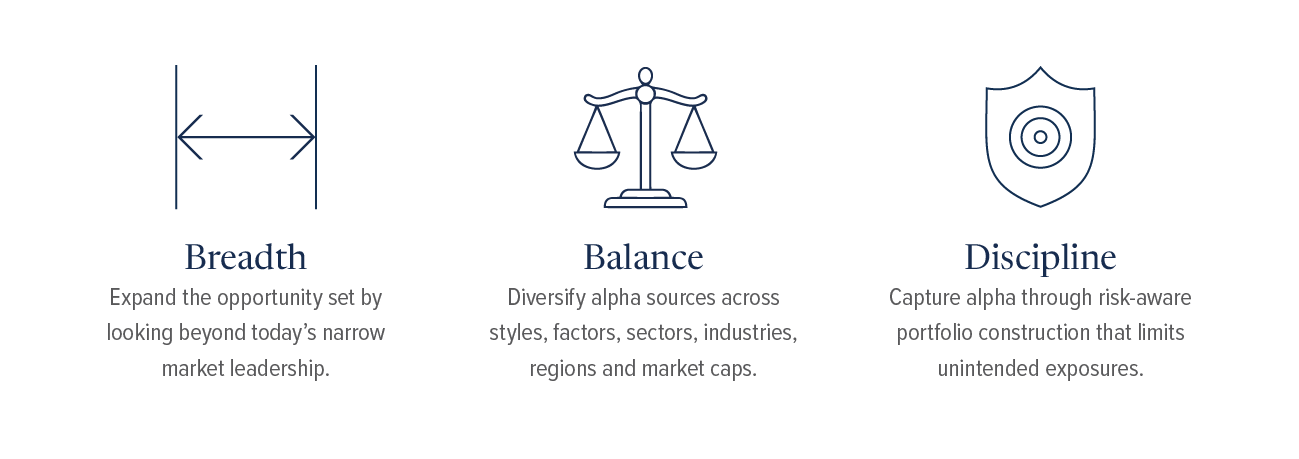
Identifying opportunities is only one part of the equation. They must be balanced across performance drivers and captured through disciplined portfolio construction, so no single factor, theme or leadership cycle dominates.
Figure 4: Three pillars of a resilient core equity allocation
Rethinking the role of core equity
In today’s markets, building a resilient core isn’t about owning more stocks. It’s about diversifying return drivers. A disciplined multi-factor process can help investors participate as leadership changes while maintaining balance, managing risk and creating more consistent opportunities for alpha.
For the Mackenzie Global Quantitative Equity (GQE) Team, building a resilient all-weather core portfolio starts with a broad global investment universe, daily stock rankings and rebalancing.
The team combines diversified exposure across performance drivers — such as value, growth and quality — with dynamic flexibility, human insight and risk-aware portfolio construction.
Together, these elements are designed to help the portfolio maintain a consistent alpha profile while avoiding overreliance on any single theme, sector, industry or leadership cycle. That is why stress testing your core matters: it helps reveal whether the allocation can hold its role as leadership changes, or whether it is quietly relying on the same factors to keep working.
The content of this page (including facts, views, opinions, recommendations, descriptions of or references to, products or securities) is not to be used or construed as investment advice, as an offer to sell or the solicitation of an offer to buy, or an endorsement, recommendation or sponsorship of any entity or security cited. Although we endeavour to ensure its accuracy and completeness, we assume no responsibility for any reliance upon it.
This document may contain forward-looking information which reflect our or third-party current expectations or forecasts of future events. Forward-looking information is inherently subject to, among other things, risks, uncertainties and assumptions that could cause actual results to differ materially from those expressed herein. These risks, uncertainties and assumptions include, without limitation, general economic, political and market factors, interest and foreign exchange rates, the volatility of equity and capital markets, business competition, technological change, changes in government regulations, changes in tax laws, unexpected judicial or regulatory proceedings and catastrophic events. Please consider these and other factors carefully and not place undue reliance on forward-looking information. The forward-looking information contained herein is current only as of July 29, 2026. There should be no expectation that such information will in all circumstances be updated, supplemented or revised whether as a result of new information, changing circumstances, future events or otherwise.