.svg)
.svg)
Monthly commentary - Mackenzie Fixed Income Team


About the author
IN THIS ARTICLE
Highlights
- Oil prices have largely retraced the conflict-driven increase, but physical conditions have not fully normalized. Inventories and traffic through the Strait of Hormuz remain below normal levels, leaving inflation vulnerable to renewed energy-market disruption despite the recent decline in market-based inflation expectations.
- U.S. core inflation has re-accelerated while the labour market is cooling rather than contracting sharply. The Federal Reserve’s initial communication under Chair Warsh was notably more hawkish, although the team believes part of this stance is intended to establish policy credibility and may soften as the economic cycle evolves.
- We remain overweight long-dated U.S. inflation-linked bonds. The decline in breakeven inflation rates has improved valuations and provides an attractive opportunity to maintain protection against renewed price pressures, fiscal risks and a potentially more accommodative Federal Reserve over the medium term.
- The portfolio’s U.S. dollar overweight has been reduced following a strong move, with option structures providing flexibility to express a modest tactical short. Emerging-market exposure remains constructive across both local bonds and currencies, with Brazil preferred for its high nominal and real yields despite election-related headline risk.
Fixed Income Team views
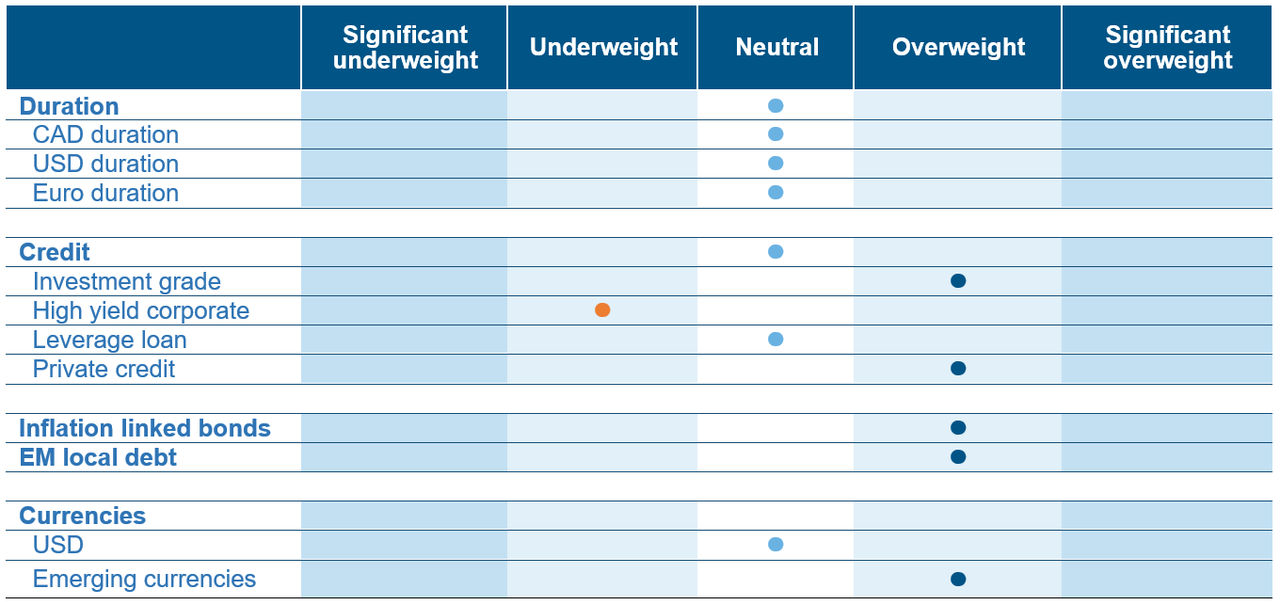 Source: Mackenzie Investments. As of June 30, 2026.
Fixed Income market update
Fixed income markets continued to navigate a volatile macroeconomic environment during the period. The conflict-related increase in oil prices largely reversed, with Brent returning close to its pre-war level as additional physical supply reached the market through alternative routes and pipelines. However, the underlying supply system has not fully normalized. Inventories remain constrained and traffic through the Strait of Hormuz continues to operate below normal capacity, suggesting that the decline in the energy risk premium may be more complete in financial markets than in the physical market.
The reversal in oil prices contributed to a sharp decline in short-term inflation expectations, with U.S. two-year breakeven inflation falling below 2%. The team does not believe that this fully captures the underlying inflation risk. U.S. core PCE inflation accelerated to 3.4% year-over-year in May and remains materially above the Federal Reserve’s objective. At the same time, labour-market conditions appear to be cooling gradually rather than deteriorating abruptly, with softer job creation but limited evidence of widespread layoffs.
The Federal Reserve’s first major communication under Chair Warsh was notably shorter and more hawkish than markets had expected. The June projections moved higher and investors shifted from anticipating rate cuts to pricing approximately one-and-a-half increases during 2026. The team views this initial hawkishness partly as a credibility-building exercise. A new Chair appointed by a growth-oriented administration has an incentive to demonstrate independence and a willingness to contain inflation. While that approach may suppress inflation expectations in the near term, it also creates the possibility that the Federal Reserve adopts a more flexible or accommodative reaction function once its credibility has been established.
Against this backdrop, nominal U.S. duration remains less attractive than real yields and inflation protection. Long-dated real yields offer meaningful carry, while lower breakeven inflation rates provide relatively inexpensive protection if energy prices, fiscal policy or services inflation generate renewed price pressures. The team also continues to monitor yield-curve steepening opportunities, as restrictive front-end policy and upward pressure on long-dated yields from fiscal and term-premium risks can occur simultaneously.
In Canada, the Bank of Canada left its policy rate unchanged at 2.25%. Although markets continue to price some probability of higher rates, the team believes the domestic economy remains more vulnerable than the U.S. economy. Weak business investment, housing-market adjustments, slower population growth and uncertainty surrounding CUSMA negotiations are weighing on confidence. These conditions could ultimately allow the Bank of Canada to ease policy later in the year, even if the Federal Reserve remains restrictive.
Emerging-market local debt continues to offer more compelling risk-adjusted value than many developed-market corporate-credit sectors. Brazil remains a preferred market, with local yields near 14% providing substantial income and real-rate support. Elections and potential changes in fiscal leadership may generate volatility, but a meaningful portion of the political risk appears increasingly recognized by investors.
Fund positioning
Portfolio positioning remains focused on maintaining inflation protection while limiting exposure to nominal-duration and corporate-spread risks that offer insufficient compensation. The portfolio retains an overweight allocation to inflation-linked bonds, particularly long-dated U.S. TIPS. Breakeven inflation rates have declined materially as oil prices retraced and the Federal Reserve adopted a more hawkish tone, improving the valuation of inflation protection. The team believes this position should be managed countercyclically, adding protection when markets become increasingly confident that inflation is no longer a concern.
Within nominal government bonds, overall duration remains measured. The team continues to prefer real yields and breakeven exposure over a broad long position in U.S. Treasuries. The portfolio also retains flexibility to implement curve-steepening positions where restrictive monetary policy supports front-end yields while fiscal risks and term-premium normalization place upward pressure on longer maturities.
The portfolio’s previous U.S. dollar overweight has been reduced following the currency’s strong performance. Through option structures, the portfolio may now hold a modest tactical short position where valuations have become extended. This adjustment is consistent with the view that the Federal Reserve’s current hawkishness may prove temporary. Emerging-market exposure remains constructive across both bonds and currencies, with Brazil representing a key position because of its attractive nominal yields, positive real carry and favourable relative value.
Corporate-credit positioning remains selective. Spreads across investment-grade bonds, high-yield bonds and leveraged loans generally provide limited additional compensation for accepting weaker balance sheets or greater default risk. Rather than moving broadly from BB-rated securities into single-B or CCC borrowers, the portfolio is emphasizing higher-quality income, liquidity and issuer-level research. Where additional risk is appropriate, the team currently sees better opportunities in selected emerging markets than in the weakest portions of developed-market high yield.
Within private credit, manager and strategy selection remain critical. The portfolio favours institutionally oriented managers with long track records, diversified exposures, conservative loan-to-value ratios, strong interest coverage and meaningful equity cushions beneath the debt. Preferred borrowers generally operate in defensive or essential-service industries with recurring revenues and limited commodity, refinancing or regulatory risk. The recent divergence between institutional capital commitments and retail redemptions further reinforces the importance of disciplined liquidity management and avoiding concentrated or distressed strategies.
Credit market performance
Credit markets generated modest positive returns in June as progress toward de-escalation in the U.S.–Iran conflict, resilient economic data and improving high-yield fund flows offset a more hawkish Federal Reserve and higher underlying government-bond yields. Performance within high yield remained relatively resilient but increasingly selective. BB-rated and single-B bonds returned 0.32% and 0.26%, respectively, while CCC-rated bonds were approximately flat. Leveraged loans also posted a small positive return, although the market’s technical and fundamental dispersion deteriorated. Software remained the principal area of weakness. The Morningstar LSTA software-loan segment declined 1.66% in June and was down 6.31% year to date, compared with a positive 1.31% return for the broader index.
Index | Yield | Yield m/m | Spread | Spread m/m | Performance (%) | |||
bp | bp | bp | 1m | 3m | YTD | 1Y | ||
Investment Grade | ||||||||
CA | 4.1% | 3 | 90 | 4 | 0.3 | 2.1 | 2.2 | 4.4 |
US | 5.2% | 7 | 76 | 2 | 0.2 | 1.7 | 1.0 | 4.5 |
High Yield |
|
|
|
|
|
|
|
|
CA | 7.0% | 8 | 251 | -2 | 0.4 | 2.9 | 1.7 | 5.3 |
US | 7.5% | 10 | 275 | 1 | 0.3 | 3.1 | 1.9 | 5.7 |
US Leverage Loans | 8.2% | 11 | 437 | 9 | 0.1 | 1.9 | 1.3 | 4.4 |
Source: Bloomberg as of 30th June 2026, performance is reflective of local returns
Commissions, trailing commissions, management fees, and expenses all may be associated with mutual fund investments. Please read the prospectus before investing. The indicated rates of return are the historical annual compounded total returns as of June 30, 2026, including changes in share value and reinvestment of all distributions and does not take into account sales, redemption, distribution, or optional charges or income taxes payable by any security holder that would have reduced returns. Mutual funds are not guaranteed, their values change frequently, and past performance may not be repeated. Index performance does not include the impact of fees, commissions, and expenses that would be payable by investors in the investment products that seek to track an index.
Index performance does not include the impact of fees, commissions, and expenses that would be payable by investors in investment products that seek to track an index.
This document may contain forward-looking information which reflect our or third party current expectations or forecasts of future events. Forward-looking information is inherently subject to, among other things, risks, uncertainties, and assumptions that could cause actual results to differ materially from those expressed herein. These risks, uncertainties and assumptions include, without limitation, general economic, political and market factors, interest and foreign exchange rates, the volatility of equity and capital markets, business competition, technological change, changes in government regulations, changes in tax laws, unexpected judicial or regulatory proceedings and catastrophic events. Please consider these and other factors carefully and not place undue reliance on forward-looking information. The forward-looking information contained herein is current only as of May 31, 2026. There should be no expectation that such information will in all circumstances be updated, supplemented or revised whether as a result of new information, changing circumstances, future events or otherwise.
The content of this commentary (including facts, views, opinions, recommendations, descriptions of or references to, products or securities) is not to be used or construed as investment advice, as an offer to sell or the solicitation of an offer to buy, or an endorsement, recommendation or sponsorship of any entity or security cited. Although we endeavour to ensure its accuracy and completeness, we assume no responsibility for any reliance upon it.
All information is historical and not indicative of future results. Current performance may be lower or higher than the quoted past performance, which cannot guarantee results. Share price, principal value, and return will vary, and you may have a gain or a loss when you sell your shares. Performance assumes reinvestment of distributions and does not account for taxes. Performance may not reflect any expense limitation or subsidies currently in effect. Short-term trading fees may apply.
This material is for informational and educational purposes only. It is not a recommendation of any specific investment product, strategy, or decision, and is not intended to suggest taking or refraining from any course of action. It is not intended to address the needs, circumstances, and objectives of any specific investor. Mackenzie Investments, which earns fees when clients select its products and services, is not offering impartial advice in a fiduciary capacity in providing this sales and marketing material. This information is not meant as tax or legal advice. Investors should consult a professional advisor before making investment and financial decisions and for more information on tax rules and other laws, which are complex and subject to change.
The rate of return is used only to illustrate the effects of the compound growth rate and is not intended to reflect future values of the mutual fund or returns on investment in the mutual fund.