

Monthly commentary - Mackenzie Fixed Income Team


About the author
IN THIS ARTICLE
Highlights
- US government bonds recovered in October as investors reassessed growth and interest-rate expectations, while persistent energy-related inflation, AI investment uncertainty and fiscal concerns contributed to continued market volatility.
- The Bank of Canada increased its policy rate to 2.50% and materially revised its inflation outlook higher. The team expects further tightening but remains concerned that higher rates could expose underlying weakness in Canadian housing and employment.
- The team continued to favour selective relative-value opportunities over significant outright duration exposure. Short French sovereign positioning and a long Norwegian krone position relative to the Canadian dollar contributed positively, while Brazilian election volatility detracted from performance in certain global mandates.
- Credit positioning became more selective, with increased emphasis on individual high-yield bonds and opportunities in healthcare, insurance, financials and data-centre-related credit. The loan portfolios retained an underweight to technology and software, although the magnitude of that underweight was reduced.
- US high-yield bonds recovered modestly, while leveraged loans declined for the first time in several months. Lower-quality credits remained under pressure, particularly in telecommunications, cable and other fundamentally challenged sectors.
Fixed Income Team views
 Source: Mackenzie Investments. As of October 30, 2026.
Fixed Income market update
October was characterized by renewed volatility across fixed income markets as investors balanced persistent inflation pressures against growing concerns surrounding the sustainability of economic growth and AI-related capital spending. US Treasury bonds recovered from September's weakness, however, the broader fixed income outlook remained complicated by elevated energy prices, substantial financing requirements and uncertainty around central-bank policy.
In Canada, the Bank of Canada increased its policy rate by 25 basis points to 2.50%. Its October Monetary Policy Report materially revised the inflation outlook, projecting average CPI inflation of 3.1% in 2027 compared with 2.0% in July. Elevated oil prices, refinery disruptions and higher import costs were identified as important drivers, with the Bank expecting additional cost increases to gradually pass through to consumer prices. While second-quarter GDP growth of 3.3% demonstrated greater resilience than previously anticipated, the team remains cautious about the underlying strength of the Canadian economy. Labour-market slack, housing affordability challenges and renewed trade uncertainty could limit the sustainability of growth.
The Bank's introduction of its Prima forecasting model also received attention. The framework places greater emphasis on how changes in input costs flow through supply chains and influence inflation over time. In the team's assessment, this approach reinforces the Bank's concerns about persistent inflation and increases the likelihood of additional tightening. However, the team believes the Canadian economy may be more sensitive to higher interest rates than the Bank's projections imply, raising the possibility of a policy error.
In the United States, the Federal Reserve held rates steady in October following September's increase. Economic activity remained supported by resilient consumption and substantial AI-related investment, although investors increasingly questioned whether the current pace of capital spending could be sustained into 2027. The team continues to view AI investment as an important source of US economic strength, while recognizing that a slowdown could materially alter growth expectations and the outlook for longer-term yields.
European government bonds faced additional pressure from political and fiscal developments, particularly in France. French sovereign spreads widened relative to German Bunds, with weakness extending into other European markets. Persistent budget disagreements and uncertainty ahead of France's 2027 presidential election reinforced concerns about fiscal sustainability. The team considers meaningful European Central Bank intervention unlikely without broader financial-market disruption or significant contagion.
The US midterm elections introduced a further source of policy uncertainty, particularly around fiscal spending, AI investment incentives and sector-specific regulation. While different electoral outcomes could create near-term volatility, the team expects inflation, growth and central-bank policy to remain more important drivers of fixed income markets over the medium term.
Fund positioning
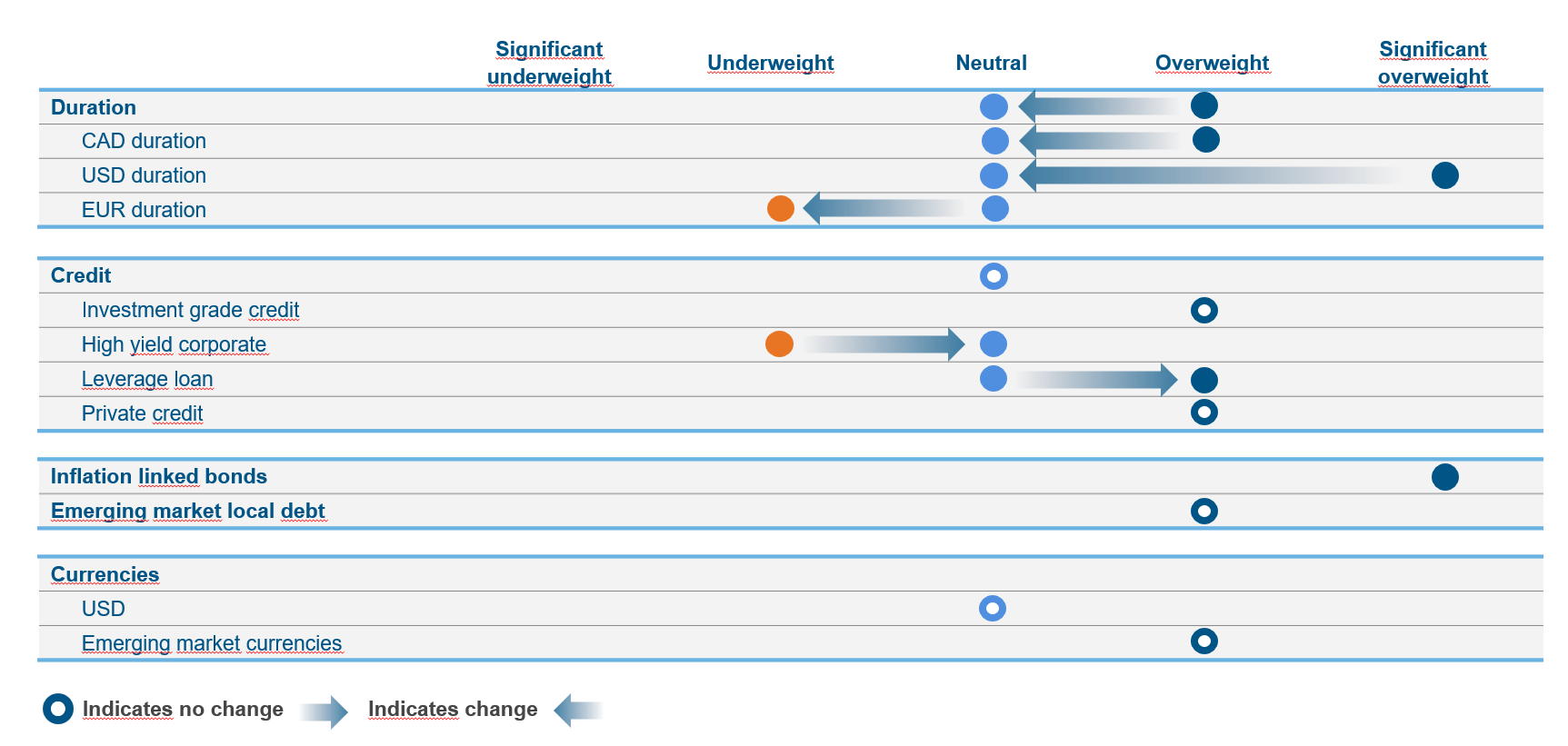
The macro team maintained a measured approach to interest-rate exposure during October, emphasizing relative-value opportunities and disciplined risk management. With inflation remaining elevated and monetary-policy expectations continuing to evolve, the team has been reluctant to increase outright duration materially without greater confirmation that yields offer sufficient compensation for the associated volatility.
In Australia, the team maintained a duration-neutral relative-value position favouring Australian government bonds against US Treasuries. The position reflects the assessment that Australian monetary policy has moved into restrictive territory, with higher borrowing costs increasingly affecting households and housing demand. The team believes these pressures could eventually lead the Reserve Bank of Australia to shift towards easing earlier than other major central banks. European sovereign positioning remained an important source of relative performance. The team's underweight to French government bonds benefited from widening spreads against German Bunds, while reduced exposure to selected peripheral European markets also contributed positively. These positions reflect ongoing concerns about fiscal sustainability, political uncertainty and relative valuations.
Currency positioning provided a more mixed contribution. The long Norwegian krone position against the Canadian dollar benefited from elevated energy prices and the relative strength of Norway's external position. Conversely, Brazilian government bond holdings experienced significant volatility around the presidential election. Although the team continues to recognize the attraction of elevated Brazilian real yields, the election outcome and subsequent market reaction weighed on performance in certain global and unconstrained strategies.
Within credit, the team continued repositioning selected loan portfolios toward higher-conviction securities. Loan allocations were selectively increased in healthcare, insurance, financials and technology, while certain data-centre-related high-yield bonds were added following spread widening and improved valuations. The technology and software underweight was maintained but reduced, reflecting a more balanced approach to sector risk.
Looking ahead, the team expects further tightening from both the Bank of Canada and the Federal Reserve. However, the potential for Canadian monetary policy to restrain economic activity more than anticipated creates opportunities for selective yield-curve positioning. Across credit markets, the emphasis remains on attractive carry, improving security selection and maintaining flexibility as valuations adjust.
Credit market performance
October brought a partial recovery in US high-yield bonds supported by lower Treasury yields despite wider credit spreads but renewed weakness in leveraged loans. High-yield spreads widened as sector dispersion remained pronounced, with utilities, retail and energy outperforming, while telecommunications and cable experienced significant losses.
Leveraged loans recorded their first monthly decline in eight months. The weakness extended beyond software into cyclical and consumer-facing sectors, with declining secondary prices and rising net supply contributing to softer technical conditions. Nevertheless, continued coupon income provided a partial offset to market-value losses.
Credit quality remained a significant differentiator. BB-rated high-yield bonds returned 1.17%, compared with a 2.26% decline in CCC-rated bonds. Lower-rated loans also struggled, reflecting greater refinancing challenges and the impact of higher debt-service costs. Telecommunications and cable were particularly weak across both markets, while selected defensive and higher-quality sectors proved more resilient.
Primary-market activity moderated considerably. US high-yield bond issuance declined to $14.6 billion from $51.7 billion in September, while institutional loan issuance decreased to $42.1 billion. Despite market weakness, default activity remained relatively contained during October. Nevertheless, elevated distressed debt volumes and growing dispersion across issuers reinforced the importance of fundamental credit analysis.
Index | Yield | Yield m/m | Spread | Spread m/m | Performance (%) | |||
bp | bp | bp | 1m | 3m | YTD | 1Y | ||
Investment Grade | ||||||||
CA | 4.5% | -8 | 96 | 9 | 1.0 | 0.1 | 1.0 | 0.7 |
US | 5.8% | -23 | 94 | 10 | 2.0 | -0.3 | -0.8 | -0.5 |
High Yield |
|
|
|
|
|
|
|
|
CA | 7.7% | -25 | 297 | 12 | 0.7 | -0.5 | 1.0 | 2.1 |
US | 8.5% | 5 | 344 | 32 | 0.3 | -1.2 | 0.3 | 1.5 |
US Leverage Loans | 8.6% | 38 | 450 | 22 | -0.2 | 0.9 | 3.1 | 4.1 |
Source: Bloomberg as of 31st October 2026, performance is reflective of local returns
Commissions, trailing commissions, management fees, and expenses all may be associated with mutual fund investments. Please read the prospectus before investing. The indicated rates of return are the historical annual compounded total returns as of October 31, 2026, including changes in share value and reinvestment of all distributions and does not take into account sales, redemption, distribution, or optional charges or income taxes payable by any security holder that would have reduced returns. Mutual funds are not guaranteed, their values change frequently, and past performance may not be repeated. Index performance does not include the impact of fees, commissions, and expenses that would be payable by investors in the investment products that seek to track an index.
Index performance does not include the impact of fees, commissions, and expenses that would be payable by investors in investment products that seek to track an index.
This document may contain forward-looking information which reflect our or third party current expectations or forecasts of future events. Forward-looking information is inherently subject to, among other things, risks, uncertainties, and assumptions that could cause actual results to differ materially from those expressed herein. These risks, uncertainties and assumptions include, without limitation, general economic, political and market factors, interest and foreign exchange rates, the volatility of equity and capital markets, business competition, technological change, changes in government regulations, changes in tax laws, unexpected judicial or regulatory proceedings and catastrophic events. Please consider these and other factors carefully and not place undue reliance on forward-looking information. The forward-looking information contained herein is current only as of October 31, 2026. There should be no expectation that such information will in all circumstances be updated, supplemented or revised whether as a result of new information, changing circumstances, future events or otherwise.
The content of this commentary (including facts, views, opinions, recommendations, descriptions of or references to, products or securities) is not to be used or construed as investment advice, as an offer to sell or the solicitation of an offer to buy, or an endorsement, recommendation or sponsorship of any entity or security cited. Although we endeavour to ensure its accuracy and completeness, we assume no responsibility for any reliance upon it.
All information is historical and not indicative of future results. Current performance may be lower or higher than the quoted past performance, which cannot guarantee results. Share price, principal value, and return will vary, and you may have a gain or a loss when you sell your shares. Performance assumes reinvestment of distributions and does not account for taxes. Performance may not reflect any expense limitation or subsidies currently in effect. Short-term trading fees may apply.
This material is for informational and educational purposes only. It is not a recommendation of any specific investment product, strategy, or decision, and is not intended to suggest taking or refraining from any course of action. It is not intended to address the needs, circumstances, and objectives of any specific investor. Mackenzie Investments, which earns fees when clients select its products and services, is not offering impartial advice in a fiduciary capacity in providing this sales and marketing material. This information is not meant as tax or legal advice. Investors should consult a professional advisor before making investment and financial decisions and for more information on tax rules and other laws, which are complex and subject to change.
The rate of return is used only to illustrate the effects of the compound growth rate and is not intended to reflect future values of the mutual fund or returns on investment in the mutual fund.