.svg)
.svg)
Diversifying global equity portfolios with gold


Highlights
Diversification is changing — even in global equity portfolios
Global equity investing has long been viewed as an effective way to diversify across countries, sectors and companies. Yet beneath that broad exposure, portfolio concentration has steadily increased.
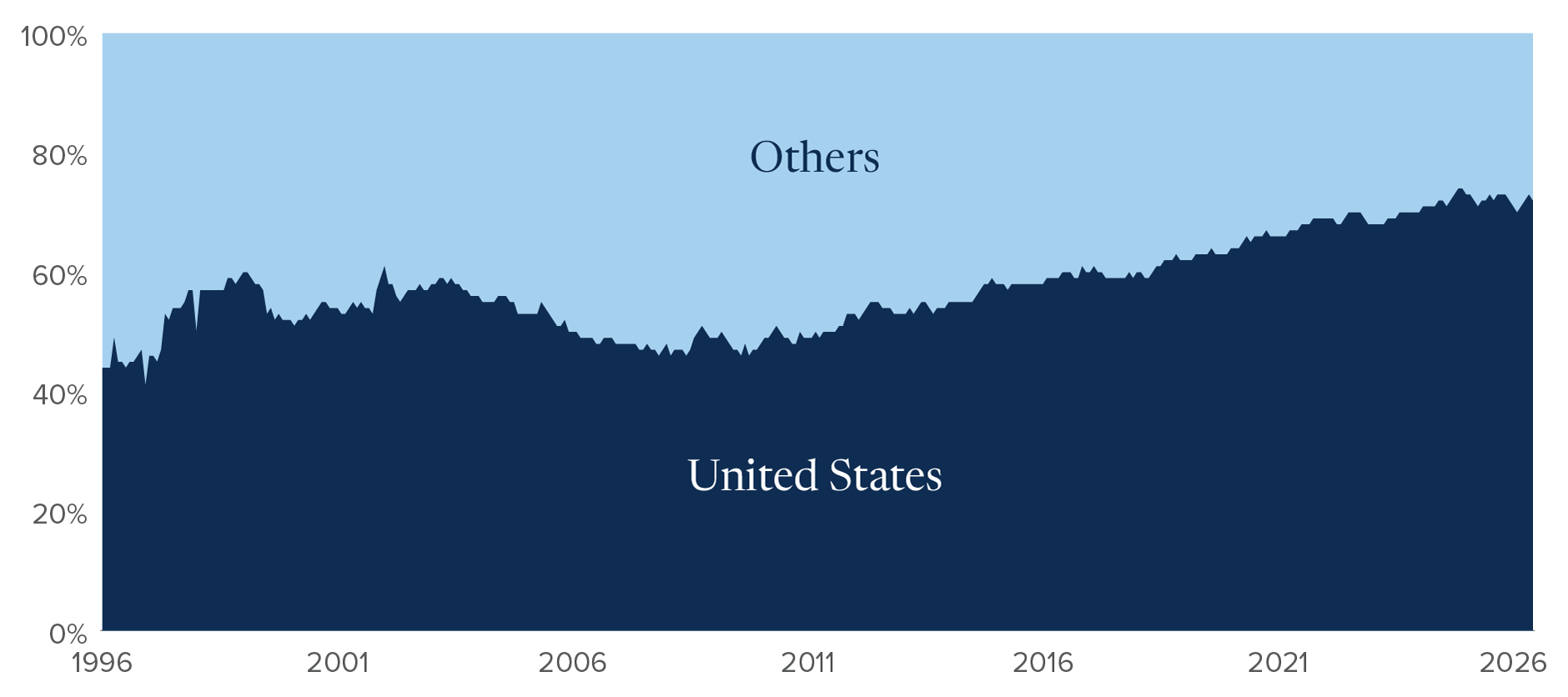
Today, 72% of the MSCI World Index is represented by US companies, up from roughly 44% three decades ago. The increase reflects years of exceptional corporate performance, technological leadership and deep capital markets. It has also changed the nature of diversification within global equity portfolios.
Although many US companies generate revenues globally, their valuations remain influenced by US monetary policy, fiscal conditions, interest rates and the US dollar. As US equity weights have grown, so too has investors' exposure to those shared market, policy and currency-related drivers.
As advisors look to broaden diversification, one asset stands apart because it has historically responded differently from global equities and the US dollar: gold.
Figure 1: US stocks now represent nearly three-quarters of the
MSCI World Index.
US weight in the MSCI World Index (1996-2026)
 Source: Bloomberg, as of June 30, 2026.
Why today's environment strengthens the case for gold
The concentration of global equities has developed alongside important structural changes in the broader investment landscape.
Historically, US fiscal deficits tended to widen during recessions before narrowing as economic growth recovered. More recently, that pattern has changed. Large deficits have persisted even during periods of economic expansion, contributing to higher government debt levels and rising interest costs.
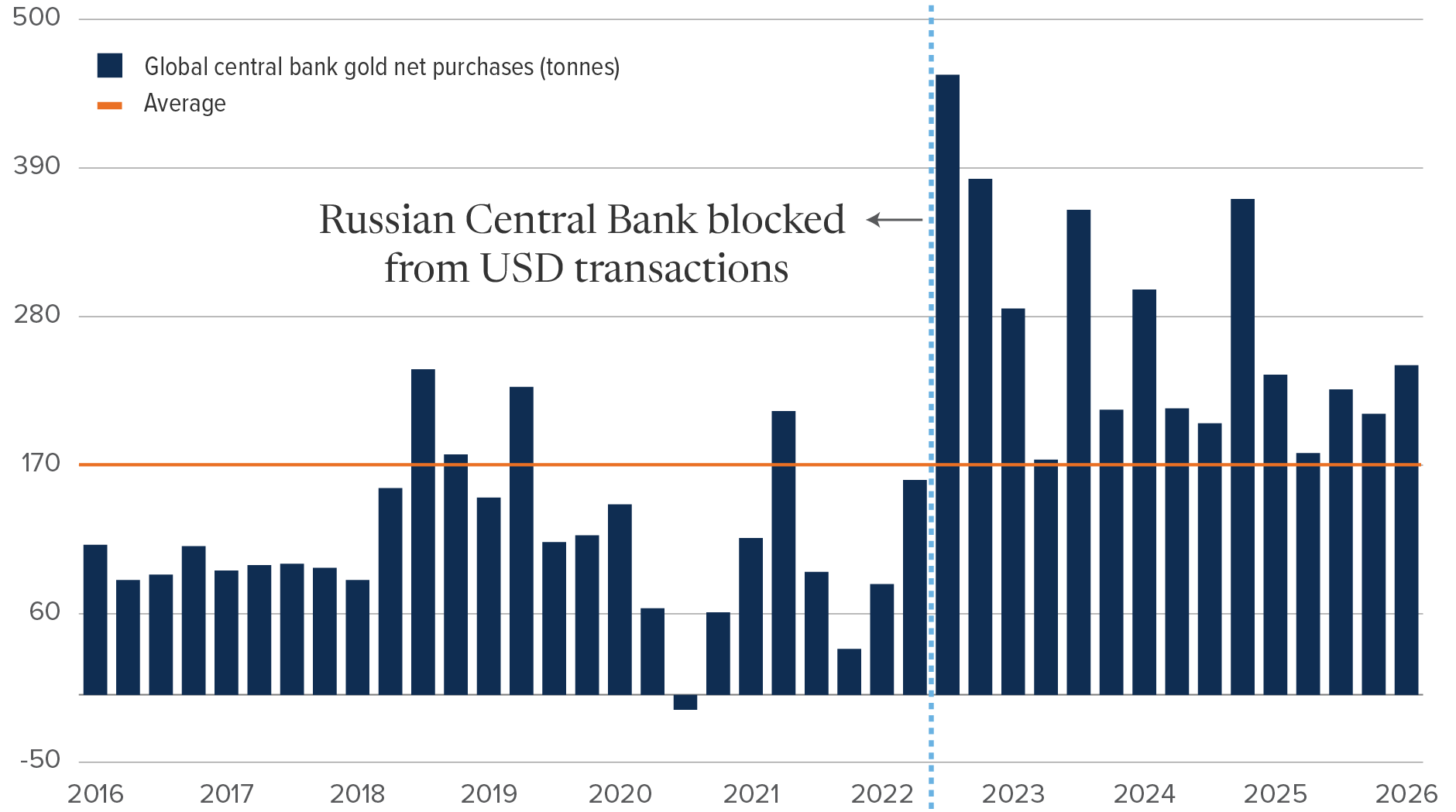
At the same time, geopolitical fragmentation has become a more prominent feature of global markets. Reserve management practices are evolving, financial sanctions have become more common and governments face growing fiscal pressures as refinancing needs increase.
None of these developments determines a single outcome for markets or the US dollar.
However, they reinforce the importance of complementing portfolios heavily influenced by US assets with investments that respond to a different mix of economic, financial and geopolitical conditions.
Gold has become an increasingly relevant consideration for advisors seeking to strengthen portfolio resilience.
Figure 2: Global Central Bank Gold net purchases
Source: World Gold Council, as of March 31, 2026
Why gold is different
Gold occupies a unique position among investment assets because it is not dependent on the earnings of a company, the creditworthiness of a government or the cash flows of a bond.
Unlike financial assets issued by corporations or sovereign borrowers, gold is not another entity's liability. Its supply grows gradually through mining rather than monetary policy, while demand is influenced by investors, central banks, jewellery markets and industrial uses.
These characteristics distinguish gold from equities and currencies. Gold does not generate income, and its performance can vary over shorter periods. However, its price has historically responded to factors including real interest rates, the US dollar, investor sentiment and geopolitical developments.
Since the 1970s, gold has appreciated substantially more than US consumer prices, demonstrating its ability to preserve purchasing power across multiple economic and monetary environments.
For advisors evaluating strategic diversification, these characteristics distinguish gold from conventional equity and fixed income exposures rather than positioning it as a substitute for either.
Gold can broaden portfolio resilience
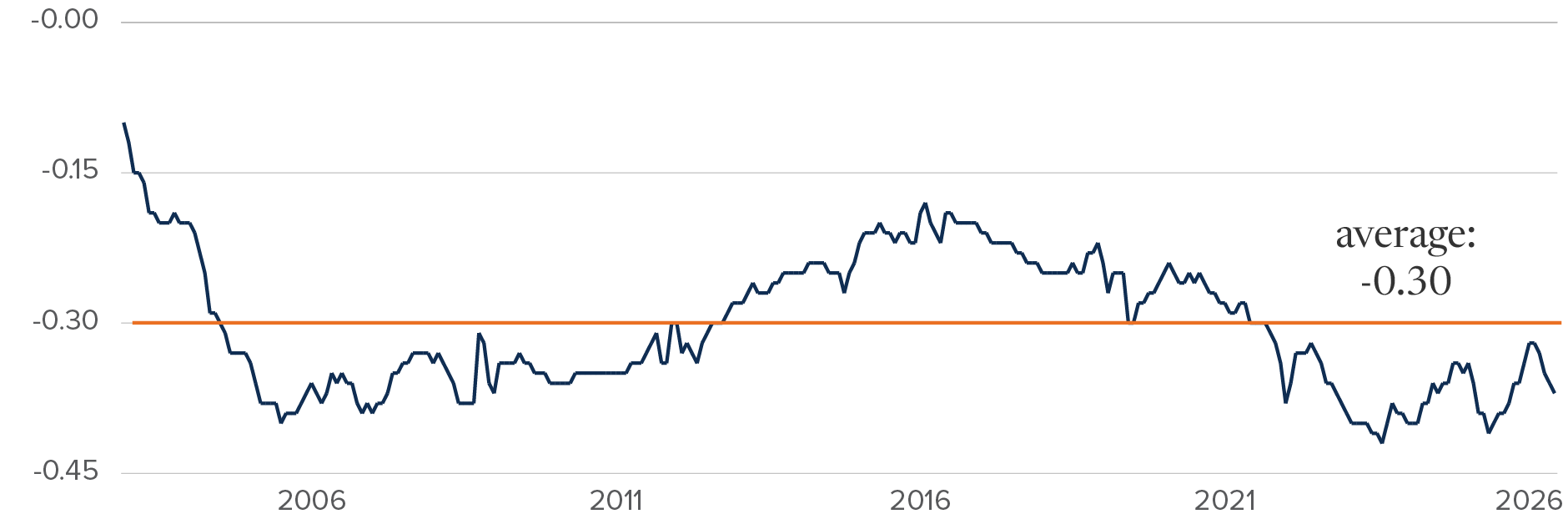
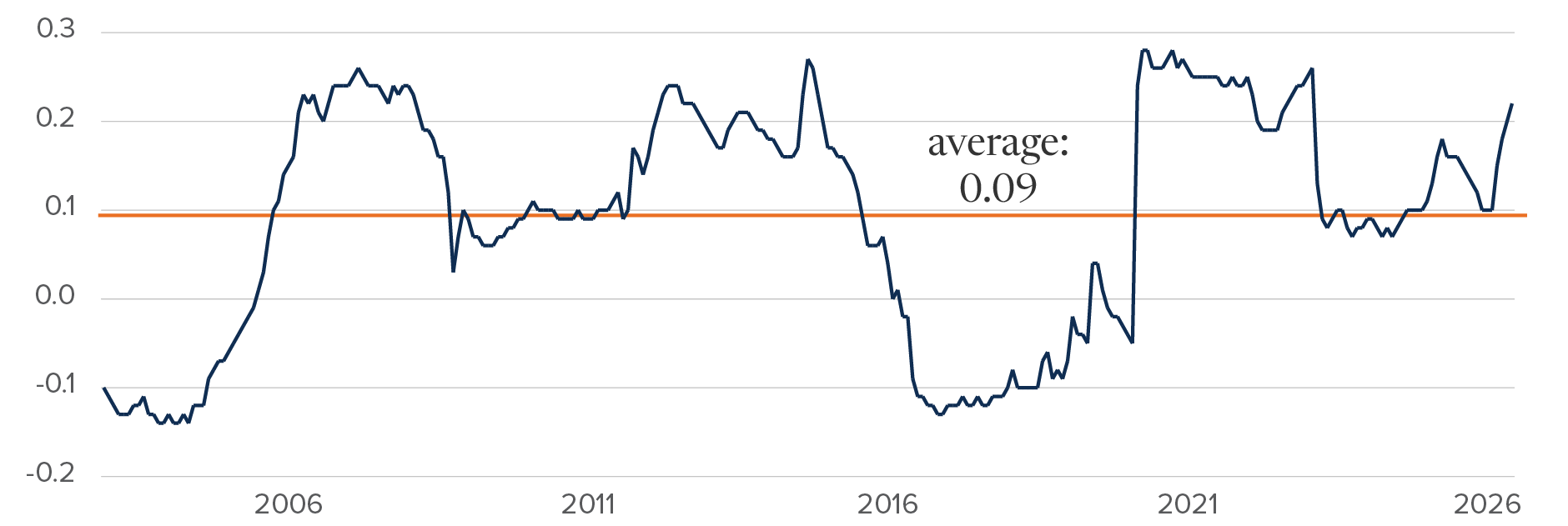
One of gold's most important characteristics is that it has historically exhibited a low and variable relationship with global equities, alongside a generally negative relationship with the US dollar.
Neither relationship is constant. During some market environments, gold and equities have moved in the same direction, while in others they have diverged. Similarly, gold's relationship with the US dollar changes over time.
Gold is not negatively correlated with global equities in every environment, nor is it a substitute for them. Instead, its distinct behaviour can complement a global equity allocation and reduce dependence on a common set of market, policy and currency influences.
Figure 3: Gold's Correlations with Global Equities and the Broad US Dollar
Gold Rolling 3-year correlations with the Broad
US Dollar Index (2000-2026)
Gold Rolling 3-year correlations with
MSCI World Index (2000-2026)
Source: Bloomberg, as of June 2026. Gold: LBMA Gold Price PM USD. Global equities: MSCI World Index NR USD. Dollar: Nominal Broad U.S. Dollar Index. Rolling 36-month correlations are based on daily returns.
Diversification is not simply about increasing the number of holdings within a portfolio. It is also about expanding the range of factors that influence portfolio outcomes. As global equity benchmarks have become increasingly concentrated, gold has offered exposure to a different mix of economic and financial conditions while allowing global equities to continue serving as the portfolio’s primary source of long-term growth.
This distinction has become increasingly relevant as central banks have become a significant source of demand for gold. Their purchases reflect a desire to diversify currency, sovereign-credit and geopolitical risks, reinforcing gold’s role as an asset that behaves differently from many conventional financial holdings.
Building resilience through diversification
Global equities remain an important source of long-term growth, but their increasing concentration in US equities has left portfolios more dependent on a common set of market, policy and currency-related influences.
Gold is not a replacement for global equities. Its value lies in being influenced by a different mix of factors. By complementing a global equity allocation with a differentiated source of portfolio behaviour, advisors can broaden diversification and strengthen resilience as the investment landscape evolves.
To learn more about this strategy, contact your Mackenzie Sales Team.

Commissions, trailing commissions, management fees, and expenses all may be associated with Exchange Traded Funds. Please read the prospectus before investing. The indicated rates of return are the historical annual compounded total returns including changes in unit value and reinvestment of all distributions and does not take into account sales, redemption, distribution, or optional charges or income taxes payable by any securityholder that would have reduced returns. Exchange Traded Funds are not guaranteed, their values change frequently and past performance may not be repeated.
This document may contain forward-looking information which reflects our or third party current expectations or forecasts of future events. Forward-looking information is inherently subject to risks, uncertainties and assumptions that could cause actual results to differ materially from those expressed herein. Please consider these and other factors carefully and not place undue reliance on forward-looking information. The forward-looking information contained herein is current only as of August 6, 2026. There should be no expectation that such information will in all circumstances be updated, supplemented or revised whether as a result of new information, changing circumstances, future events or otherwise.
The content of this article (including facts, views, opinions, recommendations, descriptions of or references to products or securities) is not to be used or construed as investment advice, as an offer to sell or the solicitation of an offer to buy, or an endorsement, recommendation or sponsorship of any entity or security cited. Although we endeavour to ensure its accuracy and completeness, we assume no responsibility for any reliance upon it.
Index performance does not include the impact of fees, commissions and expenses that would be payable by investors in investment products that seek to track an index.