.svg)
.svg)
Integrating private markets within a balanced portfolio

About the author
IN THIS ARTICLE min read
A structural framework for multi-asset implementation
Balanced portfolios are constructed to deliver durable growth while moderating volatility. For decades, that balance has been implemented primarily through public equities and fixed income.
The investable landscape supporting those exposures is evolving. A significant portion of corporate growth, financing activity and asset ownership now resides in private markets. At the same time, the historical diversification relationship between equities and fixed income has shown itself to be less consistently reliable.
Balanced portfolios remain foundational. The question is how to implement them more comprehensively by drawing from a broader opportunity set while preserving their intended balance of growth and income.
A multi-asset private markets allocation offers that possibility when integrated within a disciplined portfolio construction framework.
What a multi-asset private markets allocation represents
We believe a multi-asset private markets strategy combines exposure across:
- Private equity.
- Private credit.
- Real assets, such as infrastructure and real estate.
These exposures have both growth-oriented and income-oriented characteristics. Many structures also incorporate a liquidity sleeve to support capital flows and portfolio management.
The Mackenzie Northleaf Multi-Asset Private Markets Fund is constructed on this framework through the global platform of Northleaf Capital Partners.
Illustrative long-term target exposures include:
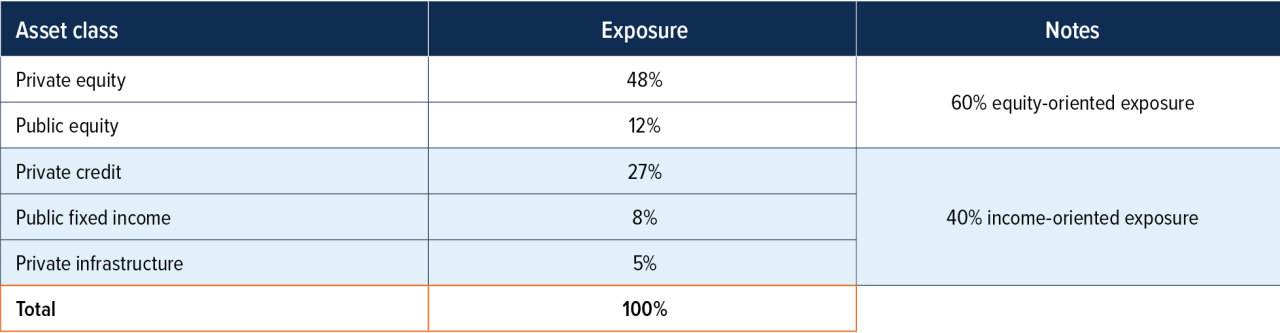
For illustrative purposes only. The fund’s product features and target portfolio construction are subject to change. NGPM’s seed portfolio’s private equity exposure will primarily be through Northleaf’s evergreen fund, NGPE; private credit exposure will primarily be through Northleaf’s evergreen fund, NSPC-L; and the private infrastructure exposure will primarily be through Northleaf’s evergreen fund, NEIF.
On a look-through basis, this composition approximates the traditional 60/40 portfolio construction framework, with 60% equity-oriented exposure and 40% income-oriented exposure. In effect, the fund could operate as a balanced sleeve within a portfolio.
The importance of proportional implementation
A traditional 60/40 portfolio expresses a deliberate balance between growth and stability.
Adding a private markets allocation without considering its internal composition can unintentionally tilt that balance. Funding the allocation entirely from equities increases the portfolio’s relative income exposure. Funding it entirely from fixed income increases overall growth exposure.
In either case, the portfolio drifts from its intended structure. A more disciplined approach aligns funding with the internal structure of the allocation being introduced.
A proportional funding framework
Where the multi-asset private markets fund approximates 60% equity-oriented and 40% income-oriented exposure, implementation can mirror that structure.
For each dollar allocated:
- 60% is sourced from public equities.
- 40% is sourced from public fixed income.
This methodology replaces portions of public exposures with private exposures while maintaining the portfolio’s overall growth/income orientation.
Illustrative allocation adjustments
Assuming an initial 60% public equity/40% public fixed income allocation:
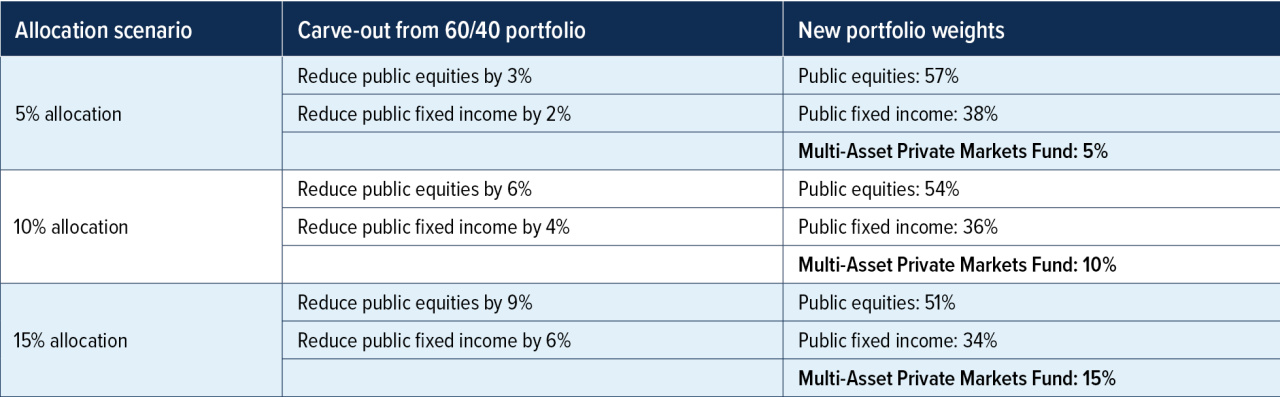
Generic examples are provided for illustrative purposes only.
In each scenario, the total portfolio maintains its intended balanced orientation.
Long-term return implications of allocation size
When funded proportionally, the multi asset private markets sleeve increases the portfolio’s blended expected return. Over long horizons, that difference compounds meaningfully, as shown below.
Evolving the 60/40 with multi-asset private markets
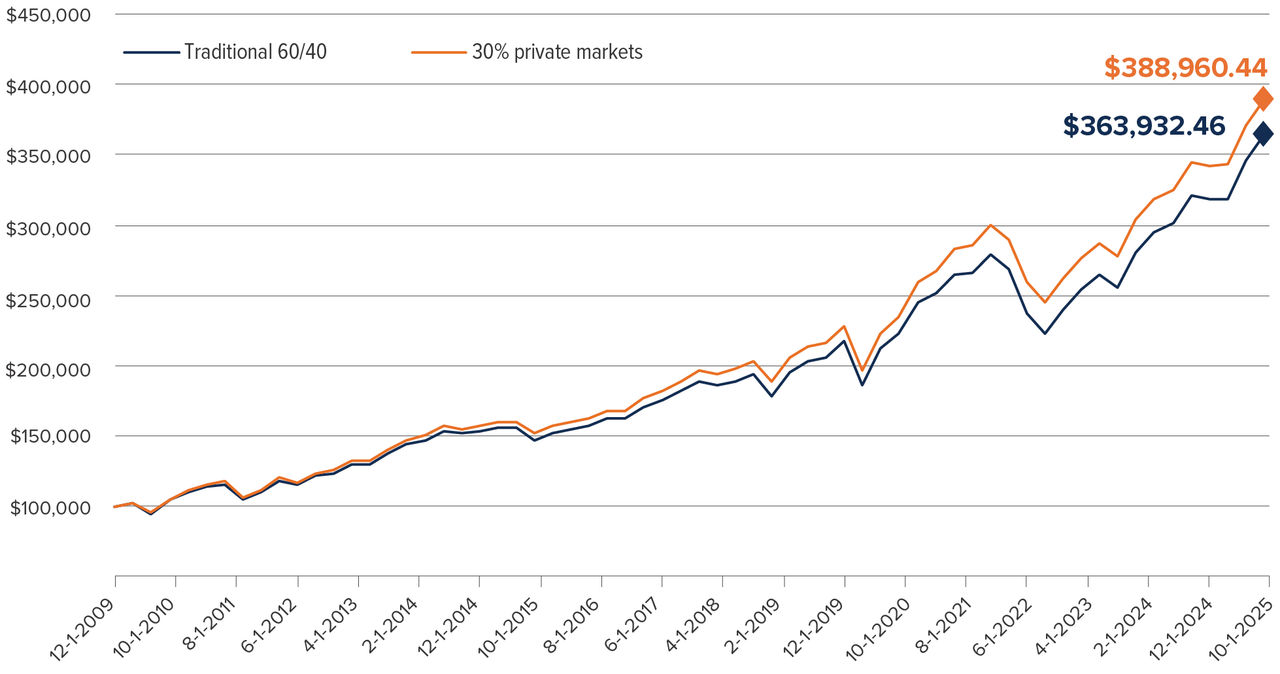
For illustrative purposes only. The performance information shown above is hypothetical and should not necessarily be relied upon as indicative of how a portfolio would have performed over the relevant period. The example asset allocation is shown for illustrative purposes only. Figures in USD, from December 2009 to September 2025.
Source: Bloomberg, Morningstar. The 30% allocation to private markets includes 10% private equity, 10% private credit, 10% infrastructure; 45% public equity and 25% fixed income. This represents the 15‑year annualized returns of the following private markets indices: Private Credit returns represented by the MSCI Global Private Credit Index. Private Equity is represented by the MSCI Global Private Infrastructure Index. The traditional 60/40 portfolio represents 60% public equity indices and 40% public income indices. Public equity indices represented by the MSCI World. Fixed income indices represented by the Bloomberg US Aggregate Bond Index.
Rebalancing and structural management
A defining feature of a multi-asset private markets fund is the active management of its internal allocation ranges, preserving the intended growth-income profile over time.
Within the Mackenzie Northleaf Multi-Asset Private Markets Fund, exposures across private equity, private credit and infrastructure are maintained within defined target ranges, supported by a liquidity sleeve to facilitate capital flows and portfolio management. As a result, the fund operates as a self-contained balanced sleeve.
At the total portfolio level, rebalancing can be executed through public equity and fixed income exposures, preserving overall balance while allowing the private allocation to operate as a strategic component.
Redefining the balanced portfolio
Balanced portfolios are not being replaced. They are evolving.
Access to private equity, private credit and infrastructure through a single multi-asset structure allows qualified investors to broaden their potential sources of growth and income within a familiar framework.
When funded proportionally and managed with structural discipline, the allocation maintains the portfolio’s intended balance between growth and income while expanding the potential sources behind that balance.
For investors with access to private markets, this represents a natural next step in balanced portfolio construction.

For advisor use only (as defined in NI 45-106). Past performance and the simulated performance contained herein is not indicative of any future results.
The content of this document (including facts, views, opinions, recommendations, descriptions of or references to, products or securities) is not to be used or construed as investment advice, as an offer to sell or the solicitation of an offer to buy, or an endorsement, recommendation or sponsorship of any entity or security cited. Although we endeavour to ensure its accuracy and completeness, we assume no responsibility for any reliance upon it.
This material is not intended to constitute an offer of units of Mackenzie Northleaf Multi-Asset Private Markets Fund (the “Fund”). The information herein is qualified in its entirety by reference to the applicable Offering Memorandum of the Fund. The OM contains information about the investment objectives and terms and conditions of an investment in the Fund (including fees) and also contains tax information and risk disclosures that are important to any investment decision regarding such Fund.