

The case for emerging market fixed income


Emerging market fixed income has developed into a broad, diverse asset class that can provide income, diversification and exposure to economic cycles that differ from those in Canada and other developed markets. For many investors, it still recalls a narrow collection of highly indebted governments, unstable currencies and volatile markets. That view no longer reflects the breadth of the asset class.
The central investment case is not that emerging markets have become risk-free. It is that the asset class has matured, while its potential income and diversification benefits remain relevant for long-term portfolios.
Today, the asset class spans countries, companies, currencies and economic cycles. It includes large, liquid markets such as Mexico, Brazil, India, South Korea and Indonesia, alongside smaller economies with distinct sources of risk and return.
Lay of the land: three types of emerging market debt
Emerging market fixed income is often discussed as one asset class, but it is better understood as an umbrella covering three distinct markets: local-currency government bonds, hard-currency sovereign bonds and corporate bonds. Each has different return drivers, currency exposure and risks.
Higher oil prices, for example, may strengthen an oil exporter and its energy producers while increasing costs for an importer, airline or manufacturer. The same global development can improve one borrower’s balance sheet and weaken another’s.
Region | Major issuers/countries | Key drivers |
EM Americas | Brazil, Mexico, Chile, Colombia, Peru, Argentina | US rates, commodity prices, Latin American politics, China demand for commodities |
EM EMEA | Saudi Arabia, UAE, Turkey, South Africa, Poland, Hungary, Egypt | Oil prices, geopolitics, European growth, regional conflicts |
EM Asia | China, India, Indonesia, Malaysia, Philippines, Thailand, South Korea | China growth, regional trade, technology exports, domestic consumption, USD strength, global manufacturing cycle |
Local-currency government bonds are issued by a country in its own currency. For a Canadian investor, returns come from coupon income, changes in local interest rates and currency movements. A Brazilian bond, for example, may rise in price when interest rates fall, yet weakness in the Brazilian real against the Canadian dollar can offset that gain.
Hard-currency sovereign bonds are generally issued by governments in US dollars or euros and often behave more like global credit investments than local interest-rate investments. Currency risk may be lower for the investor, but it does not disappear; some of that risk shifts to the borrower, which must obtain foreign currency to repay the debt. Returns are driven primarily by global interest rates and the additional yield (or credit spread) investors demand for taking the country’s credit risk.
Corporate bonds are issued by companies and banks in local or hard currencies. Company cash flow, debt levels, liquidity, governance and sector conditions matter alongside the country backdrop.
The case for emerging market debt
Diversification is another potential benefit. Emerging central banks do not always follow the same policy cycle as the Bank of Canada, the US Federal Reserve or the European Central Bank. Inflation, growth and monetary-policy cycles do not move in perfect unison across Mexico, India, Brazil, China or Southeast Asia. That variety can create opportunities unavailable in a portfolio concentrated solely in Canada or the US.
The principal attraction is income. Many emerging market bonds offer higher yields than comparable developed-market bonds because investors are compensated for additional uncertainty. Countries move through inflation, growth and monetary-policy cycles at different times, creating a broader range of potential return opportunities.
Higher income comes with the trade-off of greater volatility and potentially deeper temporary losses. Diversification may help at the portfolio level, but it is not guaranteed, particularly when a stronger US dollar or global risk shock causes many markets to decline together.
Higher yield alone is not an investment thesis; it compensates investors for greater uncertainty. Investors must determine whether the additional income is sufficient to cover currency, credit, political and liquidity risks.
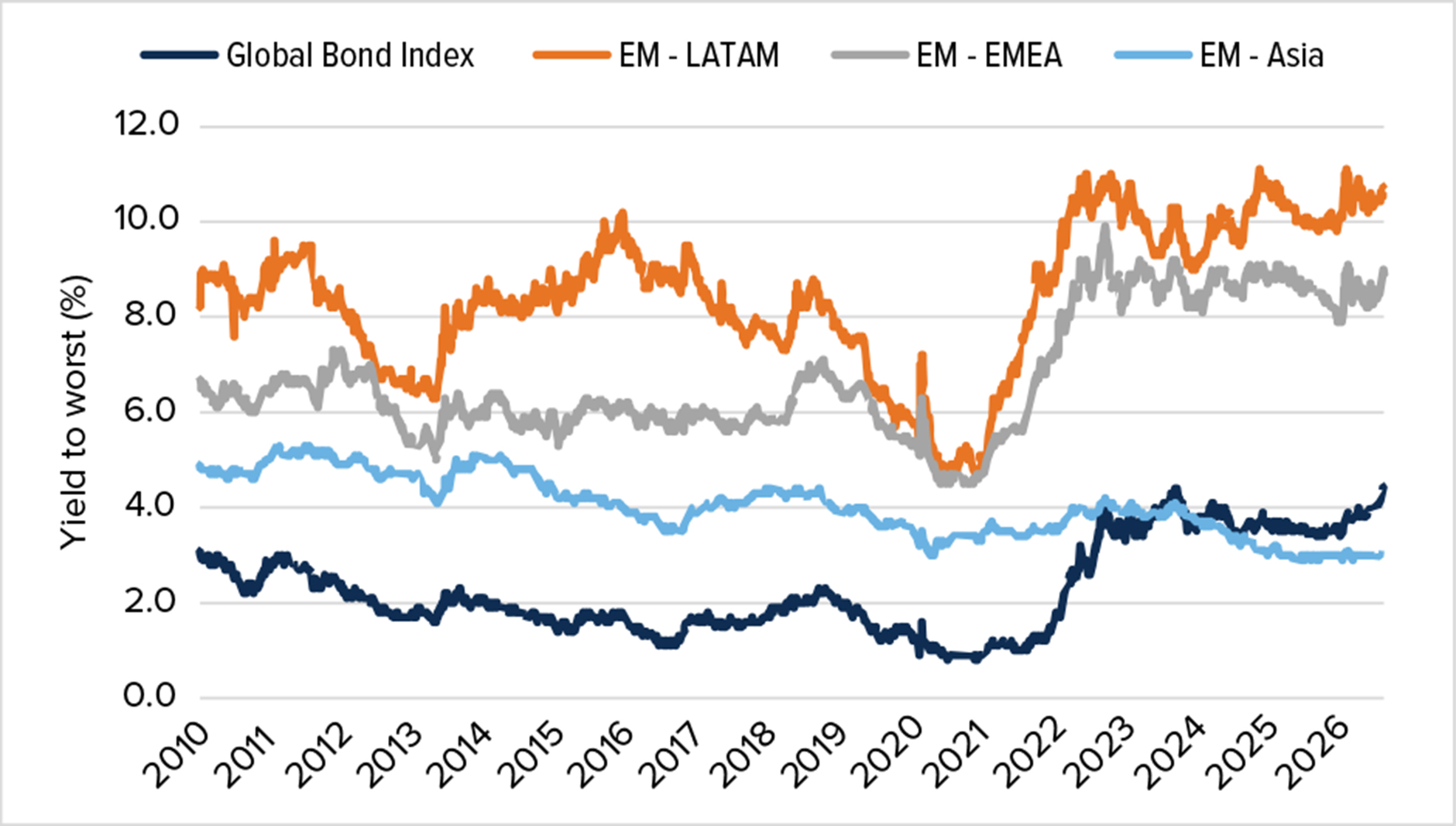
Source: Bloomberg, as of September 30, 2026.
Indices: Global Bond Index – Bloomberg GlobalAgg Statistics Index; EM - LATAM – Bloomberg EM Local Currency Latam TR Index Value Unhedged USD; EM - EMEA – Bloomberg EM Local Curr Europe/Mideast/Africa TR Index Unhedged USD; EM - Asia – Bloomberg EM Local Currency Universal Asia TR Index Unhedged USD.
Structural improvements have strengthened resilience
Many emerging economies have evolved considerably in recent decades. Inflation-targeting frameworks, flexible exchange rates, foreign-exchange reserves and deeper domestic bond markets are now features of many markets. Local banks, pension plans and insurance companies also participate in these markets, alongside foreign investors. These factors help shape the investment environment across emerging economies, although conditions vary significantly by country.
These improvements do not eliminate risk. Currency risk is particularly important: local-currency depreciation can erase years of coupon income. Higher global interest rates or a sharply stronger US dollar can also cause capital to leave emerging markets quickly. Corporate bonds may introduce additional industry, governance and refinancing risks.
A high yield compensates investors for uncertainty; it is not, by itself, a reason to invest.
Political changes can lead to weaker fiscal discipline, unconventional monetary policy or restrictions on capital. Corporate and sovereign borrowers can struggle to refinance when global liquidity tightens. During periods of stress, trading conditions may deteriorate quickly, especially in smaller local markets.
Energy and food shocks also matter because these items often represent a larger share of consumer spending in emerging economies. Higher commodity prices can lift inflation, weaken currencies and force central banks to raise interest rates. Vulnerability varies considerably: energy importers such as Thailand and South Korea face different pressures from exporters such as Brazil or Colombia.
Common misconceptions
The first misconception is that emerging market debt is a homogeneous asset class. China’s low-yield, policy-directed market has little in common with Brazil’s high-carry bond market. South Korea and the Czech Republic are advanced industrial exporters, while India is driven more heavily by domestic growth. Brazil’s inflation dynamics differ from South Korea’s, while Mexico’s connection to the US economy differs substantially from South Africa’s dependence on commodities and domestic reform.
A second misconception is that all emerging market bonds are speculative. The universe includes both investment-grade and below-investment-grade issuers, and many local government-bond markets are supported by substantial domestic savings.
A third misconception is that higher yields automatically mean better value. A critical view argues that the yield advantage over developed markets has narrowed and may no longer adequately compensate investors for risk across the asset class. The structural case for emerging-market debt should not be interpreted as an argument for buying every country at every valuation.
Current opportunities favour selectivity
The current opportunity set is increasingly shaped by domestic rather than purely global factors. Relatively attractive real yields and policy buffers are evident in parts of Latin America, emerging Europe, the Middle East and Africa. In Brazil, Colombia, Mexico and South Africa, yields, improving policy credibility or reform prospects may support returns.
Currency trends also remain differentiated. Higher-carry currencies in Latin America and parts of EMEA may benefit from attractive interest-rate differentials, while several Asian currencies offer less carry and may be more sensitive to global inflation or US dollar strength.
Renewed energy inflation, fiscal slippage, weaker currencies or persistently high US real interest rates could quickly reduce those prospective returns.
Structural progress does not eliminate country-specific risks. Some emerging countries have stronger institutions, deeper domestic savings pools and better external balances than in previous cycles. Others remain vulnerable to fiscal slippage, political intervention, inflation, commodity shocks or dependence on foreign financing.
The key message is selectivity. Country-level outcomes can be an important consideration when assessing emerging-market fixed income. Country-level analysis begins with the economic regime. Is growth accelerating or slowing? Is inflation improving? Is the central bank acting early enough to preserve confidence?
Valuation comes next. Does the yield adequately compensate investors for inflation, default and liquidity risk?
A local-currency index fund is a targeted investment in local interest rates and currencies. It is not a complete allocation to emerging market fixed income. A flexible active strategy may move among countries and segments as relative value changes.
An allocation can provide differentiated exposure alongside a core portfolio of high-quality bonds. Investors should be aware that currency and market volatility can result in periods of weakness and fluctuations in value.
Consider Mackenzie Emerging Markets Local Currency Bond Index ETF for targeted exposure to emerging market local-currency bonds.
Why invest in this fund?
- Market-capitalization-weighted indexing may help limit portfolio turnover and associated transaction costs.
- Targeted access to specific market segments.
Commissions, management fees, brokerage fees and expenses may all be associated with Exchange Traded Funds. Please read the prospectus before investing. The indicated rates of return are the historical annual compounded total returns including changes in unit value and reinvestment of all distributions, and do not take into account sales, redemption, distribution, or optional charges or income taxes payable by any security holder that would have reduced returns. Exchange Traded Funds are not guaranteed, their values change frequently, and past performance may not be repeated.
Index performance does not include the impact of fees, commissions, and expenses that would be payable by investors in the investment products that seek to track an index.
This document may contain forward-looking information which reflect our or third party current expectations or forecasts of future events. Forward-looking information is inherently subject to, among other things, risks, uncertainties and assumptions that could cause actual results to differ materially from those expressed herein. These risks, uncertainties and assumptions include, without limitation, general economic, political and market factors, interest and foreign exchange rates, the volatility of equity and capital markets, business competition, technological change, changes in government regulations, changes in tax laws, unexpected judicial or regulatory proceedings and catastrophic events. Please consider these and other factors carefully and not place undue reliance on forward-looking information. The forward-looking information contained herein is current only as of October 7, 2026. There should be no expectation that such information will in all circumstances be updated, supplemented or revised whether as a result of new information, changing circumstances, future events or otherwise.
The content of this article (including facts, views, opinions, recommendations, descriptions of or references to, products or securities) is not to be used or construed as investment advice, as an offer to sell or the solicitation of an offer to buy, or an endorsement, recommendation or sponsorship of any entity or security cited. Although we endeavour to ensure its accuracy and completeness, we assume no responsibility for any reliance upon it.