.svg)
.svg)
The considerations behind a gold allocation

About the author
IN THIS ARTICLE
Executive Summary
Funding decision
The source of funds is a critical consideration when making asset allocation decisions. Inter-asset class changes such as equity versus fixed income are inherently more complex than changes within an asset class (for example, US equities versus global equities). Inter-asset class decisions are most complex when introducing an exposure (in this case, gold) that does not have a dedicated strategic asset allocation. This becomes clear by way of example. Portfolio managers often adjust relative positioning between government and corporate bonds depending on the compensation for risk through spreads, but all of the securities under consideration are fixed income in nature. But adjusting the position size of fixed income versus equities is more complex, as any change will materially change the range of outcomes for the portfolio given different assumptions for expected returns, volatility and cross-asset correlations.
The funding decision for gold introduces an additional layer of complexity because gold typically sits outside the traditional equity and fixed income allocations that form the core of a strategic asset allocation. Fixed income could provide a source of funds, but doing could reduce some of the ballast it provides against equity risk. Equities could provide another source of funds. However, reallocating from equities to buy gold as a diversifier against fiat currency debasement would fundamentally change the portfolio’s projected level of growth and capital appreciation.
Gold equities are not gold
Some Canadian investors may feel they possess adequate exposure to gold through the weighting of the Materials sector in the S&P/TSX Composite Index. Caution is warranted with this approach, as gold equities do not possess the same portfolio characteristics as a direct allocation.
First, the sheer magnitude of exposure to gold equities is likely insufficient to diversify against fiat currency debasement. Consider the example of a balanced investor with 60% allocated to equities, one-quarter (15%) of which is invested in Canadian equities. Based on current index weightings, pure gold producers would represent approximately 2% of the overall portfolio. Exposure to pure gold producers through the S&P 500 (0.20%) and MSCI World (0.65%) is even more limited, which reinforces the limited diversification gold mining equities can provide without altering the range of outcomes for a portfolio. 1
Second, and more importantly, equities of gold producers are not a reliable proxy for owning gold exposure itself. Gold equities provide exposure to operating companies, which means price activity reflects company-specific factors such as management decisions, production costs, reserve quality, country-specific mine risks and valuation. The economics of mining introduce operating leverage. Changes in gold prices have a disproportionate impact on a producer’s profitability as revenues change against a cost base that may be relatively fixed. Gold equities represent exposure to both the underlying commodity and the economics and execution of the companies producing it. Ultimately, these are equity securities in a business, and their price behaviour can differ from gold itself.
Owning securities of companies whose profitability is influenced by gold is not equivalent to owning gold itself as a diversifier against fiat currency depreciation.
Solving portfolio construction via overlay
MGEG allows advisors to reallocate to global equities in a novel manner. Such an allocation can help broaden global equity diversification while adding meaningful gold exposure as a diversifier against fiat currency debasement. The structure of MGEG allows for a fully invested global equity allocation while adding a systematic gold futures overlay equal to 50% of the allocation to MGEG.
Figure 1 - MGEG portfolio composition
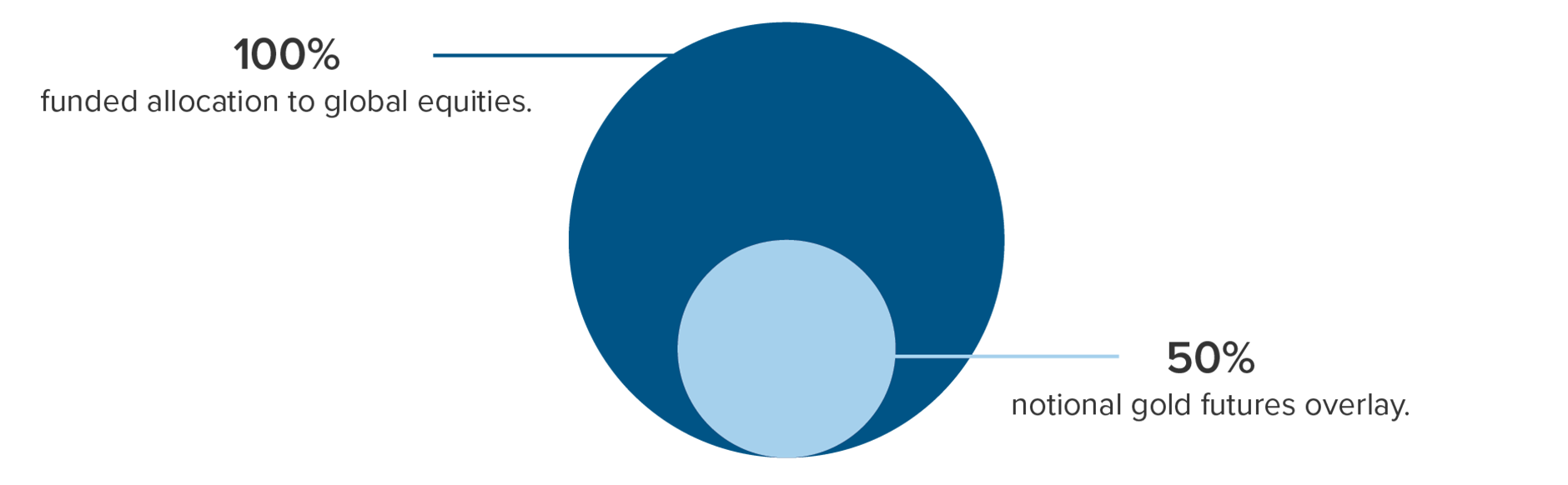
Figure 2 - Simplified illustration of funded allocation, cash margin and gold exposure
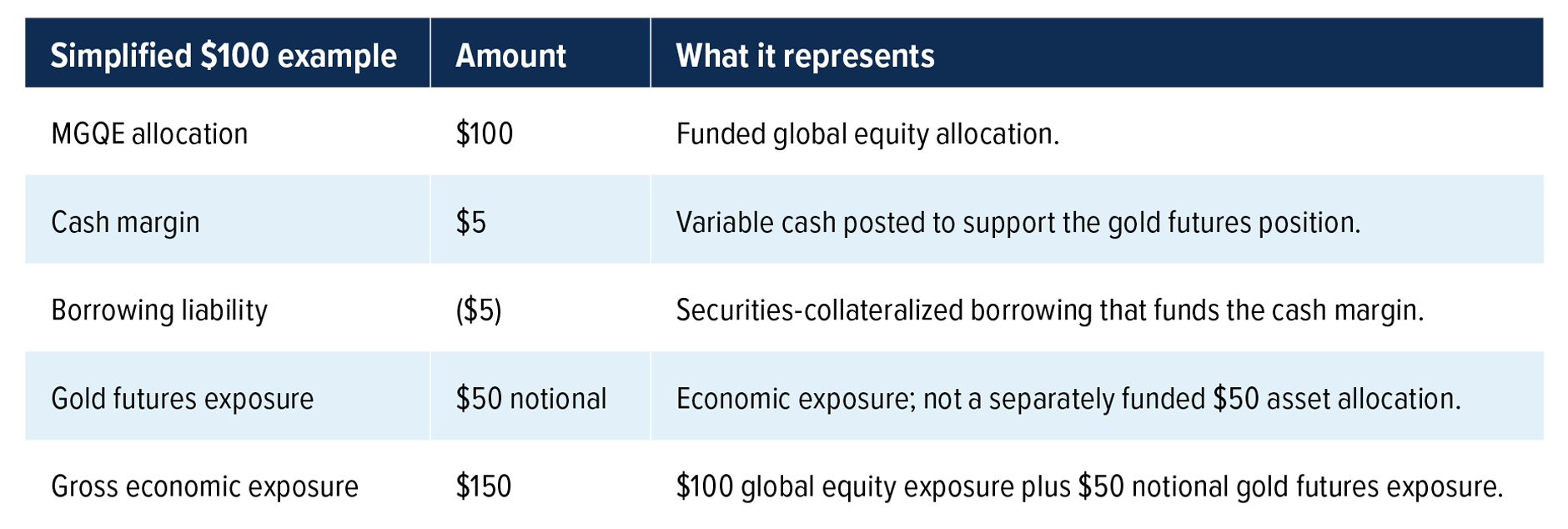 Illustrative only. The 5% cash-margin estimate is based on exchange margin requirements. Actual margin and financing requirements may change over time. Gross economic exposure is not the same as invested capital or NAV; it includes the notional exposure created through futures.
This is important from a portfolio construction perspective. MGEG allows an advisor to deliberately fund the allocation from an overweight equity position and reallocate that capital to global equities, preserving the role of equities within the strategic asset allocation while improving geographic diversification. The gold exposure is then added through the overlay rather than funded by reducing the equity allocation. This provides both meaningful global equity exposure and meaningful, direct economic exposure to gold rather than relying on the incidental exposure provided by gold-producing companies.
To learn more about this strategy, contact your Mackenzie Sales Team.

1 Source: Bloomberg, as of September 15, 2026. The S&P/TSX Composite Index Materials sector represents 18.67% of the index, with pure gold producers accounting for 72.1% of the Materials sector. The approximately 2% portfolio exposure is calculated as 15% Canadian equities x 18.67% Materials sector x 72.1% pure gold producers = 2.02%. Pure gold producers represent 0.20% of the S&P 500 Index and 0.65% of the MSCI World Index.
For advisor use only. No portion of this communication may be reproduced or distributed to the public, as it does not comply with investor sales communication rules. Mackenzie disclaims any responsibility for any advisor sharing this with investors. Commissions, trailing commissions, management fees, and expenses all may be associated with Exchange Traded Funds. Please read the prospectus before investing. The indicated rates of return are the historical annual compounded total returns including changes in unit value and reinvestment of all distributions and does not take into account sales, redemption, distribution, or optional charges or income taxes payable by any securityholder that would have reduced returns. Exchange Traded Funds are not guaranteed, their values change frequently and past performance may not be repeated.
This document may contain forward-looking information which reflects our or third party current expectations or forecasts of future events. Forward-looking information is inherently subject to risks, uncertainties and assumptions that could cause actual results to differ materially from those expressed herein. Please consider these and other factors carefully and not place undue reliance on forward-looking information. The forward-looking information contained herein is current only as of August 6, 2026. There should be no expectation that such information will in all circumstances be updated, supplemented or revised whether as a result of new information, changing circumstances, future events or otherwise.
The content of this article (including facts, views, opinions, recommendations, descriptions of or references to products or securities) is not to be used or construed as investment advice, as an offer to sell or the solicitation of an offer to buy, or an endorsement, recommendation or sponsorship of any entity or security cited. Although we endeavour to ensure its accuracy and completeness, we assume no responsibility for any reliance upon it.
Index performance does not include the impact of fees, commissions and expenses that would be payable by investors in investment products that seek to track an index.