.svg)
.svg)
The growing investment case for resources
IN THIS ARTICLE min read
As countries focus on resilience and rebuilding supply chains and infrastructure, demand for the resources needed to support that investment is growing.
Global resource dependencies are being reassessed.
For decades, the global economy increasingly concentrated production in countries where resources and manufactured inputs could be produced at lower costs, relying on global trade to move energy, metals and other essential materials to where they were needed. Countries did not necessarily need to produce everything themselves, as long as global markets could reliably supply it.
That assumption is becoming less certain.
Europe’s experience with Russian natural gas offered a stark example. The invasion of Ukraine exposed the risks of concentrated energy dependence, as Europe’s heavy reliance on Russian pipeline gas left it vulnerable to supply disruption.
As a result, governments and companies are reconsidering their dependencies. Manufacturing is moving closer to where products are ultimately sold, critical infrastructure is being rebuilt, countries are diversifying their suppliers of energy and resources, and new supply-chain capacity is being developed.
A world that builds additional factories, processing facilities, energy infrastructure and supply chains in several regions will need more resources than one optimized primarily for cost and efficiency.
FIGURE 1 – Why demand for resources is growing A greater focus on economic and national resilience is leading to more investment in the physical economy – and that requires more resources.
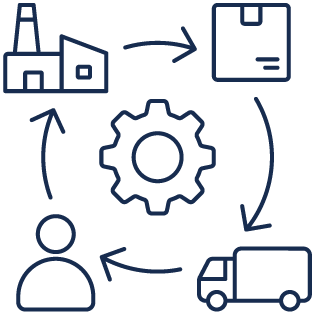
More resilient supply chains
Companies and governments are building more capacity closer to home.
More infrastructure investment
Factories, energy systems and transportation networks require significant physical investment

More demand for resources
That investment requires energy, metals and construction materials
A “great rebuild” is underway
The shift toward greater economic and strategic resilience is contributing to renewed investment in the physical economy.
Physical economy: The real-world infrastructure, materials and energy that keep the economy running.
New factories require energy, steel and construction materials. Transportation and industrial infrastructure require cement, aggregates and metals. New processing capacity requires both the materials to build it and the energy to operate it.
Rising electricity demand is adding to this investment cycle, as industrial growth, electrification and data centres increase the need for more power. Meeting that demand will require investment across a range of energy sources, as well as significant amounts of copper, aluminum, steel and other materials to build the transmission lines and other infrastructure needed to produce and deliver that electricity.
European steel and cement offer a clear example. Germany’s large-scale defense and infrastructure spending plans are expected to drive investment in new physical capacity, while European policies favouring lower-emission domestic production are changing the competitive environment for local producers.
Why resources may deserve a greater role in portfolios
These changes come at a time when many investors’ portfolios are underexposed to the companies producing physical inputs the global economy increasingly needs.
Portfolios built primarily around broad global equities have only a modest exposure to the physical economy and hard assets.
Hard assets: Tangible assets with physical value, such as commodities, infrastructure and real estate.
A dedicated allocation to resources can provide more deliberate exposure to these trends. It also opens up a wider range of opportunities beyond familiar Canadian energy and pipeline companies.
FIGURE 2 – Resource exposure varies significantly across portfolios
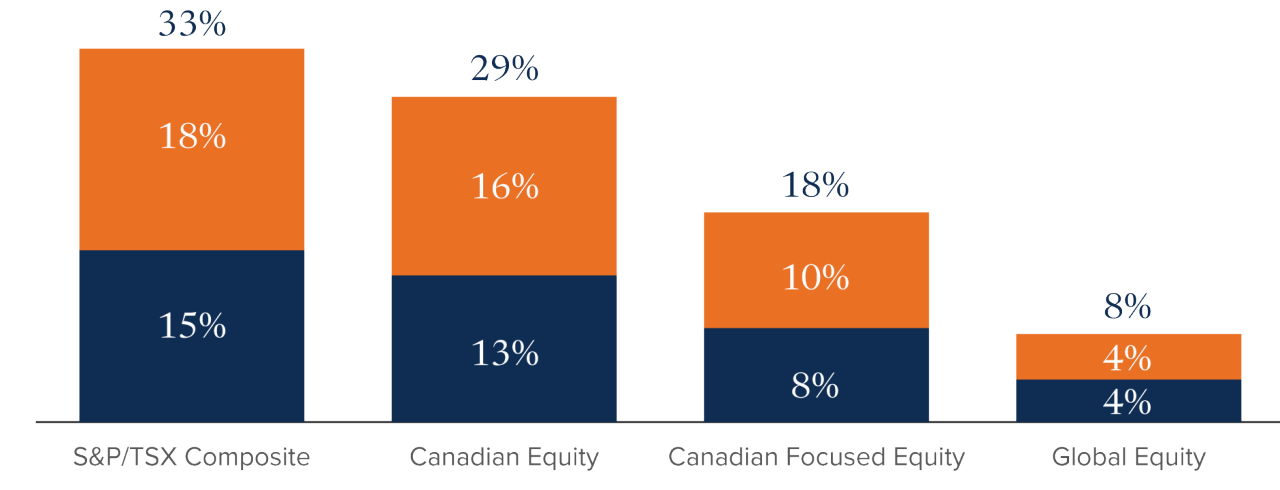 Source: Morningstar Direct. As of July 31, 2026. Energy + Materials weights shown for the S&P/TSX Composite and selected Morningstar categories.
Specialist active management matters in this space
Commodities each respond to different economic, geopolitical and supply-and-demand conditions.
An attractive environment for gold does not necessarily imply the same conditions for copper or natural gas. Even within the same commodity, the economics of individual producers can differ considerably. That is where specialist research becomes important.
Resource investing requires decisions at two levels: First, understanding the outlook for the underlying commodity itself. Second, determining which companies are best positioned within it.
At the company level, asset quality, production costs and reserve life can matter as much as the direction of the commodity price. Information can also be highly specialized and difficult to assess from financial statements alone.
Reserve life: How long the known reserves can support production at the current rate of extraction.
The Mackenzie Resources and Energy Evolution Team combines investment analysis with backgrounds in science and engineering to assess those factors across global resource markets. That technical expertise is backed by research from the ground up. The team conducts on-site due diligence around the world from the Andes to the Yukon to evaluate assets and operating conditions first-hand. Site visits can provide context on geology, infrastructure, management and operational risks that financial analysis alone may not capture.
The Mackenzie FuturePath Global Resource Fund brings those strengths together in a single global resource solution. Rather than concentrating in one commodity or one part of the resource market, the fund provides active exposure across global energy, materials and precious metals, diversified by subsector, market capitalization and geography.
A world investing more heavily in more in supply chains, infrastructure and power will need more resources. But not every commodity or company will benefit equally, making diversification, selectivity and specialist expertise increasingly important.
Learn more about the Mackenzie FuturePath Global Resource Fund

Commissions, trailing commissions, management fees and expenses all may be associated with mutual fund investments. Please read the prospectus before investing. Mutual funds are not guaranteed, their values change frequently and past performance may not be repeated. The content of this page (including facts, views, opinions, recommendations, descriptions of or references to, products or securities) is not to be used or construed as investment advice, as an offer to sell or the solicitation of an offer to buy, or an endorsement, recommendation or sponsorship of any entity or security cited. Although we endeavour to ensure its accuracy and completeness, we assume no responsibility for any reliance upon it.
©2026 Morningstar. All Rights Reserved. The information contained herein: (1) is proprietary to Morningstar and/or its content providers; (2) may not be copied or distributed; and (3) is not warranted to be accurate, complete or timely. Neither Morningstar nor its content providers are responsible for any damages or losses arising from any use of this information. Past performance is no guarantee of future results.