

PFICs: A lesser-known US tax issue affecting certain Canadian investments

About the author
IN THIS ARTICLE
Highlights
- Canadian mutual funds and ETFs may trigger U.S. tax obligations for U.S. persons.
- PFICs may result in additional taxes, reporting requirements and compliance costs.
- QEF and Mark-to-Market elections may offer alternative tax treatments, with potential RRSP/RRIF exceptions.
- Advisors should encourage clients to consult a U.S. or cross-border tax professional before making investment decisions.
What to consider before buying, holding or selling an investment
Certain investments commonly held in Canada can have significant U.S. tax consequences when they are held by a client who is, or may be, a U.S. person for U.S. federal income tax purposes.
This includes U.S. citizens, even if they reside in Canada, as well as green card holders and individuals considered U.S. residents for tax purposes. If there is any uncertainty, the client's status should be confirmed by a U.S. or cross-border tax professional.
This is particularly the case for certain Canadian mutual funds, Canadian exchange-traded funds (ETFs), and other investment companies organized outside the United States. These investments may be classified as passive foreign investment companies (PFICs).
The objective is not to determine, on your own, whether an investment is a PFIC or to choose the applicable tax treatment. Rather, it is to recognize the issue, make the client aware of it, and take the appropriate steps before recommending or changing the investment.
1. PFICs: Why should you be concerned?
An investment that is common in Canada may be treated very differently in the United States.
When a client who is, or may be, a U.S. person for U.S. federal income tax purposes holds a PFIC, holding the investment may result in:
- A requirement to file a separate U.S. Form 8621 annually for that investment;
- Special tax rules applying to distributions received or gains realized when the investment is sold.
These rules may result in higher-than-expected taxes, an interest charge relating to prior years, complex calculations, and significant compliance costs.
The issue may arise even if the investment has not yet been sold or if distributions are automatically reinvested.
An investment that is appropriate from a Canadian perspective may therefore have significant tax and administrative consequences in the United States.
2. Could your client hold a PFIC without realizing it?
A PFIC is generally a corporation organized outside the United States whose income or assets are primarily passive in nature.
Investments that warrant particular attention include:
- Canadian mutual funds;
- Canadian ETFs;
- Funds organized outside the United States;
- Certain investment companies or foreign corporations whose activities are primarily passive.
However, not all foreign investments are PFICs. Shares held directly in a corporation that operates an active business, bonds, and deposits are not automatically subject to the PFIC rules.
The fund's name, the currency it uses, and the markets in which it invests are not sufficient to determine its status on their own. For example, a Canadian fund that invests exclusively in U.S. companies generally remains a fund organized in Canada. It does not become a U.S. fund simply because of the securities it holds.
The investment's legal structure and its treatment for U.S. tax purposes should be considered, not simply the securities it holds.
3. Why can PFICs be costly?
When no specific tax election applies, certain distributions and gains may be subject to the default PFIC regime.
The applicable gain or distribution may then be allocated across the years during which the investment was held. Amounts allocated to prior years may be subject to unfavourable tax treatment for those prior years, together with an interest charge. As a result, the gain may not receive the U.S. tax treatment normally accorded to capital gains.
Selling the investment does not eliminate the issue. Instead, the sale may trigger the application of these rules.
Form 8621 is the primary U.S. form associated with PFICs. It may be required to report on the investment, certain income or gains, and applicable tax elections.
Potential exception for RRSPs and RRIFs
Investments held in a Registered Retirement Savings Plan (RRSP) or Registered Retirement Income Fund (RRIF) may also meet the definition of a PFIC. However, an exception may exempt the client from the annual requirement to file Form 8621 for PFICs held in these plans because their income generally benefits from tax deferral under the Canada-U.S. tax treaty when the plan is treated as a foreign pension fund.
This exception does not mean that the investment ceases to be a PFIC or that all U.S. reporting or tax obligations associated with the plan are eliminated. Its application should be confirmed based on the client's circumstances by a U.S. or cross-border tax professional.
4. PFIC tax elections at-a-glance
U.S. tax rules provide for several possible tax treatments. It is useful to know whether the client has already made an election, since it may affect the consequences of a sale or change in investment.
Election | What to keep in mind |
Default regime | Certain distributions and gains may be allocated across the years during which the investment was held, with unfavourable tax treatment and an interest charge. |
Qualified Electing Fund (QEF) | The client generally includes their share of the income and gains reported by the fund each year. The fund must provide the necessary U.S. tax information.* |
Mark-to-Market | For certain eligible securities, the annual change in value is included in U.S. income. This election is not available for all securities listed on an exchange.** |
* The QEF election generally requires the fund to provide an Annual Information Statement (AIS). Not all Canadian funds produce this document. Mackenzie, however, makes annual PFIC statements available to investors. Annual Information Statements for Mackenzie ETFs are available on the Mackenzie website, while for other Mackenzie funds, an individualized PFIC statement can be obtained through the financial advisor.
** The mark-to-market election is available only for certain eligible securities. The fact that a fund is listed on an exchange is not sufficient to conclude that this election is available. The timing of the election is also important. An election made after several years of ownership does not necessarily eliminate consequences associated with prior years.
Before recommending a sale or replacement, it is important to confirm with the client's tax professional whether a PFIC election has already been made.
5. Common assumptions to avoid
Certain assumptions commonly arise when discussing PFICs. However, they can lead to incorrect conclusions.
“The fund invests in the United States, so it is not a PFIC.”
Where the fund invests does not determine its status. A fund organized in Canada may create PFIC considerations even if it holds only U.S. securities.
“Nothing has been sold, so there is nothing to report.”
Certain reporting obligations may arise annually even while the investment is still held.
“Simply selling the investment will solve the problem.”
On the contrary, a sale may trigger the PFIC regime and result in a complex tax calculation.
6. Your role
A few key steps can help you identify potential PFIC situations, inform your client of the issue and direct them to the appropriate tax resources.
Identify
When a client is, or may be, a U.S. person for U.S. federal income tax purposes, pay particular attention to mutual funds, ETFs, and other funds organized outside the United States.
Inform
Ensure the client understands that an investment commonly held in Canada may be subject to U.S. PFIC rules. When the investment is already held, encourage the client to confirm the following with their U.S. or cross-border tax professional:
- whether the investment is a PFIC;
- whether reporting obligations have been met;
- whether a tax election has been made;
- whether an AIS is available from the investment manager.
Refer to a tax professional
Before any purchase, sale, substitution, or redemption of an investment that may constitute a PFIC, encourage the client to consult their U.S. or cross-border tax professional to understand the applicable tax consequences.
PFIC considerations at a glance
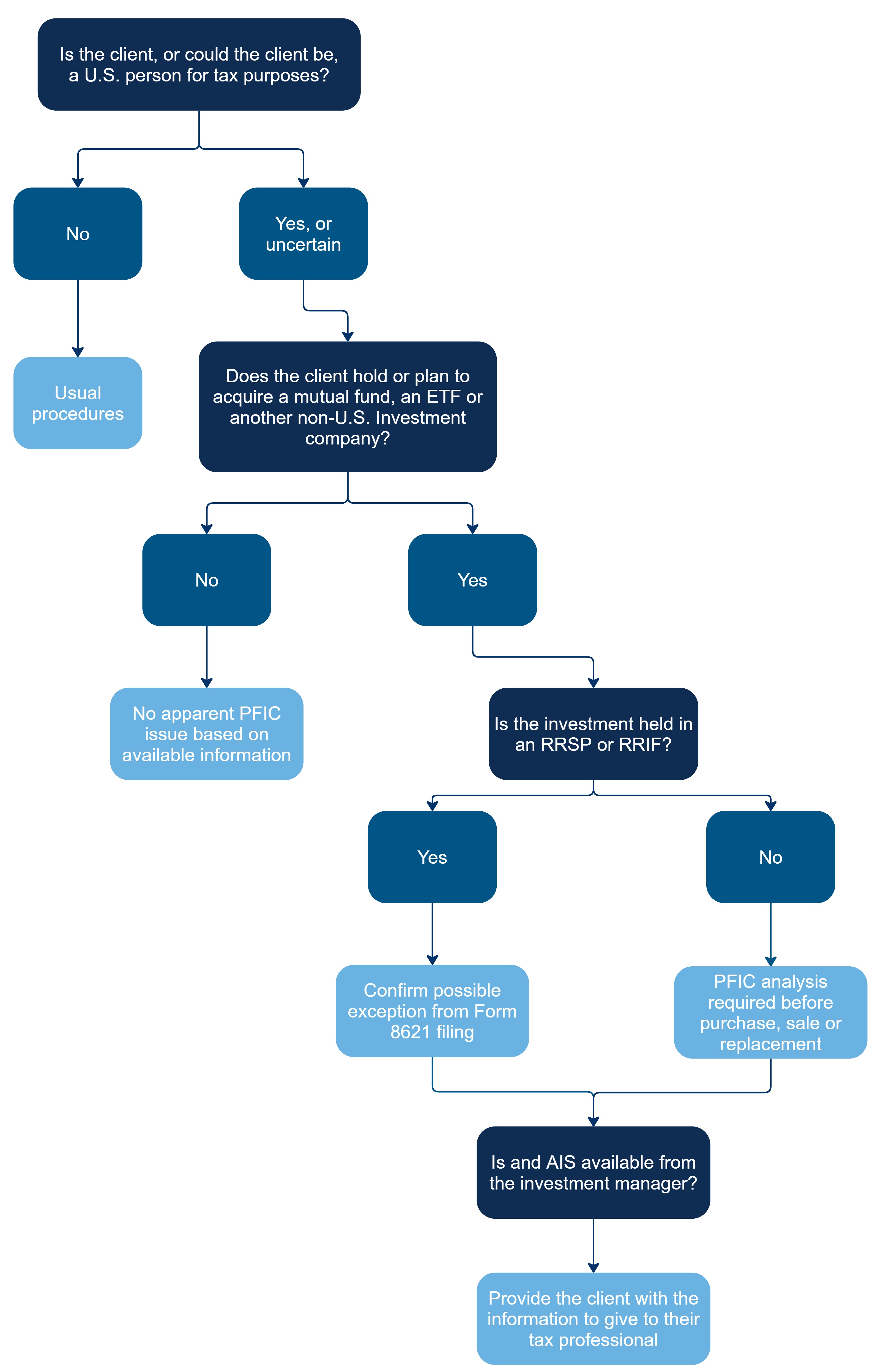
The following diagram helps identify situations that should be reviewed before action is taken. It does not replace an analysis by the client's U.S. or cross-border tax professional.
For general questions about PFICs or to better understand the issues to consider in a particular situation, contact our Tax and Estate Planning team.