.svg)
.svg)
Canada at a crossroads


Key takeaways
Canada's growth model is changing
Canada's economy is entering a new phase. For much of the past decade, growth was supported by rapid population gains, a resilient housing market and predictable access to the US market. Today, each of these drivers is becoming less reliable.
While Canada may avoid a recession, economic growth is likely to remain below potential as households contend with elevated debt, productivity remains weak and trade uncertainty weighs on business investment. Unlike a typical cyclical slowdown, these are structural shifts that could shape Canada's economic outlook—and financial markets—for years to come.
Structural shifts are reshaping the outlook
Canada's changing trade relationship with the US represents one of the country's most significant structural challenges. For decades, Canadian businesses benefited from predictable, rules-based access to their largest export market. That certainty has diminished.
Rather than providing a long-term framework, CUSMA now faces annual reviews through 2036, increasing uncertainty for exporters and businesses making long-term investment decisions.
Scenario | Potential implication |
Annual CUSMA reviews (current) | Prolonged uncertainty and delayed business investment. |
Significant renegotiation | Higher trade costs through stricter rules of origin or changing tariff preferences. |
Withdrawal from CUSMA | Material increase in trade barriers unless replaced by bilateral agreements. |
Long-term extension | Greater certainty for exporters and integrated North American supply chains. |
Source: Bank of Canada
Demographics add another layer to this transition. After several years of exceptionally strong population growth, labour force expansion is slowing. Future economic growth will increasingly depend on productivity improvements rather than workforce expansion.
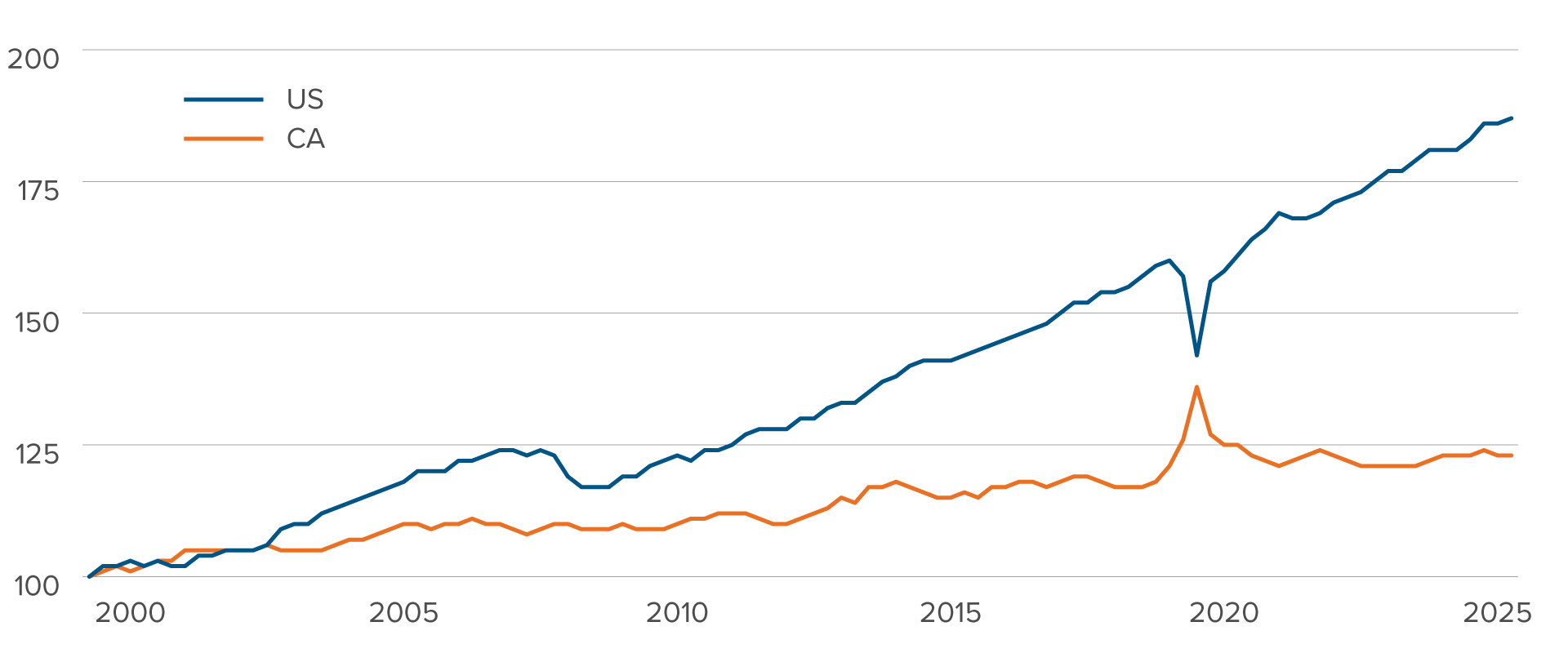
Canadian productivity has lagged the US for much of the past two decades, limiting wage growth, business investment and long-term economic resilience.
Productivity Divergence
Output per unit of labor (2000 = 100)
Source: Statistics Canada, US Bureau of Economic Analysis as of March 31, 2026.
Canada's productivity gap with the US highlights one of the country's most persistent structural challenges. While artificial intelligence may improve productivity over time, those gains are unlikely to emerge quickly enough to offset today's economic headwinds.
Artificial intelligence represents both an opportunity and a challenge. While it has the potential to improve productivity over the long term, meaningful gains are unlikely to materialize quickly enough to offset today's structural headwinds.
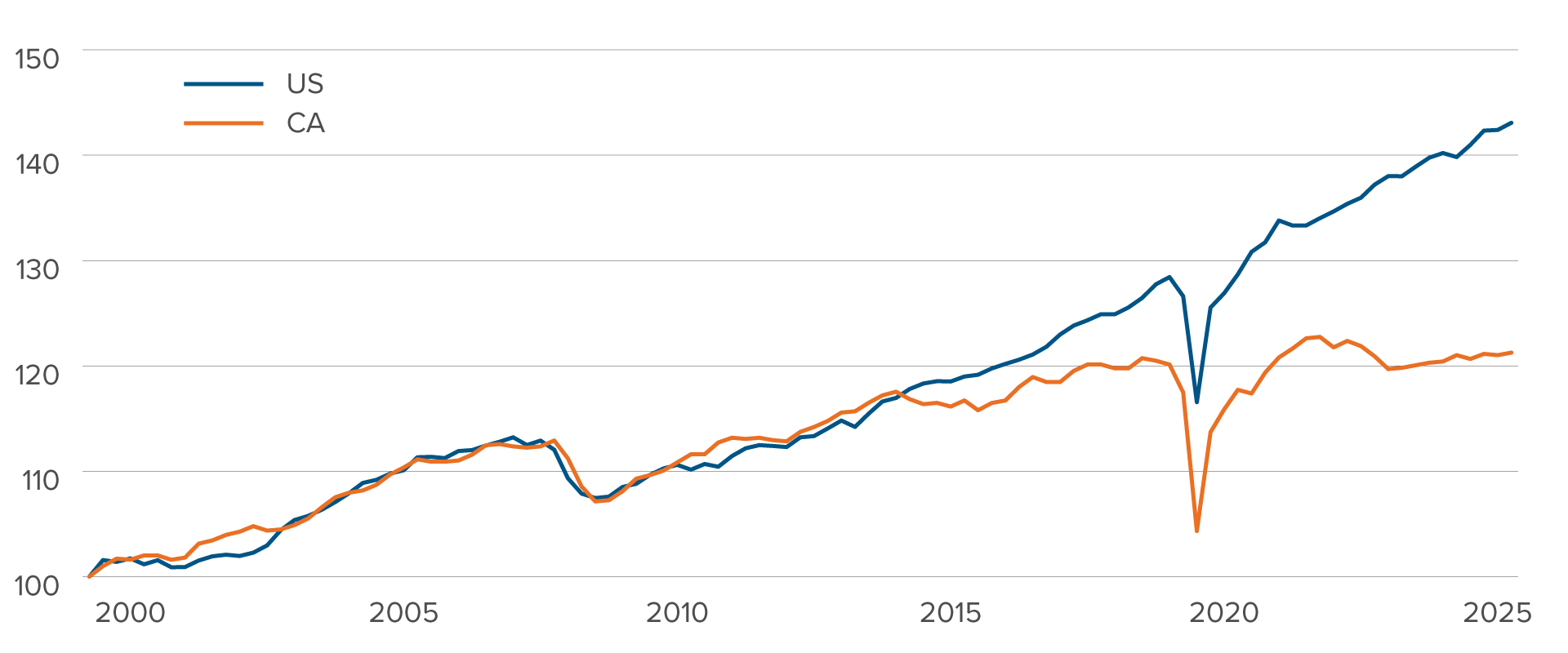
Real GDP per capita has continued to lag the US, underscoring the combined effects of weaker productivity and slower economic momentum.
A widening gap in living standards
Real GDP per Capita Growth (2000 = 100)
Source: Statistics Canada, US Bureau of Economic Analysis as of March 31, 2026.
The divergence in real GDP per capita illustrates how Canada's structural challenges are increasingly affecting household prosperity and long-term growth potential.
Investor takeaway: Slower population growth, weaker productivity and greater trade uncertainty are likely to keep Canada's growth below trend, reinforcing the importance of active portfolio positioning.
Cyclical headwinds remain
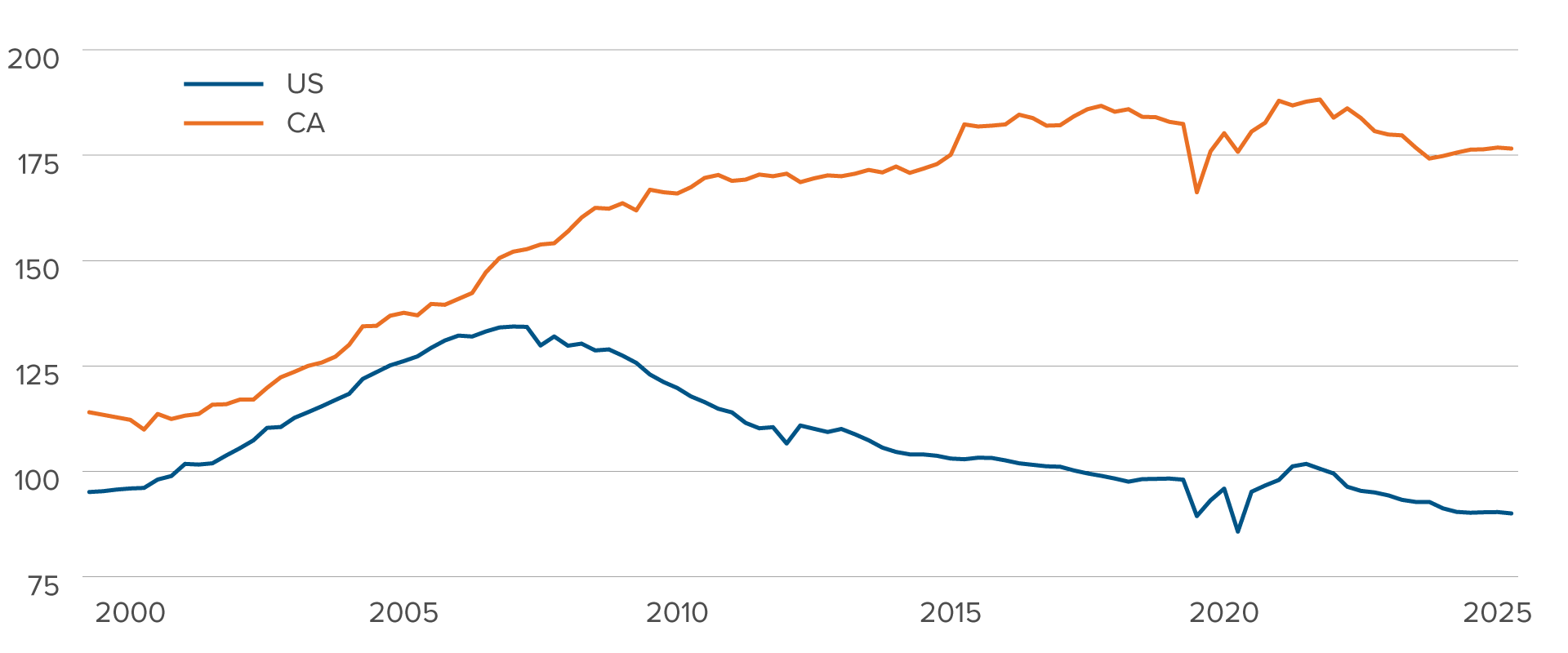
Alongside these structural changes, cyclical pressures continue to weigh on the economy. Consumers have become more cautious as labour market conditions soften and wage growth moderates. While spending has remained resilient, elevated household debt continues to constrain discretionary consumption.
The cash flow brake on Canadian consumption
Leverage: Household debt to disposable income (%)
Source: Statistics Canada, US Bureau of Economic Analysis as of March 31, 2026.
Individual financial reports and supplementary regulatory disclosures of Canada's major chartered banks (RBC, TD, BMO, BNS, CIBC, National Bank) as of Q1 2026. Bond yields as of June 30, 2026.
Canadian households continue to carry significantly higher debt levels than their US counterparts, leaving consumers more sensitive to higher borrowing costs and limiting the potential for a broad-based rebound in spending.
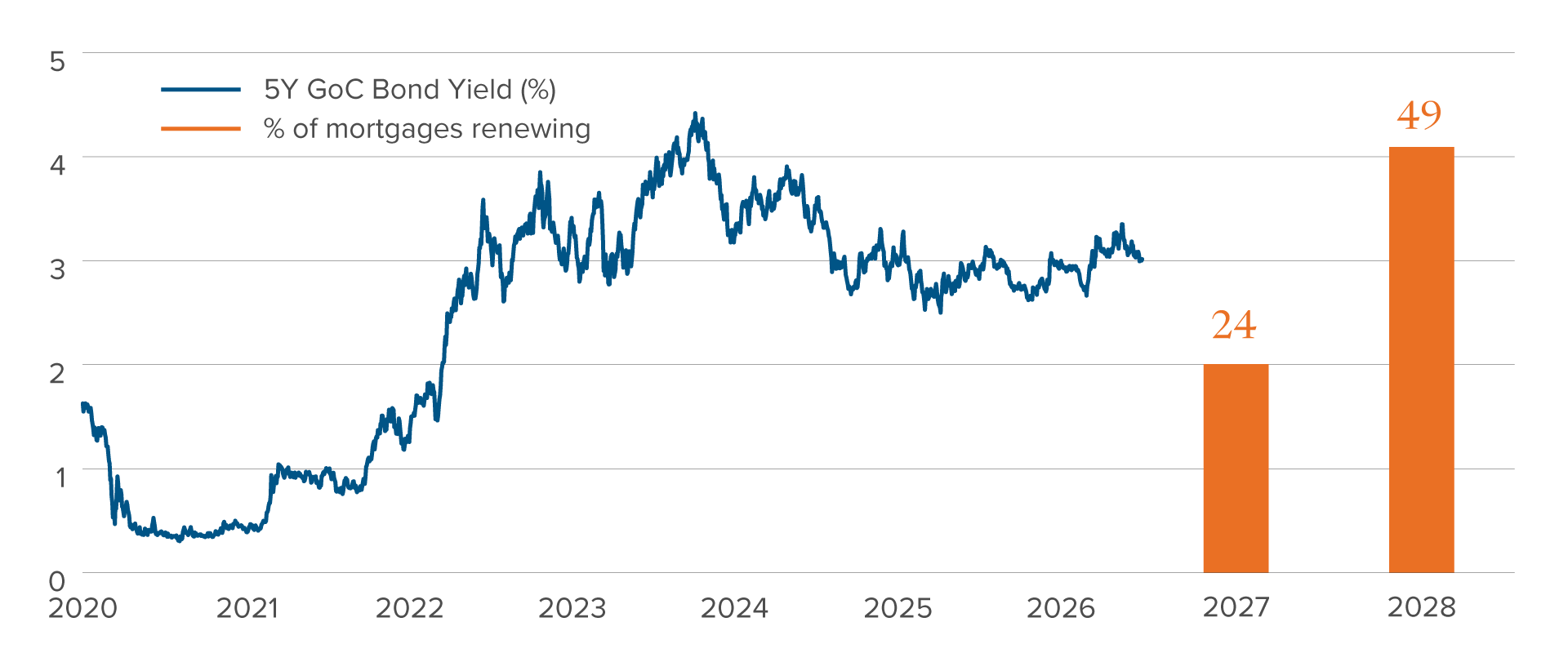
The housing market also remains under pressure. Home prices have declined from their 2022 peak, while elevated condominium inventory in Ontario and British Columbia continues to weigh on activity. The remaining wave of pandemic-era mortgage renewals is expected to add further pressure as borrowers transition to higher borrowing costs.
Canadian Mortgage Renewal Wave
Rate reset from record low to higher interest rate
Source: Statistics Canada, US Bureau of Economic Analysis as of March 31, 2026.
Individual financial reports and supplementary regulatory disclosures of Canada's major chartered banks (RBC, TD, BMO, BNS, CIBC, National Bank) as of Q1 2026. Bond yields as of June 30, 2026.
Higher mortgage payments are expected to continue weighing on household cash flow, reinforcing pressure on consumer spending.
These challenges are reflected in Canada's broader economic performance.
Investor takeaway: Elevated household leverage, weaker housing activity and slowing consumer spending are likely to keep domestic growth below trend, supporting a more constructive outlook for Canadian fixed income.
Considerations for investors
Markets continue to focus on inflation risks but may be underestimating Canada's domestic growth challenges. Slowing population growth, weak productivity, housing market softness and highly leveraged consumers all point to an economy that is likely to remain constrained even as inflation moderates.
If growth continues to disappoint, the Bank of Canada could have greater scope to ease monetary policy than markets currently anticipate. In this environment, actively managed fixed income strategies may be well positioned to capitalize on changing rate expectations, evolving yield curve opportunities and selective credit market dislocations.
Key takeaways
- Canada's traditional growth drivers are becoming less reliable.
- Productivity will play a larger role in future growth but is unlikely to improve quickly.
- Elevated household debt and housing market weakness continue to constrain the economy.
- Markets may be underestimating the potential for lower Canadian interest rates.
- The evolving macroeconomic backdrop supports a constructive outlook for Canadian fixed income.
Mackenzie fixed income solutions
Canada's evolving macroeconomic backdrop may favour active fixed income strategies that can respond to changing interest rate expectations, manage duration dynamically and identify opportunities across sectors and issuers. Mackenzie offers ETF solutions that can help advisors position portfolios for this environment.
ETF | Ticker | Management fee | Portfolio role |
Mackenzie Canadian Short Term Fixed Income ETF | MCSB | 0.35% | An actively managed short-duration strategy designed to provide income while reducing interest rate sensitivity through exposure to high-quality Canadian fixed income securities. |
Mackenzie Canadian Strategic Fixed Income ETF | MKB | 0.40% | An actively managed core fixed income strategy with the flexibility to adjust duration, sector allocation and credit exposure as market conditions evolve, seeking opportunities across a broad Canadian investment-grade universe. |
Commissions, trailing commissions, management fees, brokerage fees and expenses all may be associated with mutual fund investments and Exchange Traded Funds. Please read the prospectus before investing. The indicated rates of return are the historical annual compounded total returns including changes in share or unit value and reinvestment of all dividends or distributions and does not take into account sales, redemption, distribution, or optional charges or income taxes payable by any securityholder that would have reduced returns. Mutual funds and Exchange Traded Funds are not guaranteed, their values change frequently and past performance may not be repeated.
The content of this document (including facts, views, opinions, recommendations, descriptions of or references to, products or securities) is not to be used or construed as investment advice, as an offer to sell or the solicitation of an offer to buy, or an endorsement, recommendation or sponsorship of any entity or security cited. Although we endeavour to ensure its accuracy and completeness, we assume no responsibility for any reliance upon it.
This document may contain forward-looking information which reflect our or third party current expectations or forecasts of future events. Forward-looking information is inherently subject to, among other things, risks, uncertainties and assumptions that could cause actual results to differ materially from those expressed herein. These risks, uncertainties and assumptions include, without limitation, general economic, political and market factors, interest and foreign exchange rates, the volatility of equity and capital markets, business competition, technological change, changes in government regulations, changes in tax laws, unexpected judicial or regulatory proceedings and catastrophic events. Please consider these and other factors carefully and not place undue reliance on forward-looking information. The forward-looking information contained herein is current only as of June 30, 2025. There should be no expectation that such information will in all circumstances be updated, supplemented or revised whether as a result of new information, changing circumstances, future events or otherwise.