.svg)
.svg)
Canada stands at a pivotal moment in the global race for critical minerals. These resources enable reindustrialization in the West, support defense systems and drive technologies essential to the energy transition — from electric vehicles to grid storage and artificial intelligence.
The federal government’s new “One Project, One Process” framework signals an awareness that time is of the essence. But leadership on the global stage will depend on execution.
The Mackenzie Resource Team has assessed nearly 10,000 mining projects across the country to identify those with the greatest economic and strategic potential.
To lead, Canada must streamline permitting, invest in infrastructure and defend fair competition in global markets. The moment calls for urgency, pragmatism and coordination across government, industry and finance.
The global race for critical minerals
Demand is rising sharply, yet production and refining remain highly concentrated. Select countries, like China, dominate both, controlling not only output but processing and refining capacity. This creates major vulnerabilities for economies that depend on secure, lasting sources of supply.
Figure 1 - Share of refined material production by country (%)
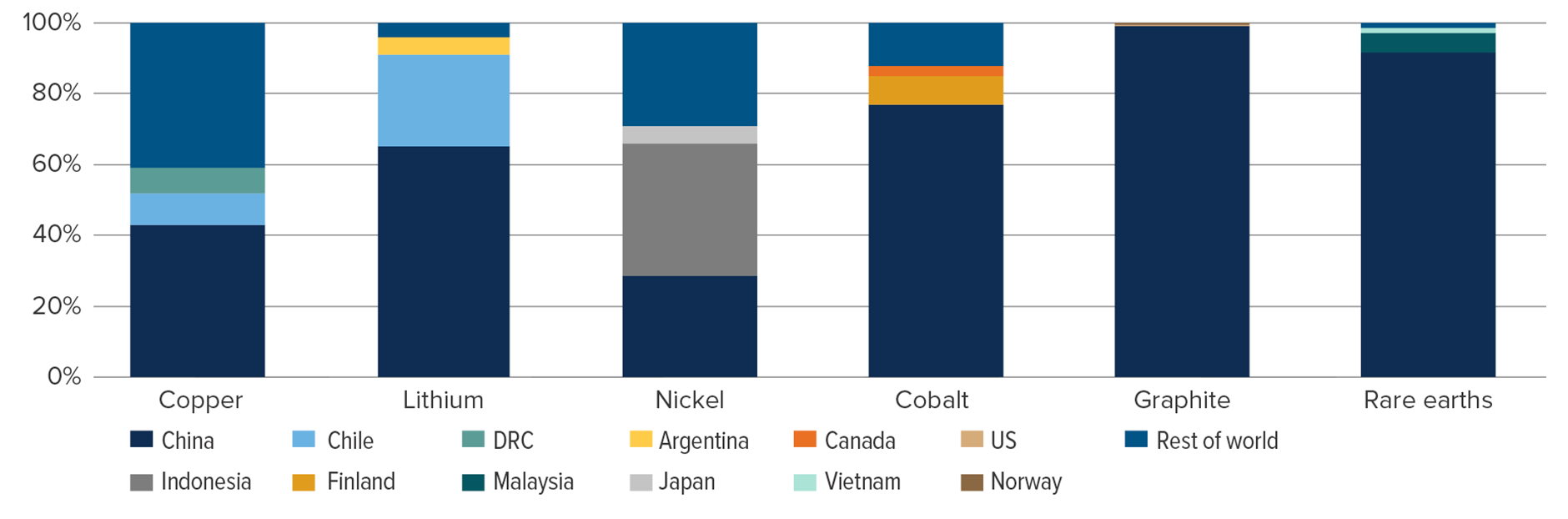 Source: IEA Global Critical Minerals Outlook 2024, data as at December 31, 2023
The new global trade landscape
The old model of global trade — offshoring and lowest-cost sourcing — no longer guarantees prosperity or resilience. Nations are reshoring production, deploying industrial subsidies and using trade policy to strengthen domestic control over supply chains.
In the critical minerals space, Canada faces structural disadvantages. Competitors often operate with weaker environmental standards and receive heavy state support, allowing them to produce at lower cost and higher carbon intensity. Left unchecked, this imbalance risks eroding Canada’s competitiveness in sectors vital to national security and economic growth.
Canada’s competitive edge
Despite underinvestment, Canada holds clear advantages in the global resource race:
- A rich geological endowment: diverse, high-quality deposits that are globally competitive.
- Skilled labour and infrastructure: a world-class mining ecosystem.
- Transparent governance: a commitment to strong regulatory standards.
- Strategic geography: dual access to the Atlantic and Pacific, connecting the country to global markets.
With targeted action, these strengths can make Canada the preferred global supplier of secure, responsibly produced critical minerals.
A framework for action
Our analysis groups Canada’s most promising opportunities into three categories of seven clusters:
- Economic clusters: resources with commercially viable projects, requiring only faster permitting and process efficiency.
- Strategic clusters: vital resources where market protection, incentives or infrastructure are needed to attract investment.
- World-class clusters: established resource groups that already anchor global markets and require steady support to maintain leadership.
Figure 2 - Canadian mineral cluster mapping
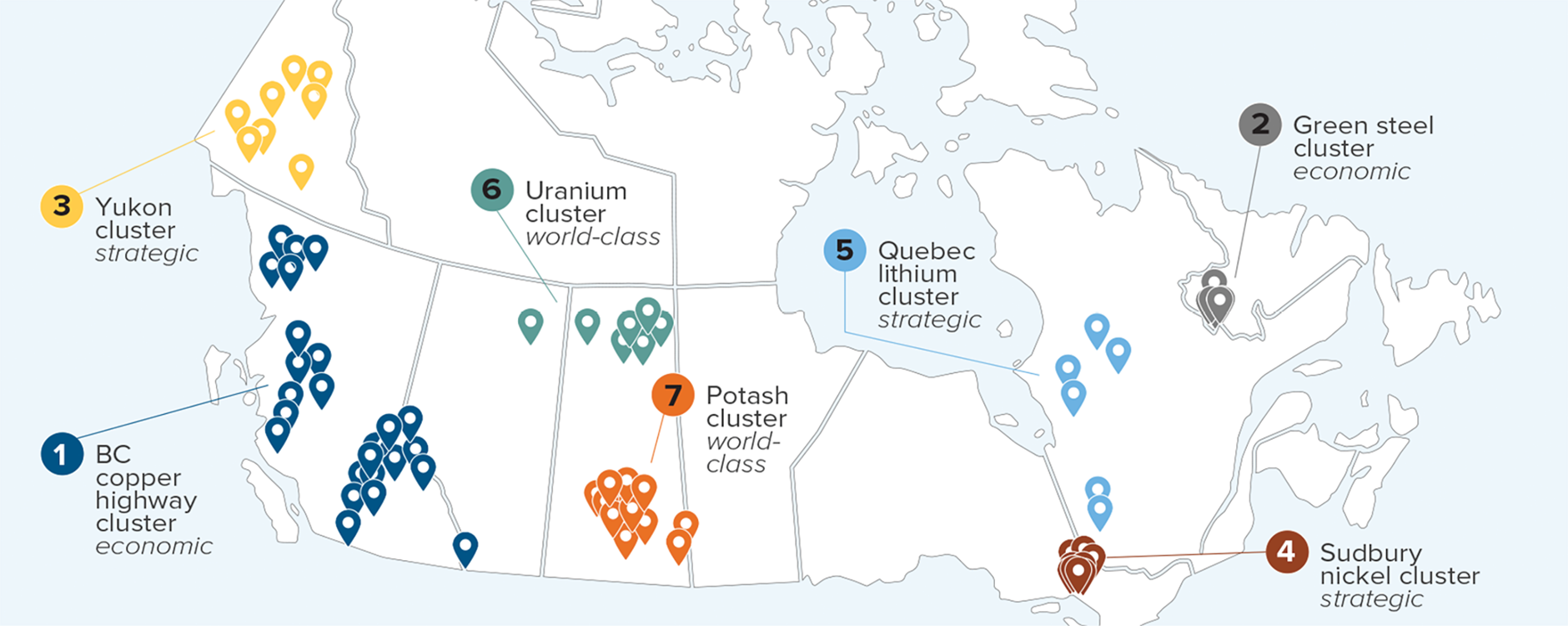 Source: Company reports, Mackenzie Investments, 2025
Economic clusters: removing bottlenecks
BC copper highway
British Columbia’s “copper highway” holds rich deposits supported by infrastructure and refining expertise. Yet greenfield projects remain underdeveloped.
To realize its full value, next steps should involve expanding power-grid capacity, prioritizing early engagement with Indigenous communities and incentivizing domestic refining to capture more value onshore.
Labrador and Quebec green steel
Canada’s premium-grade iron ore concentrate is ideal for producing low-carbon green steel. The country ranks among the highest in resource tonnage, but energy and transportation limitations constrain growth.
Next steps should involve expanding rail corridors, upgrading hydroelectric networks and extending energy infrastructure to vertically integrate low-carbon steel production.
Strategic clusters: building long-term resilience
Yukon polymetallic
The Yukon hosts significant tungsten, zinc and copper deposits but faces permitting timelines of up to 15 years.
Project success would require adopting a “one project, one assessment” model and completing the BC–Yukon Grid Connector to replace diesel power generation and reduce costs.
Sudbury nickel
Home to Canada’s largest concentration of high-quality nickel and cobalt, Sudbury remains central to North American battery supply chains. Yet global nickel prices are suppressed by heavily subsidized production in countries with weaker standards.
For successful utilization, government should implement market protections such as tariffs or offtake agreements to support long-term production, and reform Ontario’s mineral rights to encourage active exploration.
Quebec lithium
Quebec’s six high-grade lithium projects can supply growing battery clusters in Bécancour and southern Ontario, but global oversupply has delayed investment.
Next steps should include supporting early projects through temporary floor prices or offtake contracts, investing in shared refining infrastructure and reviving the Plan Nord rail extension to improve access and reduce emissions.
World-class clusters: strengthening our position
Saskatchewan uranium
The Athabasca Basin provides roughly 15% of global uranium supply. As nuclear energy gains momentum, streamlining federal permitting while maintaining rigorous environmental protections and Indigenous engagement will allow Canada to expand its role in the global nuclear fuel cycle.
Saskatchewan potash
Canada is the world’s largest potash producer, essential for global food security. To sustain leadership, the focus must shift to expanding rail and port capacity — ensuring Canadian exports reach markets efficiently and reliably.
A pivotal crossroads
The race for critical minerals is already underway, shaped by state intervention, trade realignment and strategic alliances. Canada has the resources, expertise and credibility to lead in the critical minerals economy.
The path forward is clear:
- Streamline permitting for economically viable projects.
- Invest in infrastructure to remove bottlenecks.
- Provide market protection where unfair practices undermine competitiveness.
By acting with resolve and urgency, Canada can seize this defining opportunity — strengthening its economy, advancing its climate goals and ensuring its place as a trusted global supplier and trade partner.
Authors:
Mackenzie Resource Team
Benoit Gervais, MSc, CFA — SVP, Portfolio Manager, Team Lead
Onno Rutten, MSc, MBA — VP, Portfolio Manager
Rahul Malhotra, BESc., MBA, CFA — Director, Investment Research
Eduardo Garcia Hubner, MSc., MBA — Senior Investment Analyst
Andrea Sanchez Martinez — Jr. Investment Analyst
Wamen Islam, CFA — Senior Manager, Investment Portfolio Specialist