.svg)
.svg)
Monthly commentary - Mackenzie Fixed Income Team


About the author
IN THIS ARTICLE
Highlights
- The Federal Reserve remained hawkish, pressuring U.S. Treasuries, while the Bank of Canada adopted a more balanced stance amid persistent domestic growth and population challenges.
- The funds maintained cautious nominal-duration exposure and an overweight to inflation-linked bonds, reflecting elevated inflation risks and more attractive market-implied breakeven levels.
- The funds retained constructive emerging-market exposure, particularly Brazil, while reducing U.S. dollar positioning toward neutral and using options selectively for modest short exposure.
- Leveraged loans outperformed high-yield bonds, supported by floating-rate structures and stronger technicals, while pronounced CCC spread widening reinforced the need for selectivity.
- Rising AI-related capital spending is supporting economic activity but reducing hyperscaler free cash flow and increasing financing needs, prompting greater discipline on valuation and issue selection.
Fixed Income Team views
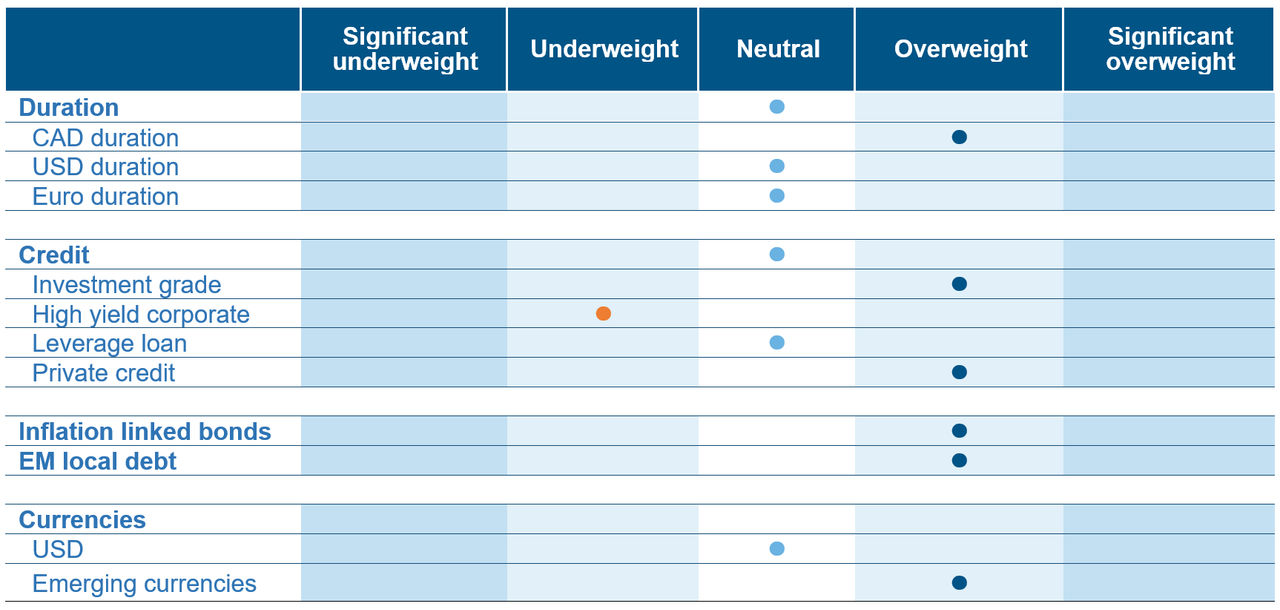 Source: Mackenzie Investments. As of July 31, 2026.
Fixed Income market update
The Federal Reserve maintained a relatively hawkish tone. Policymakers emphasized that several consecutive benign inflation readings would likely be required before the central bank could conclude that price pressures were returning sustainably to target. Chair Warsh also reiterated the importance of restoring inflation to 2%, while describing the labour market as broadly balanced. As a result, markets continued to assign some probability to additional rate increases by year-end, despite reducing those expectations following the softer inflation release.
This backdrop kept pressure on U.S. government bonds. Ten-year Treasury yields finished July approximately 27 basis points higher, while long-duration fixed-rate assets underperformed. At the same time, continued investment in artificial intelligence and data-centre infrastructure supported U.S. economic activity, even as investors became more cautious about the implications of significantly higher capital expenditures for corporate free cash flow and debt issuance.
The Bank of Canada left its policy rate unchanged at its July meeting, in line with market expectations. The Bank continued to project excess supply through its forecast horizon and revised its estimate of the output gap to show greater economic underperformance than previously anticipated. However, it also indicated that the weakest period of Canadian growth may have passed following two consecutive quarters of negative real GDP growth. With risks around energy prices and North American trade appearing less extreme than earlier in the year, the Bank presented a more balanced assessment and reduced the immediacy of both rate-cut and rate-hike scenarios.
Nevertheless, the Canadian economy continues to face structural challenges. Population declined in each of the three quarters through the first quarter of 2026, initially reflecting fewer international students and potentially shifting toward reductions in temporary foreign workers. Sustained population weakness could limit consumption, labour-force growth and the economy’s potential growth rate. This leaves some possibility of a Bank of Canada rate cut later in 2026, although easing is no longer the central expectation.
The divergence between the U.S. and Canadian outlooks remains important for currency markets. The Federal Reserve has more scope to maintain or increase restrictive policy given stronger U.S. growth and inflation, whereas the Bank of Canada must balance inflation risks against a weaker domestic economy. This relative policy backdrop may continue to constrain the Canadian dollar, although the U.S. dollar’s recent appreciation and substantial hawkish repricing have reduced the attractiveness of maintaining a significant long-U.S.-dollar position.
Fund positioning
Against this backdrop, the funds maintained a cautious approach to outright nominal duration. The resilience of U.S. economic activity, renewed energy-price pressures and the Federal Reserve’s continued focus on inflation suggest that government bond yields may need to remain elevated. This has made long-dated nominal U.S. duration less compelling in the near term, particularly after the market’s quick reaction to a single soft inflation print.
By contrast, the funds maintained an overweight position in inflation-linked bonds. Market-implied inflation expectations declined across two-, five-, ten- and thirty-year maturities as oil prices retreated from their intra-month highs and the Federal Reserve adopted a more hawkish tone. The team viewed this adjustment as creating an opportunity to add inflation protection countercyclically. Over longer horizons, inflation-linked securities also provide protection against the risk that the Federal Reserve moderates its inflation-fighting language after establishing policy credibility, particularly if growth begins to slow.
The portfolios remained selective within corporate credit. Spreads across investment-grade bonds, high-yield bonds, leveraged loans and portions of private credit continue to offer limited additional compensation relative to underlying risks. Rather than materially increasing exposure to lower-quality single-B and CCC issuers, where default and restructuring risks remain elevated, the team continued to look for more attractive opportunities in selected emerging-market bonds and currencies.
Brazil remained one of the preferred emerging-market exposures. Local yields near 14% provide a meaningful income advantage, while the market has not experienced the same degree of rally seen in some other emerging economies. The position is not without risk, particularly given the approaching election and the potential for changes in fiscal or cabinet policy. However, the current political outcome appears to be increasingly reflected in market expectations, reducing some of the element of surprise. The team continued to express its constructive emerging-market view through both bonds and currencies.
U.S. dollar exposure was reduced during July. The portfolios had previously held an overweight position, but the dollar’s appreciation and the market’s aggressive interpretation of the Federal Reserve’s hawkish stance reduced the expected upside. The team brought the position closer to neutral and, in selected strategies, used options to establish modest short exposure. This positioning is consistent with the view that the Federal Reserve may remain hawkish in the immediate term to reinforce its inflation-fighting credibility but could adopt a less restrictive stance over subsequent quarters.
Credit market performance
U.S. high-yield bonds and leveraged loans experienced divergent performance in July as rising government bond yields favoured floating-rate assets reflecting both higher Treasury yields and modest spread widening. Within High Yield, performance was highly differentiated by quality as CCC spreads widened by 61 bps, compared with widening of 6 bps for B rated and 11 bps for BB rated securities. This decompression indicates that investors are demanding greater compensation for weaker balance sheets and more complex refinancing situations. Leveraged loans benefited from their floating-rate structure, an increasingly hawkish monetary-policy backdrop and stronger market technicals. Performance also remained differentiated by rating. B rated loans gained approximately 0.95%, while BB loans returned 0.64%. CCC loans declined approximately 0.09%.
Within credit, the funds continued to monitor the rapid growth in AI-related issuance. Hyperscalers have substantially increased capital-spending expectations, with 2027 expenditures potentially approaching US$900 billion compared with approximately US$630 billion in 2026. While this spending remains an important support for the economy, it is also reducing corporate free cash flow and increasing financing needs. Demand for newly issued hyperscaler bonds has moderated, credit default swap spreads have moved higher and investors are increasingly requiring additional spread concession. Accordingly, the portfolios remained disciplined on valuation and issue selection rather than pursuing exposure solely on the strength of the broader AI investment theme.
Index | Yield | Yield m/m | Spread | Spread m/m | Performance (%) | |||
bp | bp | bp | 1m | 3m | YTD | 1Y | ||
Investment Grade | ||||||||
CA | 4.3% | 21 | 91 | 1 | -1.2 | 0.2 | 1.0 | 3.0 |
US | 5.5% | 26 | 79 | 3 | -1.5 | -0.8 | -0.6 | 2.7 |
High Yield |
|
|
|
|
|
|
|
|
CA | 7.2% | 17 | 251 | 0 | -0.2 | 1.1 | 1.6 | 4.7 |
US | 7.7% | 22 | 285 | 10 | -0.3 | 0.3 | 1.6 | 5.0 |
US Leverage Loans | 8.2% | -6 | 428 | -9 | 1.2 | 1.2 | 1.6 | 4.7 |
Source: Bloomberg as of 31st July 2026, performance is reflective of local returns
Commissions, trailing commissions, management fees, and expenses all may be associated with mutual fund investments. Please read the prospectus before investing. The indicated rates of return are the historical annual compounded total returns as of July 31, 2026, including changes in share value and reinvestment of all distributions and does not take into account sales, redemption, distribution, or optional charges or income taxes payable by any security holder that would have reduced returns. Mutual funds are not guaranteed, their values change frequently, and past performance may not be repeated. Index performance does not include the impact of fees, commissions, and expenses that would be payable by investors in the investment products that seek to track an index.
This document may contain forward-looking information which reflect our or third party current expectations or forecasts of future events. Forward-looking information is inherently subject to, among other things, risks, uncertainties, and assumptions that could cause actual results to differ materially from those expressed herein. These risks, uncertainties and assumptions include, without limitation, general economic, political and market factors, interest and foreign exchange rates, the volatility of equity and capital markets, business competition, technological change, changes in government regulations, changes in tax laws, unexpected judicial or regulatory proceedings and catastrophic events. Please consider these and other factors carefully and not place undue reliance on forward-looking information. The forward-looking information contained herein is current only as of May 31, 2026. There should be no expectation that such information will in all circumstances be updated, supplemented or revised whether as a result of new information, changing circumstances, future events or otherwise.
The content of this commentary (including facts, views, opinions, recommendations, descriptions of or references to, products or securities) is not to be used or construed as investment advice, as an offer to sell or the solicitation of an offer to buy, or an endorsement, recommendation or sponsorship of any entity or security cited. Although we endeavour to ensure its accuracy and completeness, we assume no responsibility for any reliance upon it.
All information is historical and not indicative of future results. Current performance may be lower or higher than the quoted past performance, which cannot guarantee results. Share price, principal value, and return will vary, and you may have a gain or a loss when you sell your shares. Performance assumes reinvestment of distributions and does not account for taxes. Performance may not reflect any expense limitation or subsidies currently in effect. Short-term trading fees may apply.
This material is for informational and educational purposes only. It is not a recommendation of any specific investment product, strategy, or decision, and is not intended to suggest taking or refraining from any course of action. It is not intended to address the needs, circumstances, and objectives of any specific investor. Mackenzie Investments, which earns fees when clients select its products and services, is not offering impartial advice in a fiduciary capacity in providing this sales and marketing material. This information is not meant as tax or legal advice. Investors should consult a professional advisor before making investment and financial decisions and for more information on tax rules and other laws, which are complex and subject to change.
The rate of return is used only to illustrate the effects of the compound growth rate and is not intended to reflect future values of the mutual fund or returns on investment in the mutual fund.