.svg)
.svg)
A policy reset, not a portfolio reset

About the author
IN THIS ARTICLE
Select Section
Key points
- Midterm elections shape fiscal, trade, and regulatory policies that directly influence financial markets.
- Markets typically price in uncertainty before elections but have historically rebounded once results become clear.
- Investors should stay focused on economic and earnings-related fundamentals rather than making portfolio decisions based on election outcomes alone.
How politics reaches markets
Among the major political events of 2026, the US midterm election is likely to have the greatest significance for financial markets during President Donald Trump's second term. With every House seat and 35 Senate seats up for election, even a modest shift in voter sentiment could tip the balance in Congress. For investors, what matters is not simply who wins, but to what extent the administration's agenda can be implemented over the next two years.
As a result, the composition of Congress matters more than the election headlines themselves. Markets are looking beyond seat counts to assess whether Washington remains unified, shifts into partial gridlock or becomes fully divided. Each outcome would create a different policy backdrop, with implications for fiscal legislation, regulatory changes, trade initiatives, Treasury issuance, economic growth and financial markets.
History suggests that midterm elections are more often a source of uncertainty than a reason to adjust long-term portfolio positioning. Political outcomes can influence market leadership and create periods of higher volatility, particularly in sectors most exposed to changes in fiscal, tax and regulatory policy. These effects have generally been cyclical rather than structural.
Investors are therefore better served viewing the 2026 midterm as an event that may reshape the policy environment rather than the investment landscape. The outcome will help determine the direction of fiscal and regulatory policy and may influence market leadership over the next two years. While politics can affect markets around the margins, over longer horizons, US equity returns have been driven far more by economic growth, monetary policy and corporate earnings than by which party controls Congress.
The House is where the risk is clearest
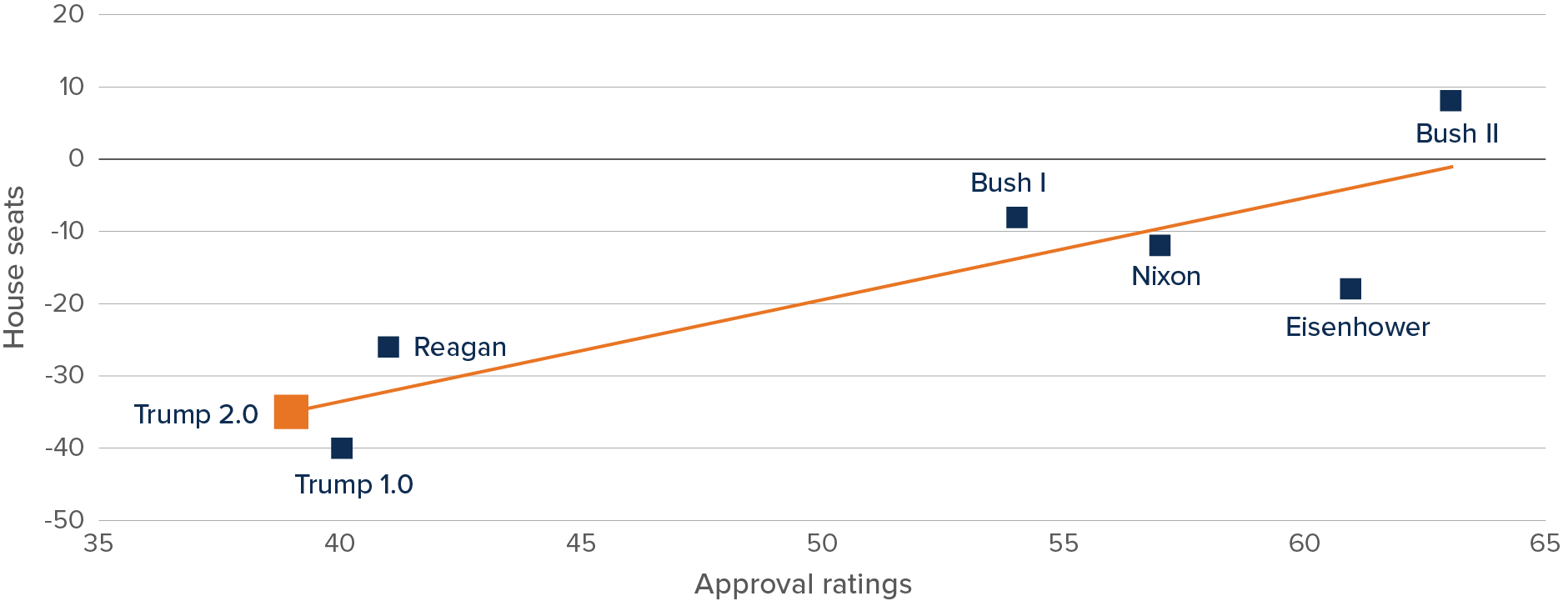
When assessing political risk, the House of Representatives is the more important chamber to watch because it tends to reflect shifts in the national mood more clearly than the Senate. Historically, presidential approval ratings have been among the strongest predictors of House seat gains and losses in a midterm election. Presidents entering their first midterm with weaker approval ratings have generally been associated with larger House losses. Figure 1 illustrates this relationship more clearly. President Trump's current approval rating sits near the lower end of the range, implying Republicans could lose around the mid-30s in House seats if the historical relationship holds.
Figure 1 - Republican presidential approval rating & House seats
gained / lost in first midterm
(Gallup, RCP, US House of Representatives)
Source: Gallup, RealClearPolitics (RCP), U.S. House of Representatives.
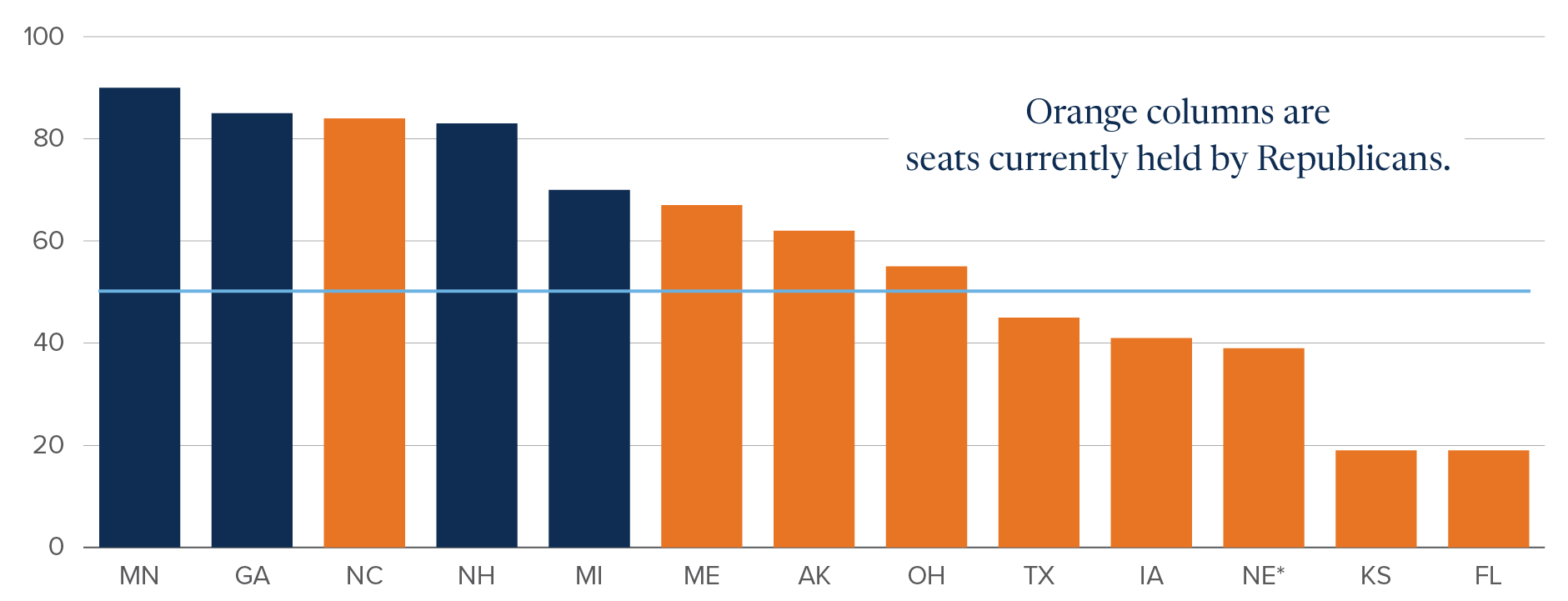
The Senate presents a more complicated picture. Unlike the House, where all 435 seats turn over every two years, the Senate is a semi-permanent body in which only one-third of seats are contested every two years. Therefore, the 35 Senate seats (33 regular and two special) that are up for grabs this fall will sit for a six-year term. Control of the chamber is therefore likely to hinge on a handful of competitive state races. As Figure 2 shows, Democrats need to gain four seats to take the majority, which entails holding difficult seats in Georgia, New Hampshire and Michigan while flipping Republican-held seats such as North Carolina, Maine, Alaska and Ohio. The narrow margin for error makes the Senate race more competitive and difficult to predict than the House.
Figure 2 - Democratic Senate race odds
(Polymarket, 6/15/26)
 *NE odds represent if Osborn (I)
Source: Polymarket, as of June 15, 2026.
Taken together, the evidence supports an increasing probability of a divided government rather than a unified one. Although polls and prediction markets should not be treated as forecasts, they can still provide a useful gauge of current political momentum. Current indicators suggest that Republican control of the House is under greater pressure, while the Senate remains more evenly contested. With House margins already thin, Democrats may not require a large swing in voter sentiment to gain control.
Various paths through Washington
Ultimately, election night is about how much fiscal capacity Washington will have over the next two years. Our base case remains that a divided government is the most likely outcome. By “divided government” we mean that the Executive Branch (the President) will be Republican, but that the Legislative Branch (Congress, which consists of the House of Representatives and the Senate) will no longer be fully controlled by the Republicans. This would not stop policymaking, but it would make another round of large fiscal initiatives considerably harder to deliver. Instead, investors would spend more time watching budget negotiations, debt-ceiling debates and executive actions than broad legislative packages. The result is likely to be a slower policy cycle rather than a fundamentally different economic one.
A continued unified Republican government would change that picture. Under a unified Republican government, the party would retain control of both the White House and Congress. The administration would have much greater freedom to pursue tax, spending and deregulatory priorities, which could initially lift growth expectations and business confidence. The market's focus, however, is likely to shift quickly to the amount of additional borrowing required to finance it. Given today's fiscal backdrop, Treasury supply and longer-term yields would likely become the more important part of the story.
A Democratic-controlled Congress would have different implications. Its significance would lie less in what it could enact than in what it could prevent. Large fiscal initiatives would become more difficult to pass, reducing the likelihood of further deficit expansion. That may be modestly supportive for duration, but it would not eliminate policy uncertainty. Trade, tariffs and parts of the regulatory agenda would remain largely under executive control.
Election night results will influence the pace of policymaking and the mix of policy risks that markets will face, but it is unlikely to overturn the macroeconomic forces that ultimately drive the long-term returns. Politics may shape the next chapter of the cycle, but it is unlikely to rewrite the story.
How markets may interpret the result
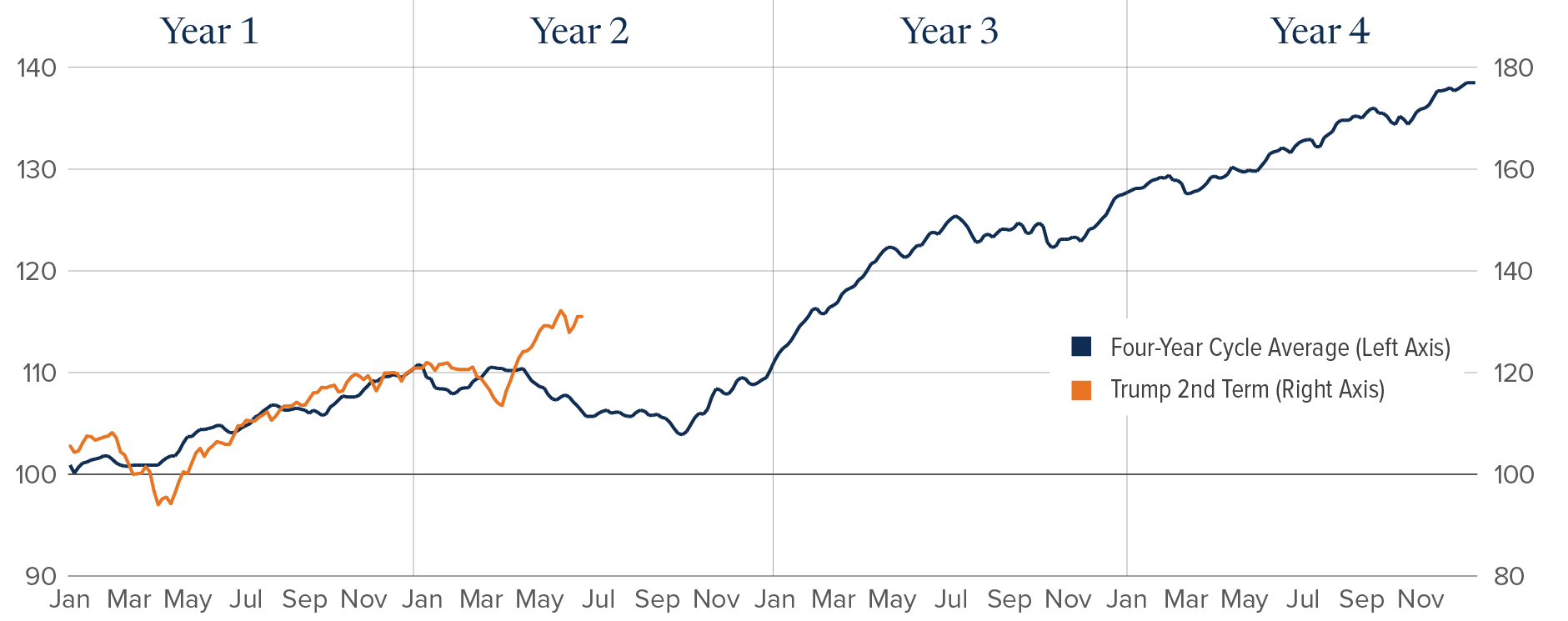
Equity markets have historically followed a recognizable pattern around US midterm elections. In the early stages of the presidential cycle, investors focus on what the new administration might achieve. As the midterm approaches, uncertainty surrounding the composition of the next Congress often weighs on sentiment. Once the result is known, that uncertainty fades and markets begin to refocus on the economic cycle. Figure 3 captures this pattern: the second year of the presidential cycle has historically been the weakest for the S&P 500, followed by stronger returns after the midterm election.
Figure 3 - Average S&P 500 price returns
during four-year presidential cycle
(1961–2024)
Source: Strategas, Policy Outlook, June 16, 2026, page 7.
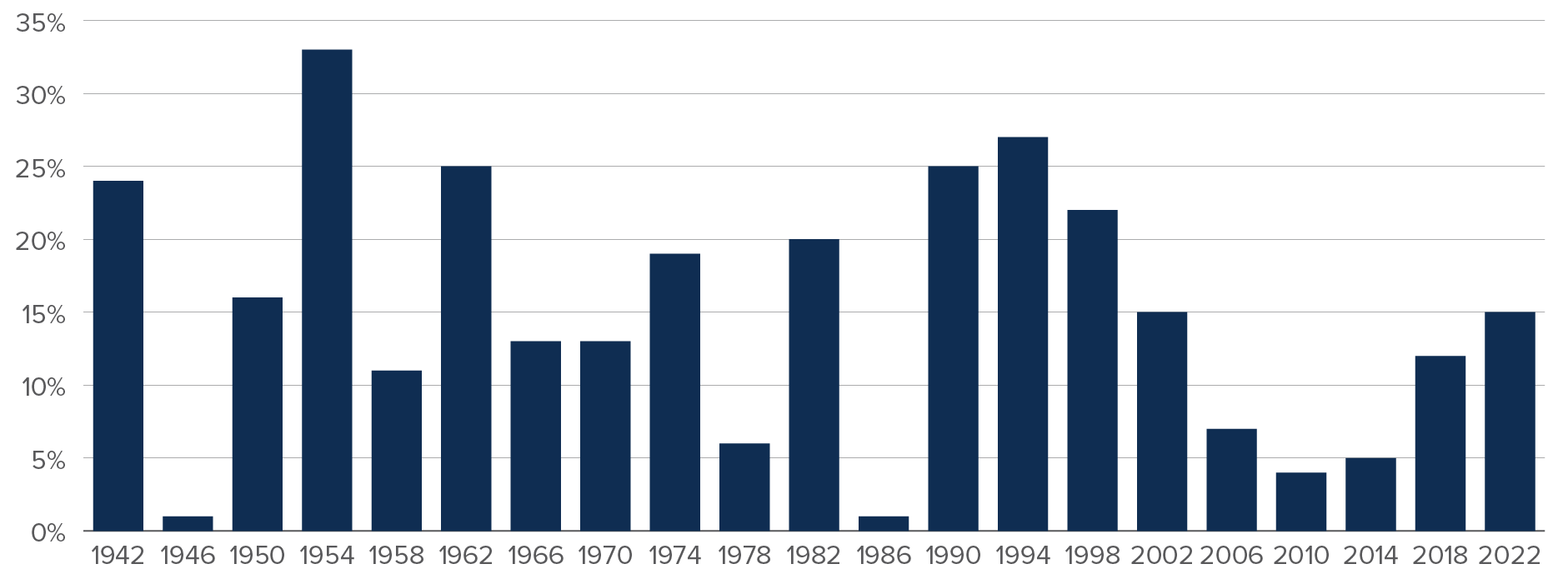
Figure 4 provides another perspective. Since 1938, the S&P 500 has never recorded a negative return over the 12-month period following the US midterm elections. Historical evidence suggests that once election-related uncertainty is lifted, regardless of political outcome, equity markets tend to move forward. It is hard to make the case that there is a direct causal linkage, but the empirical evidence shows that the lifting of uncertainty has been a positive for equity investors.
Figure 4 - S&P 500 price return 12 mo. period
following midterm election
Average = 14.8%
Source: Mackenzie Investments.
The policy implications of the election, however, are more important than the result itself. A Republican sweep would likely be welcomed by equity markets initially. Investors would see a clearer path for tax relief, lighter regulation and stronger domestic investment, which should favour smaller companies, industrials, energy, financials and businesses tied to defence and reshoring. The initial market interpretation would be clear: stronger growth prospects and a more supportive backdrop for earnings.
The more important question is how long that enthusiasm would last. With deficits already elevated, the bond market would quickly turn its attention to the cost of financing that growth. If heavier Treasury issuance and firmer inflation expectations push long-term yields higher, the rally could narrow. Banks and some cyclical companies may continue to benefit, while expensive growth stocks, real estate and other rate-sensitive areas could struggle. A Republican sweep may therefore support earnings expectations without necessarily lifting equity valuations across the board.
A divided Congress may offer a different source of stability. Figure 5 shows that equities have historically performed well under several split-government arrangements, not because gridlock is inherently positive, but because it narrows the range of possible policy outcomes. Divided government would reduce the chances of another large fiscal package and make major changes to taxes, spending and regulation more difficult to implement. That may limit some of the upside to growth, but it would also reduce the risk of another sharp rise in deficits and bond yields.
Figure 5 - Partisan control, avg. annual S&P 500 performance
(1933-2025. excl. 2001-02)
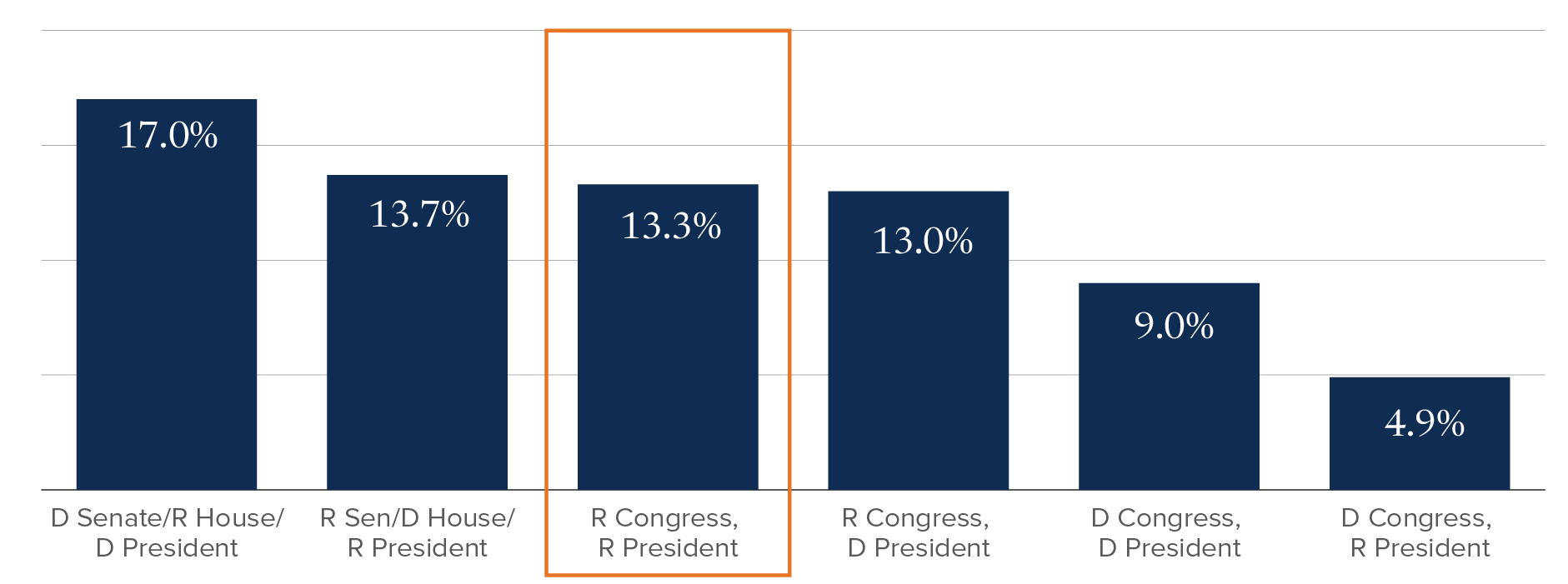
Source: Strategus (2)
*Data excludes 2001–2002 due to Sen. Jeffords changing party affiliation in mid-2001.
For markets, the appeal would be greater predictability. Companies could plan with more confidence, while investors would be able to shift their attention back toward earnings, balance sheet strength and company fundamentals. If long-term yields remain contained, quality growth and other longer-duration assets could benefit. The political noise would not disappear, but it would likely emerge through budget negotiations, government-shutdown risks and executive actions rather than sweeping legislation.
A Congress fully controlled by the Democrats would create a more mixed market response. Areas that have benefited from expectations of further tax relief, deregulation and policy support could come under pressure, particularly domestic cyclicals and businesses closely tied to the administration’s agenda. At the same time, the result could impose a firmer constraint on additional fiscal expansion.
The bond market would become central to that outcome. If investors see lower borrowing needs and less pressure on Treasury supply, long-term yields could decline. That would support technology, real estate, utilities and other rate-sensitive parts of the market, even if expectations for nominal growth softened. Markets would therefore be more likely to price a change in sector leadership than to treat the result as uniformly positive or negative.
Conclusion
For investors, the midterm is less about choosing a political winner than understanding how much policy uncertainty remains. Republican control of the House appears vulnerable, the Senate will be decided race by race, and the most likely result is a narrower path for legislation. Markets do not need a perfect outcome. They often respond once the range of possible outcomes begins to shrink and investors can assess the policy backdrop with greater confidence.
The equity setup is more nuanced than the usual midterm pattern would suggest. Stocks have avoided the pre-election drawdown that often creates room for a strong post-midterm rebound, largely because resilient growth, solid earnings and continued investment in artificial intelligence have kept investors constructive. Some of the benefit from greater political clarity may therefore already be reflected in prices. A relief rally is still possible, particularly if divided government lowers the risk of large fiscal or regulatory changes, but it may be expressed more through shifts in market leadership than through a broad move higher.
Politics may influence the pace of fiscal policy, the direction of regulation and the sectors that lead in the months ahead. It is less likely to change the forces that ultimately determine long-term returns. Economic growth, earnings, inflation and interest rates will still matter more than the composition of Congress. Election-related volatility should therefore be viewed as an opportunity to improve portfolio quality and add selectively where the fundamental case remains intact. In our view, the 2026 midterm is best thought of as a policy reset—not a portfolio reset.
Multi-Asset Strategies Team’s investment views
Tactical summary
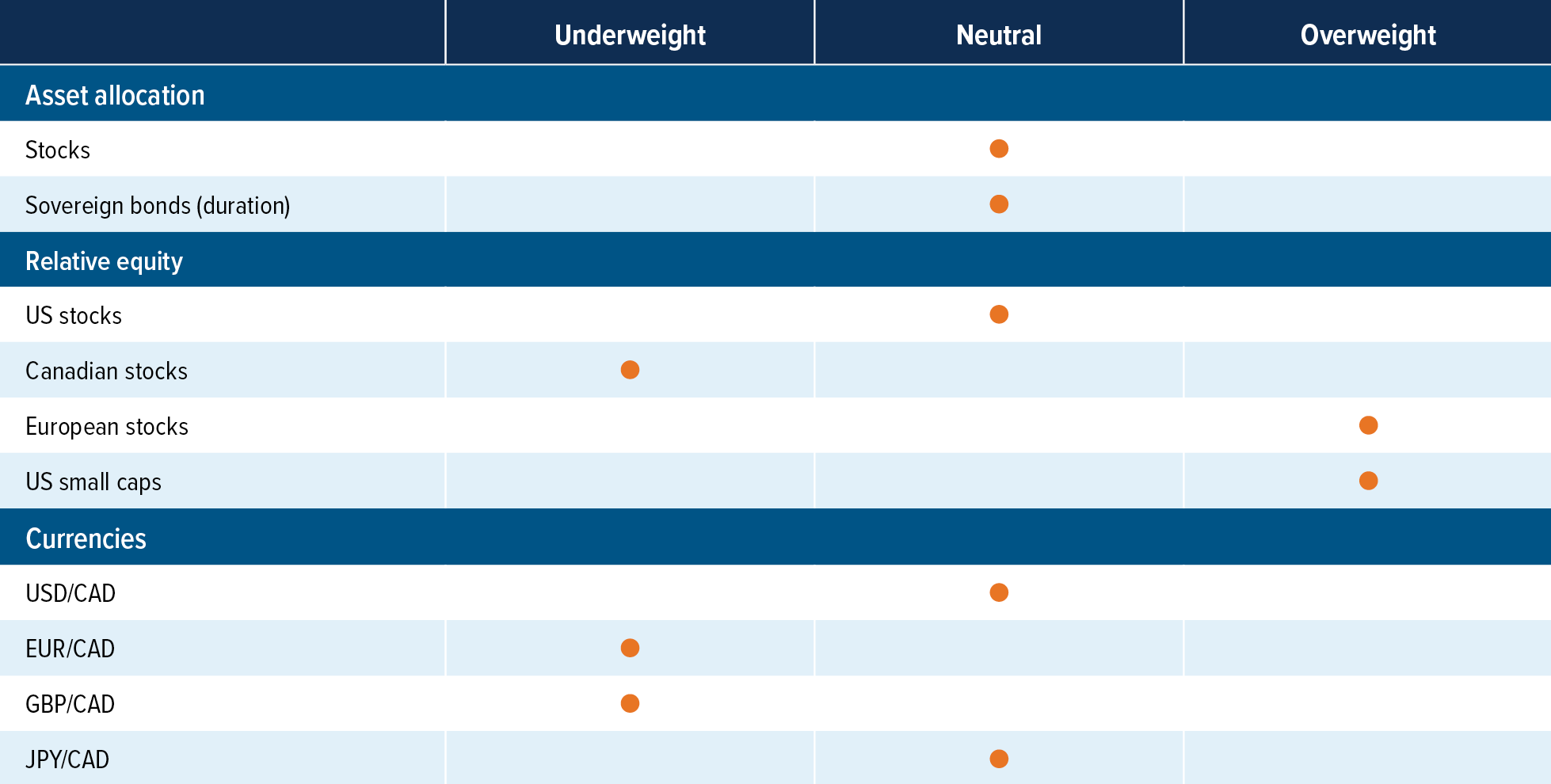
Source: Mackenzie Investments.
Note: The opinions expressed in this piece reflect short-term tactical views, which inform the positioning of some of the funds managed by the Multi-Asset Strategies Team.
Positioning highlights
Remain neutral on equities: Equity markets were subdued in July as investor pivoted away from AI hardware stocks toward previously underperforming sectors such as health care and financials. Despite relatively strong earnings thus far, investors became more selective toward companies with elevated AI capital expenditures amid concerns about the timing and magnitude of future returns. Our view is that the fundamental backdrop for equities (earnings and the economy) is strong, but we see stretched positioning from retail investors which has at times contributed to sharp selloffs, supporting our neutral stance.
Remain neutral on bonds: We remain neutral on bonds. The new Federal Reserve governor, Kevin Warsh, has adopted a forceful stance on inflation. Renewed conflict in Iran and higher energy prices may keep inflationary pressures elevated, limiting the scope for lower inflation in the near term. We therefore maintain a neutral duration position despite more attractive yields.
Trim US small cap overweight and add Europe overweight: Canada’s economic data continues to weaken while we have seen signs of bottoming European economic data. US small caps remain overweight because a stronger US economy is supportive of small cap. We have however trimmed our overweight given the strong outperformance, which has reduced their attractiveness from a valuation perspective.
Currencies: We neutralize our USD vs CAD view given strong US economic data and hawkish statements from the Federal Reserve. The USD remains overvalued, and our long-term view is for the USD to depreciate against most developed currencies. We continue to prefer the Japanese yen as the best play for this view.
Commissions, trailing commissions, management fees and expenses all may be associated with mutual fund investments. Please read the prospectus before investing. Mutual funds are not guaranteed, their values change frequently, and past performance may not be repeated. The content of this material (including facts, views, opinions, recommendations, descriptions of or references to, products or securities) is not to be used or construed as investment advice, as an offer to sell or the solicitation of an offer to buy, or an endorsement, recommendation or sponsorship of any entity or security cited. Although we endeavour to ensure its accuracy and completeness, we assume no responsibility for any reliance upon it. This material contains forward-looking information which reflects our or third party current expectations or forecasts of future events. Forward-looking information is inherently subject to, among other things, risks, uncertainties and assumptions that could cause actual results to differ materially from those expressed herein. These risks, uncertainties and assumptions include, without limitation, general economic, political and market factors, interest and foreign exchange rates, the volatility of equity and capital markets, business competition, technological change, changes in government regulations, changes in tax laws, unexpected judicial or regulatory proceedings and catastrophic events. Please consider these and other factors carefully and not place undue reliance on forward-looking information. The forward-looking information contained herein is current only as of July 31, 2026. There should be no expectation that such information will in all circumstances be updated, supplemented or revised whether as a result of new information, changing circumstances, future events or otherwise. Index performance does not include the impact of fees, commissions, and expenses that would be payable by investors in the investment products that seek to track an index.