

The allure of higher yields

About the author
IN THIS ARTICLE
Select Section
Key points
- A potential tipping point for investors? With fixed income yields becoming increasingly attractive, some retail investors may begin favouring the relative security of bonds and term deposits over the potential volatility of equities.
- From TINA to TARA. After years in which There Is No Alternative (TINA) supported equity valuations, higher bond yields are creating an environment where There Are Reasonable Alternatives (TARA).
- The direction of interest rates matters. Renewed Federal Reserve tightening, combined with persistent inflation and resilient economic growth, could push longer-term bond yields higher, potentially through the psychologically important 5.0% threshold.
- Chasing yield is not without its risks. While locking into attractive deposit rates may provide short-term comfort, reinvestment risk and foregone capital appreciation can undermine longer-term investment outcomes.
Introduction
For some retail investors, a fixed income yield of 5.0% may represent a psychological tipping point, prompting a shift away from equities toward bonds, fixed-income funds and guaranteed investment certificates (GICs).
This raises the possibility that capital markets are transitioning from a TINA (There Is No Alternative) environment to one characterized by TARA (There Are Reasonable Alternatives). For much of the past decade, historically low interest rates reinforced the TINA narrative, encouraging investors to favour equities in their pursuit of meaningful returns. That dynamic may be changing. As fixed income yields become increasingly competitive, particularly if longer-term US Treasury yields approach and potentially exceed 5.0%, investors may be tempted to reduce equity exposure in favour of more predictable income streams.
After three consecutive years of double-digit S&P 500 returns through 2025, higher valuations, geopolitical uncertainty and persistent inflationary pressures have heightened concerns about a potential equity market correction. Against this backdrop, the appeal of securing a predictable income stream is understandable.
However, attractive yields do not necessarily translate into stronger long-term investment outcomes. Investors who chase prevailing interest rates risk sacrificing capital appreciation opportunities while exposing themselves to reinvestment risk.
Where might bond yields be heading?
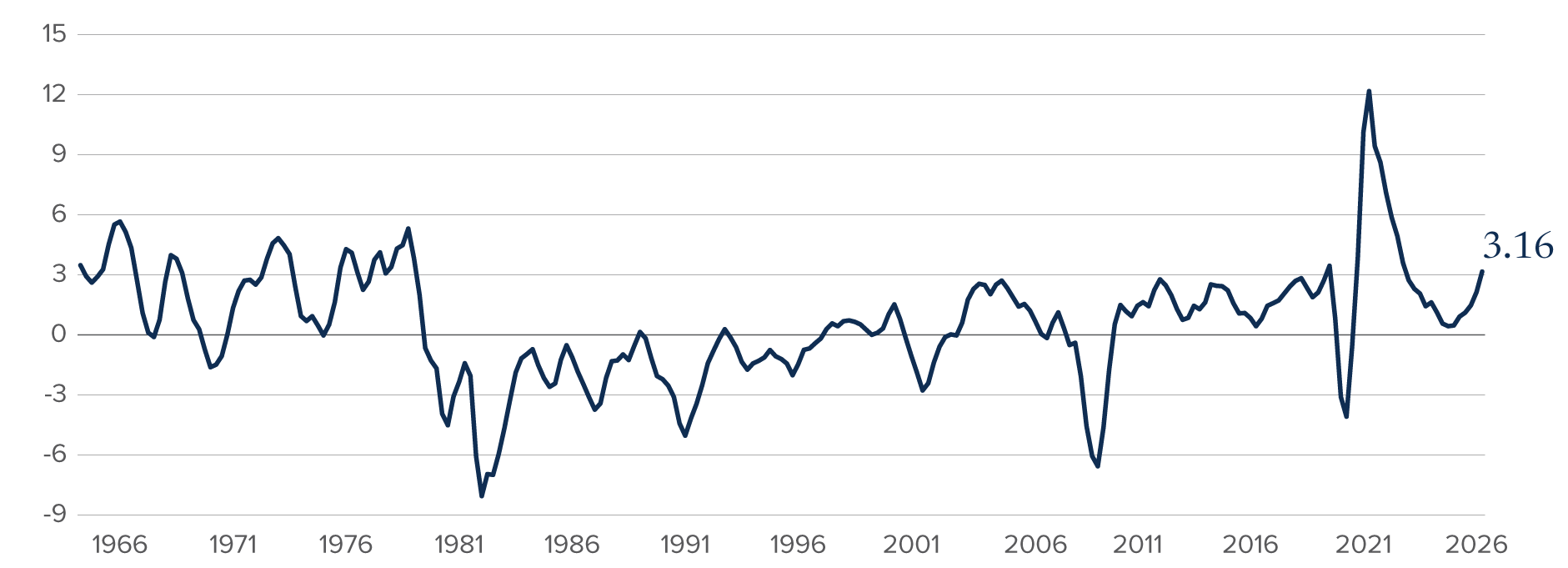
The historical relationship between nominal US GDP growth and the 10-year US Treasury yield offers insight into where bond yields may be heading (Figure 1).
Figure 1 – Year-over-year nominal GDP growth less 10-year
US Treasury yield
Source: Baird Strategas, Bloomberg as at September 9, 2026.
Assuming inflation and real Treasury yields eventually settle near 2.5% each, a nominal 10-year yield of roughly 5.0% becomes plausible. This is not a precise forecast, but rather an illustration of where yields might settle if inflation expectations and real interest rates remain elevated.
Importantly, Treasury yields are also influenced by monetary policy expectations, fiscal deficits, government borrowing requirements and the term premium investors demand for holding longer-dated securities. With US federal debt continuing to expand and inflation proving difficult to contain, several forces could contribute to sustained upward pressure on longer-term yields.
Federal Reserve policy is another important consideration. Under Chairman Kevin Warsh, the Fed raised its benchmark interest rate by 25 basis points in September to 3.75%–4.00%. Although rates remained unchanged in October, persistent inflation suggests further tightening is possible.
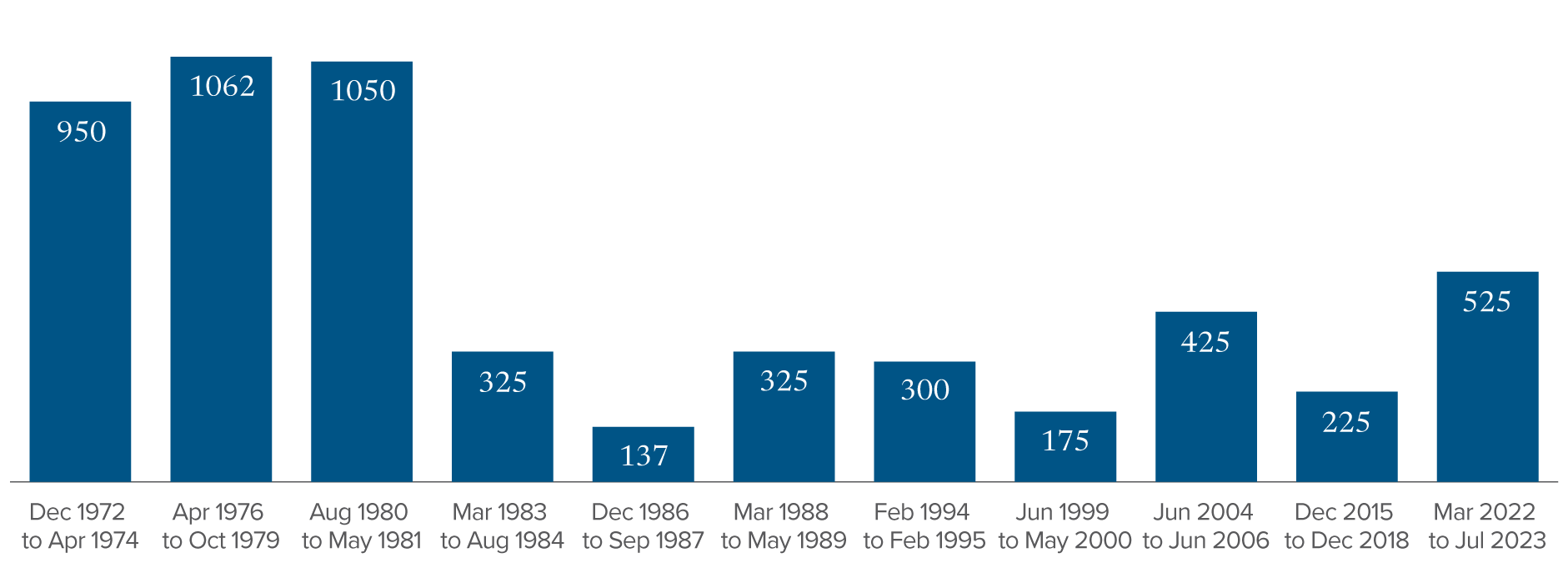
How many additional increases might be required? History offers some perspective (see Figure 2 below).
Figure 2 – Total change in Fed funds rate during previous tightening cycles (bps)
Source: Source: Baird Strategas, Bloomberg.
As illustrated in Figure 2, Federal Reserve tightening cycles have generally involved multiple interest rate increases rather than a single adjustment. The March 1997 tightening episode stands out as a notable exception, when the Fed increased rates once before leaving policy unchanged for an extended period.
While history does not guarantee a particular outcome, a cumulative tightening cycle involving two to four increases of 25 basis points each appears plausible. The ultimate magnitude will depend on the evolution of inflation, employment and economic activity. Nevertheless, investors should not assume that September's increase will necessarily be the last.
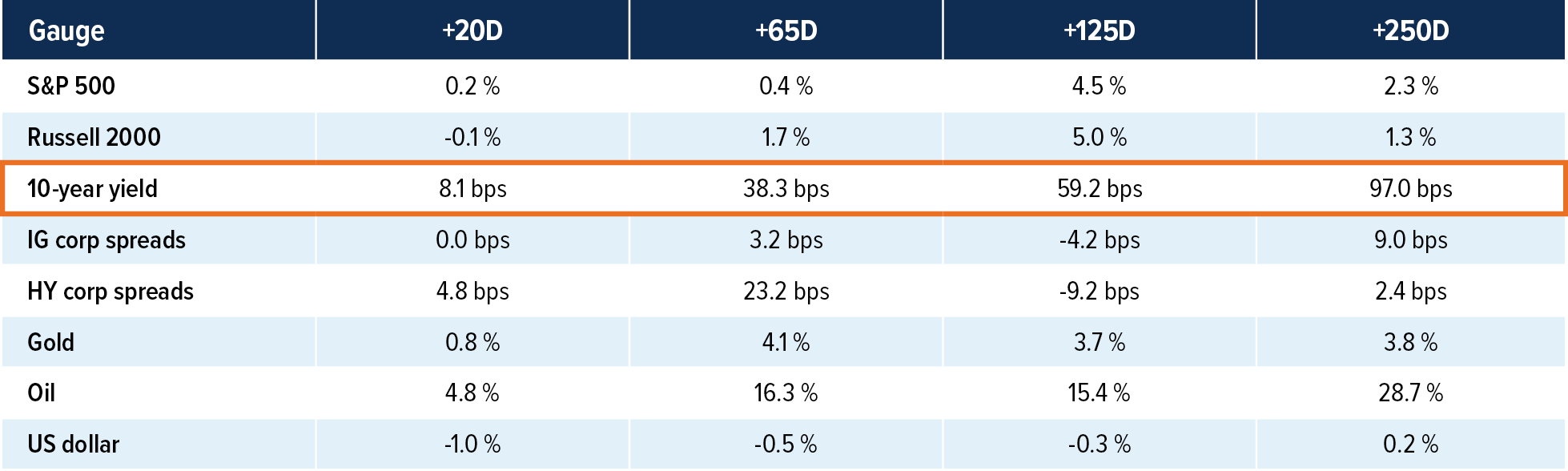
Figure 3 – Average performance following the first Fed rate hike
Source: Baird Strategas, Bloomberg
*Average from first hikes starting in June 1983 to March 2022.
**Oil data starts as of 1986; Corporate spread data starts as of 1994.
***IG = BBG US Agg Corporate avg OAS Index, HY = BBG US Corp HY avg OAS Index.
As Figure 3 demonstrates, 10-year Treasury yields have historically tended to rise following the first Fed rate hike. However, bond markets are forward-looking, and yields can subsequently decline if tighter monetary policy raises concerns about future economic growth.
Ultimately, a 5.0% yield or higher on the 10-year Treasury is certainly conceivable, but not inevitable. Much will depend on the resiliency of the US economy and whether inflation remains sufficiently persistent to warrant additional monetary tightening.
What happens when yields reach 5.0%?
As bond yields approach the psychologically important 5.0% threshold, investors may increasingly favour the relative predictability of fixed income returns over equity market volatility.
There is however an important valuation consideration. The value of a company reflects the present value of its expected future cash flows, discounted at an appropriate required rate of return. When interest rates rise, the discount rate applied to those cash flows generally increases, reducing their present value, all else being equal.
This relationship helps explain why rising bond yields can pressure equity valuations among growth-oriented companies whose expected cash flows are concentrated further into the future.
However, rising interest rates do not automatically translate into declining equity prices.
If yields rise alongside stronger economic growth and improving corporate earnings, equities may remain resilient. Conversely, inflation-driven increases that prompt aggressive monetary tightening can weigh on valuations, profitability and economic activity.
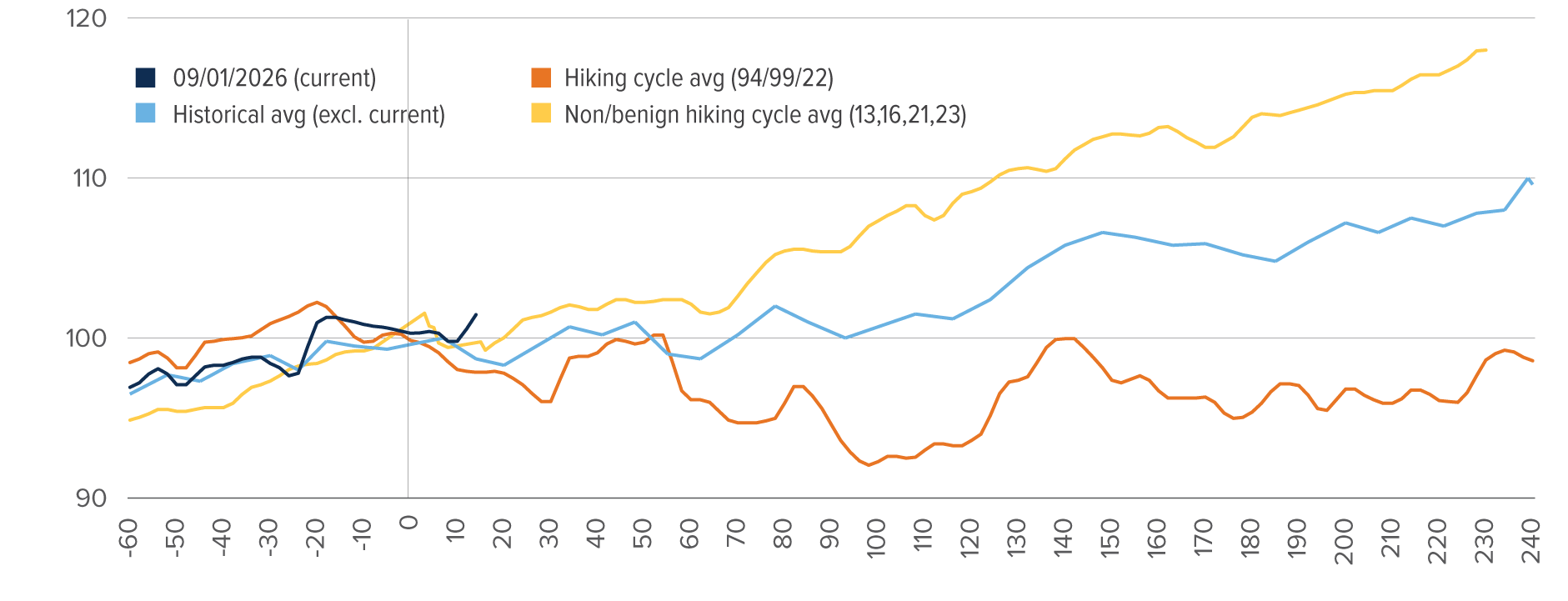
Figure 4 - S&P 500 around 10-year yield spikes
Source: Bloomberg, UBS
As Figure 4 illustrates, equities have historically responded differently to rising Treasury yields. Markets have generally struggled during aggressive tightening cycles aimed at slowing economic activity but have demonstrated greater resilience when rates rise gradually alongside sustained economic growth.
Ultimately, investors should focus less on the absolute level of bond yields and more on the conditions driving them higher. A 5.0% Treasury yield is not necessarily negative for equities; much depends on how we get there.
The temptation to chase higher yields
There is compelling evidence that retail investors respond to higher interest rates by shifting capital toward fixed income investments.
The Canadian experience during the 2022–2023 monetary tightening cycle illustrates how higher interest rates can influence investor behaviour. As the Bank of Canada raised rates, Canadian term deposit holdings surged from approximately $400 billion to $750 billion, reflecting growing demand for predictable fixed-income returns (Figure 5).
Figure 5 – Significant excess short-dated term deposits
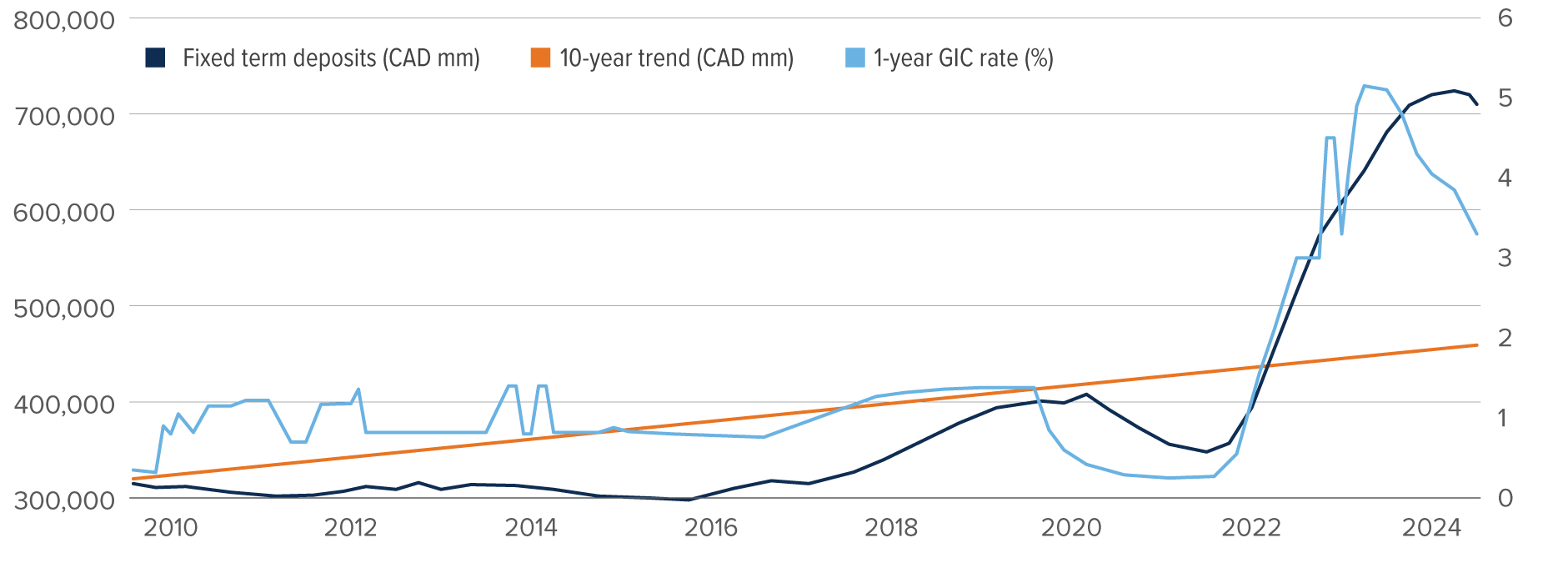
Source: Bank of Canada, CIBC World Markets and Mackenzie Investments.
Last point is December 2024.
While locking in an attractive yield may offer short-term certainty, it also introduces reinvestment risk.
Consider an investor purchasing a five-year GIC yielding 5.0%. Although the return is guaranteed for the term, comparable yields may not be available at maturity. If rates fall to 2.5%, the investor must reinvest at a substantially lower rate, potentially having missed opportunities for equity appreciation and capital gains on bonds.
There is another consideration. A GIC offers certainty regarding its contractual nominal return, but not necessarily the purchasing power of that return. Inflation and taxation can materially reduce the income ultimately available to investors.
This does not suggest that GICs are inappropriate investments. The concern arises when investors abandon a carefully constructed long-term investment strategy simply because prevailing interest rates have become temporarily attractive.
The alternative — an income-focused balanced portfolio
Rather than shifting between equities and fixed income in response to changing interest rates, investors may benefit from a diversified, income-focused balanced portfolio that combines income generation with long-term capital appreciation.
By incorporating high-quality bonds, dividend-paying equities and other income-generating investments, a balanced portfolio can provide multiple sources of return across varying market conditions.
Consider an environment in which inflation moderates and interest rates begin declining. Bond prices may appreciate, providing capital gains in addition to coupon income. At the same time, lower financing costs and improving economic conditions may support corporate profitability and equity valuations.
Conversely, if economic growth remains resilient and interest rates stay elevated, dividend-paying equities and carefully selected fixed income securities can continue contributing to portfolio returns.
While diversification does not eliminate risk or guarantee superior performance, it reduces reliance on any single interest rate outcome. Active management can further support this approach through disciplined security selection, duration management, credit analysis and tactical asset allocation.
Ultimately, the objective is not to maximize yield at a particular moment, but to pursue attractive risk-adjusted total returns over a full market cycle, consistent with investors' financial goals
Conclusion — don't confuse yield with return
As bond yields approach 5.0%, the transition from TINA to TARA may encourage investors to reconsider their equity exposure. While the appeal of predictable income is understandable, chasing higher yields can introduce reinvestment risk and the opportunity cost of forgone capital appreciation.
Rather than reacting to prevailing interest rates, investors may be better served by maintaining a diversified investment approach that balances income generation with long-term growth potential. Ultimately, the focus should remain on achieving attractive risk-adjusted total returns over a full market cycle, rather than maximizing yield at any given moment.
Multi-Asset Strategies Team’s investment views
Tactical summary
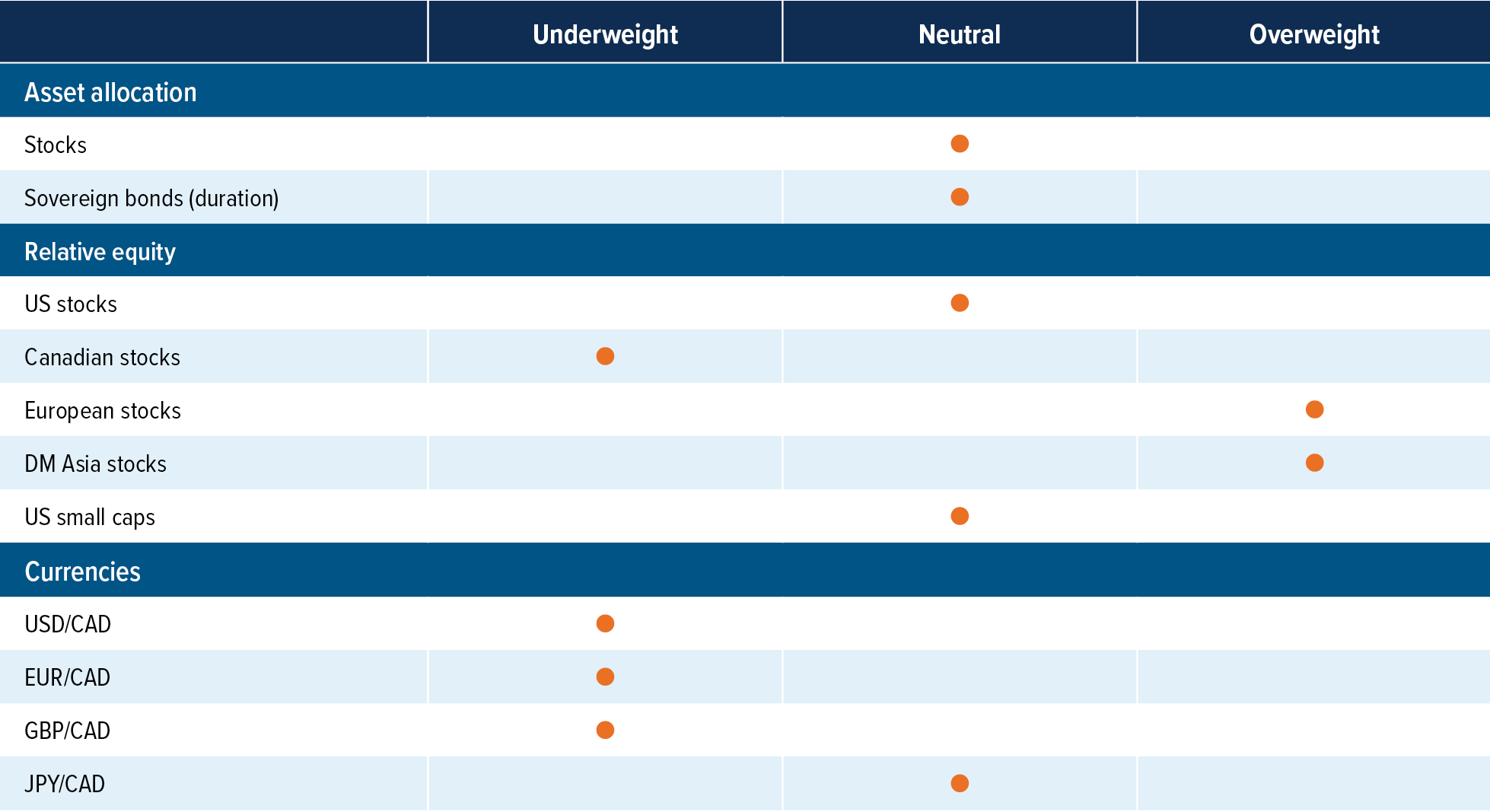
Source: Mackenzie Investments.
Note: The opinions expressed in this piece reflect short-term tactical views, which inform the positioning of some of the funds managed by the Multi-Asset Strategies Team.
Positioning highlights
Near-term uncertainties for equities offset strong earnings: Iran war, upcoming earnings season and US midterms all present uncertainties that offset good earnings this year. We trim our overweight stance to neutral while waiting for these events to unfold.
Cautious bonds: Inflation remains above the Fed’s target, so we move to neutral until inflation moderates, and sentiment or the fiscal situation improves in the US.
Europe starting to look attractive after underperforming: Uncertainty surrounding US –Canada trade relations and elevated financial sector valuations support our underweight position in Canadian equities. Meanwhile, Japan remains attractive from a valuation perspective, supported by increased investment in AI hardware. We also see opportunities in Europe, where attractive valuations and recent underperformance suggest investor pessimism may be overdone. Conversely, we have closed our overweight position in US small caps, as their growing sensitivity to the AI hardware trade introduces risks that may offset their attractive valuations relative to large caps.
Currencies: The Canadian dollar's recent sell-off has created attractive valuations relative to the US dollar, further supported by elevated oil prices. We have also shifted JPY to neutral vs. CAD, driven by an improved outlook for the Canadian dollar rather than diminished attractiveness of the yen.
Commissions, trailing commissions, management fees and expenses all may be associated with mutual fund investments. Please read the prospectus before investing. Mutual funds are not guaranteed, their values change frequently, and past performance may not be repeated. The content of this material (including facts, views, opinions, recommendations, descriptions of or references to, products or securities) is not to be used or construed as investment advice, as an offer to sell or the solicitation of an offer to buy, or an endorsement, recommendation or sponsorship of any entity or security cited. Although we endeavour to ensure its accuracy and completeness, we assume no responsibility for any reliance upon it. This material contains forward-looking information which reflects our or third party current expectations or forecasts of future events. Forward-looking information is inherently subject to, among other things, risks, uncertainties and assumptions that could cause actual results to differ materially from those expressed herein. These risks, uncertainties and assumptions include, without limitation, general economic, political and market factors, interest and foreign exchange rates, the volatility of equity and capital markets, business competition, technological change, changes in government regulations, changes in tax laws, unexpected judicial or regulatory proceedings and catastrophic events. Please consider these and other factors carefully and not place undue reliance on forward-looking information. The forward-looking information contained herein is current only as of October 31, 2026. There should be no expectation that such information will in all circumstances be updated, supplemented or revised whether as a result of new information, changing circumstances, future events or otherwise. Index performance does not include the impact of fees, commissions, and expenses that would be payable by investors in the investment products that seek to track an index.