.svg)
.svg)
Canada: open for business

About the author
IN THIS ARTICLE
Select Section
Key points
- Canada is shifting toward a more investment-driven growth model.
- Policy changes could materially improve incentives for business investment.
- A stronger investment cycle could broaden Canada’s equity opportunity set.
For years, the story surrounding the Canadian economy has been a familiar one. Productivity growth has been weak. Business investment has fallen behind that of the US. Gains in per-capita economic output have looked considerably less impressive. More recently, trade tensions with the United States have added another source of uncertainty.
Yet there is an important distinction for investors: the Canadian economy is not the Canadian equity market.
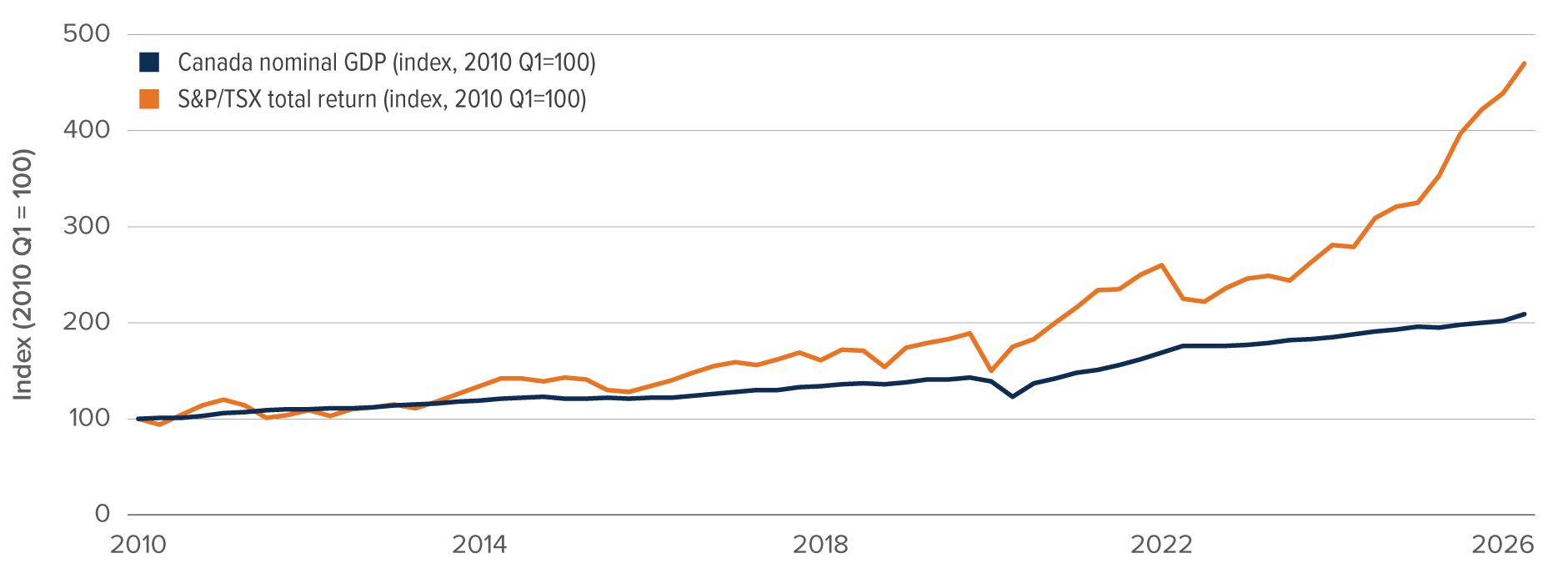
Despite a challenging domestic backdrop, Canadian equities have performed well in recent years. Part of the explanation lies in the composition of the S&P/TSX Composite Index. Financials can benefit from strong global equity and capital markets even when the domestic economy is soft, while energy and materials are heavily influenced by global commodity prices and international demand. As a result, the earnings profile of the Canadian equity market can differ considerably from that of the domestic economy.
Figure 1 - Canadian equities have outpaced the domestic economy
Cumulative growth: Canadian nominal GDP vs. S&P/TX
Source: Bloomberg, Mackenzie Investments, as at Q2 2026.
But what if the Canadian economy itself begins to provide a stronger tailwind?
Recent policy changes, combined with a substantial pipeline of major projects, suggest that Canada may be attempting to shift toward a more investment-driven growth model. It is too early to know how successful that transition will be. But if Canada can translate today's investment announcements into actual capital formation, the implications could extend beyond stronger economic growth to a broader opportunity set for Canadian equity investors.
Canada's investment challenge
Canada's productivity problem is closely connected to investment. One of the most fundamental ways to improve productivity is capital deepening: providing workers with more and better machinery, technology, infrastructure and intellectual property.
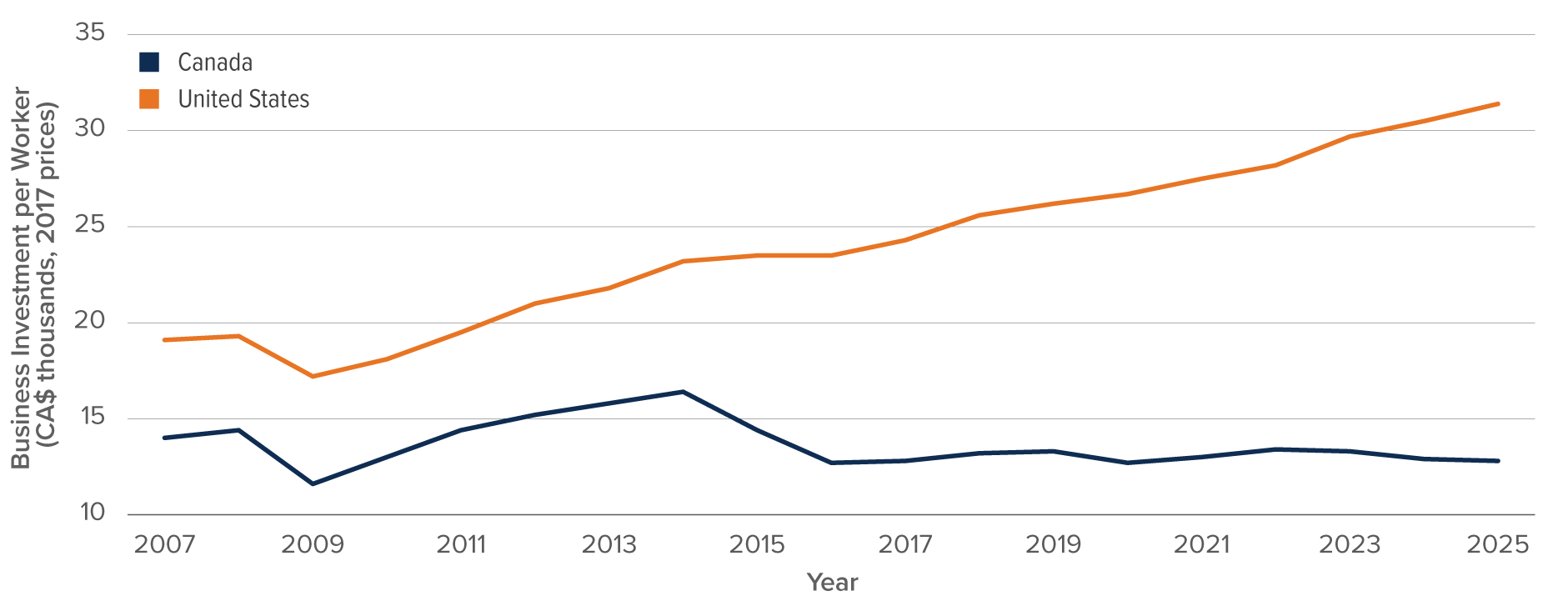
Canada has considerable room for improvement. Business investment per worker has lagged the United States for years, resulting in slower growth in the amount of capital available per worker and weighing on productivity growth.
Figure 2 - A growing business investment gap
Business investment per worker in Canada and the US, 2007-2025 (CA $2017)
Source: US Bureau of Economic Analysis, Statistics Canada, Mackenzie Investments; as at December 2025
Over long periods, productivity growth is an important determinant of real wages and living standards. More productive businesses can expand output, compete more effectively internationally and support higher incomes.
Changing Canada's growth trajectory therefore requires greater investment in its productive capacity. Increasingly, that appears to be where policy is focused.
Changing the economics of investing in Canada
The Canada Investment Summit in September brought together investors from nearly 30 countries representing more than $100 trillion in assets. The summit generated announcements approaching $500 billion in investment and financing commitments across infrastructure, energy, critical minerals, technology and artificial intelligence (AI).
Perhaps more important than the headline numbers are changes designed to improve the economics of making new investments in Canada.
Among the most significant is the new Productivity Mega Deduction, which substantially expands the range of capital expenditures businesses can deduct immediately. Qualifying assets include machinery and manufacturing equipment, software, research and development, fibre-optic infrastructure, mining property, pipelines, rail and other productive assets. The share of capital assets eligible for immediate expensing rises from roughly 15% to almost two-thirds.
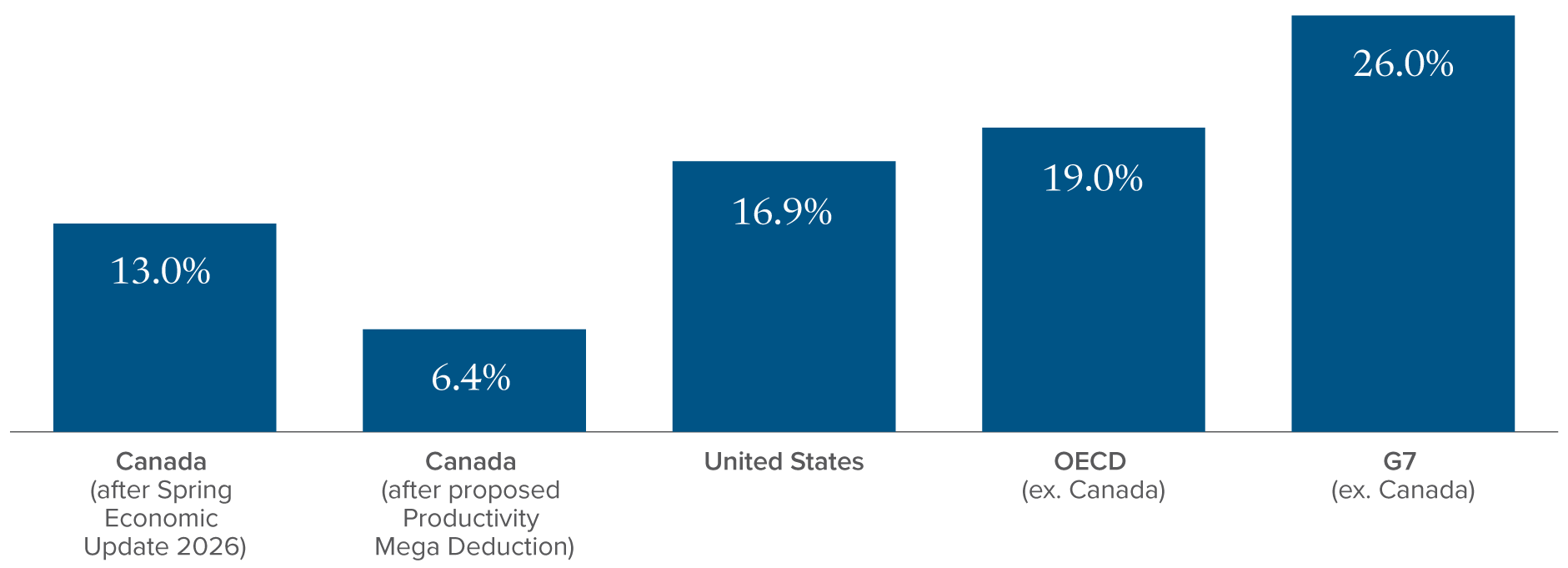
The result is a significant reduction in the estimated marginal effective tax rate (METR) on new business investment. Unlike the headline corporate tax rate, the METR estimates the overall tax burden on a new incremental investment. Canada's estimated METR falls from approximately 13% to 6.4%, compared with 16.9% in the United States, 19.0% across the OECD (ex-Canada) and 26.0% across the G7 (ex-Canada).
Figure 3 - Canada’s tax advantage for new business investment
Estimated marginal effective rate (METR) on new business investment
Source: Government of Canada
Taxes are only one consideration when companies decide where to deploy capital. Expected demand, energy costs, access to labour, trade relationships, financing and regulatory certainty also matter.
The new Major Projects Office is intended to reduce the time required to move strategically important projects through federal approvals, with an objective of one project, one review and, where applicable, substantially faster decision-making. For investors committing capital to projects with lives measured in decades, greater predictability has economic value.
From announcements to investment
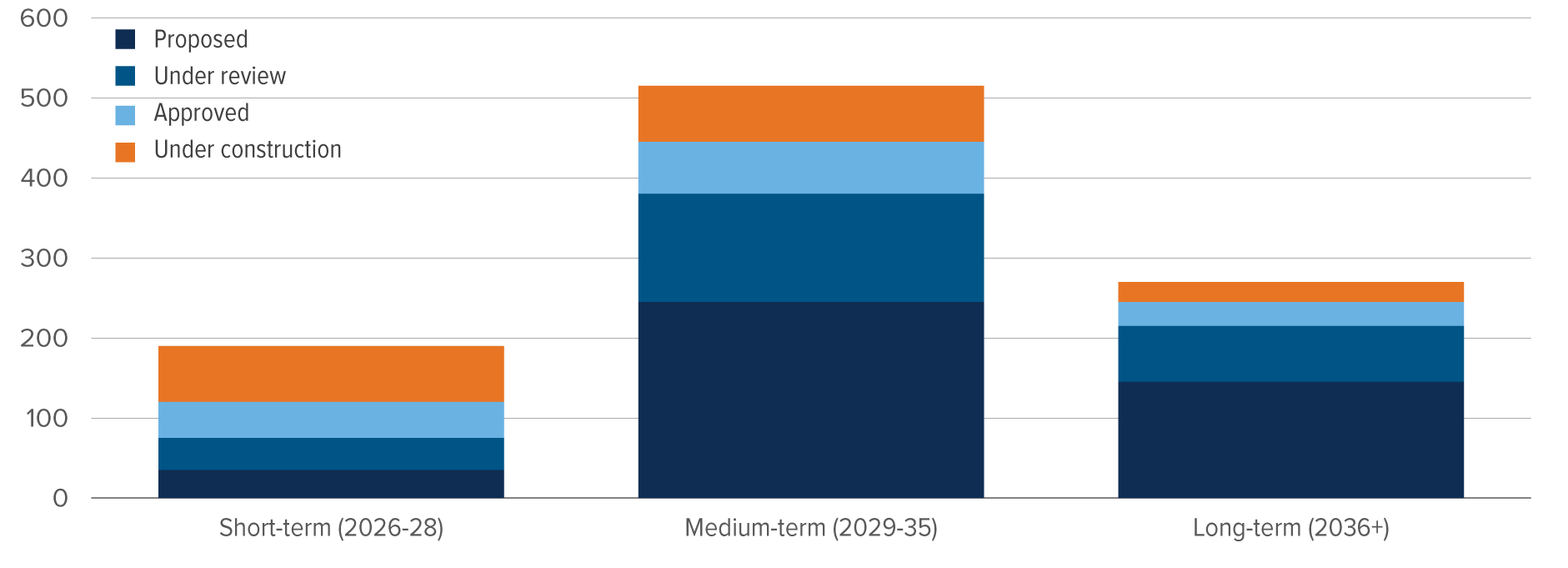
A bottom-up assessment of Canada's major-project inventory, combining data from Natural Resources Canada, ReNew Canada and the Major Projects Office while adjusting for overlap, estimates a national project pipeline of approximately $1.15 trillion across energy, mining and infrastructure. Additional defence-related projects could add another $25 billion to $62 billion. The potential investment is spread over several years, with the largest concentration of project spending expected between 2029 and 2035 (Figure 4).
Figure 4 - Canada’s major-project pipeline points to a potential investment upswing Canada potential project spending, billions od $CAD
Source: Mackenzie Investments. TD economics, project announcements and proposals.
The external environment may also be increasingly supportive.
Rapidly expanding demand for liquified natural gas (LNG), power generation, AI data centres and critical minerals create significant opportunities for Canada.[1] The country's abundant energy and mineral resources, established mining industry, electricity supply, skilled workforce and access to global markets position it well to attract investment. The opportunity is not simply to spend more, but to direct capital toward sectors where Canada can build globally competitive productive capacity.
A changing relationship with the United States
The urgency behind this shift has also been reinforced by changes in Canada's relationship with its largest trading partner.
Deep integration with the United States remains a major economic advantage, but recent tariff disputes have highlighted the risks associated with relying heavily on a single market.
Former Prime Minister Stephen Harper raised this theme in his closing remarks at the Canada Investment Summit, arguing that Canada needs to reduce its economic reliance on the United States to protect its sovereignty and become more competitive at home and connected to global markets. Prime Minister Mark Carney has similarly emphasized building greater domestic capacity while expanding Canada's relationships with other global markets.
The objective need not be disengagement from the US but rather preserving the benefits of North American integration while developing additional markets, infrastructure and sources of investment. Recent trade tensions may therefore be acting as a catalyst for changes Canada has debated for years: expanding export infrastructure, reducing barriers to investment, accelerating major projects and diversifying international trade.
From marketing Canada to building Canada
Attracting investment also depends on something harder to quantify: perception.
One message from the Canada Investment Summit was that Canada needs to market itself more actively as a destination for global capital.
But the real test will be whether foreign companies increasingly include Canada in their investment decisions, Canadian businesses deploy more capital at home and projects move from announcements into financing and construction.
Ultimately, the benefits must extend beyond investors and corporations. A successful investment cycle should increase productive capacity, create employment, improve infrastructure and raise productivity, translating over time into stronger real incomes and higher living standards.
There are also significant execution risks. Major-project construction could strain Canada's supply of skilled labour, engineering capacity and supply chains as investment accelerates toward the end of the decade. Rising costs and labour shortages could delay projects and reduce expected returns.
The opportunity is large, but execution will determine the outcome.
What could this mean for Canadian equities?
For investors, the most interesting part of this story may emerge over a longer horizon.
The Canadian equity market has performed well even without a strong domestic economy. Its substantial exposures to financials, energy and materials mean that global commodity and capital markets, interest rates and international economic activity can be at least as important as Canadian GDP growth. A stronger domestic investment cycle could add another source of earnings growth.
Some of the immediate beneficiaries are easy to identify conceptually. Major investments in energy infrastructure, electricity transmission, mining, AI data centres, transportation and defence require financing, construction, engineering, equipment and technology. Canada's existing banks, energy producers, miners and infrastructure companies participate in many of these activities.
But the longer-term effect could be broader.
Large projects create ecosystems around them. Engineering companies, equipment suppliers, technology businesses, power-management firms, transportation providers, specialized manufacturers and smaller resource companies can all participate in the capital-spending cycle.
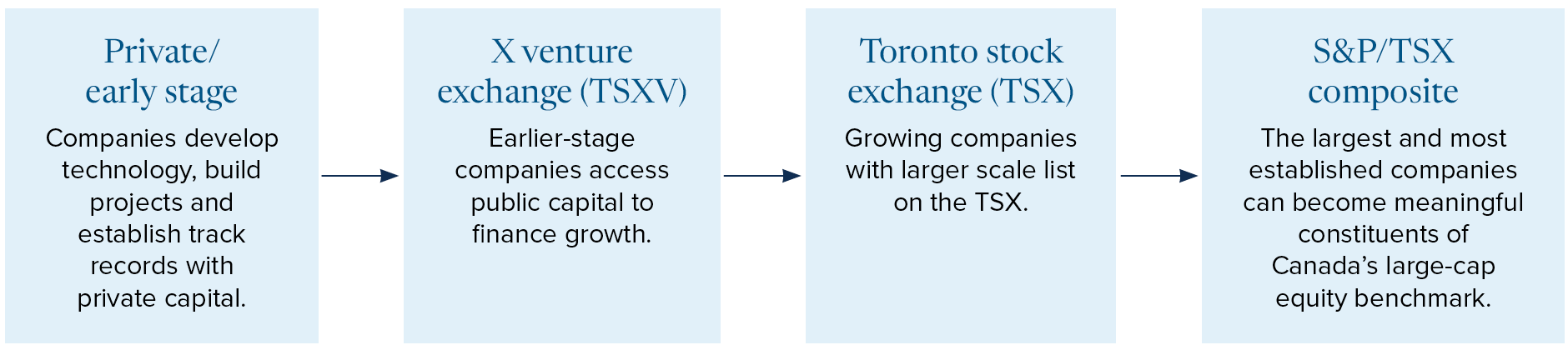
Many of these businesses are not represented meaningfully in Canada's large-cap equity benchmark today. Some are private companies; others are smaller public companies well outside the largest constituents of the S&P/TSX Composite.
If Canada's investment cycle proves durable, some of those businesses could scale. Over time, successful companies can move from private ownership into public markets, or from Canada's small-cap universe into the mid- and eventually large-cap market.
The result could be a Canadian equity market with a broader corporate opportunity set than exists today.
Figure 5 - How growing companies can expand
Canada’s equity market
A pathway from private
companies to Canada’s large-cap equity markets
Source: Mackenzie Investments. For illustrative purposes only.
None of this is guaranteed. Tax incentives do not automatically produce investment, project announcements do not guarantee construction, and capital spending does not immediately translate into higher productivity. Canada will need to demonstrate that it can execute.
But the starting conditions are changing.
Canada has spent much of the past decade discussing its productivity and investment challenges. The more important question now is whether the country can convert an increasingly competitive tax environment, a substantial project pipeline, abundant natural resources and renewed global investor interest into productive capital.
The Canadian equity market has performed well even while the domestic economy has faced significant challenges. If today's investment push succeeds, the next chapter could look different: a stronger domestic economy could become an additional tailwind for Canadian companies, while a new generation of businesses grows alongside Canada's expanding productive capacity.
Canada has made the case that it is open for business. The next phase is to build.
Multi-Asset Strategies Team’s investment views
Tactical summary
Source: Mackenzie Investments.
Note: The opinions expressed in this piece reflect short-term tactical views, which inform the positioning of some of the funds managed by the Multi-Asset Strategies Team.
Positioning highlights
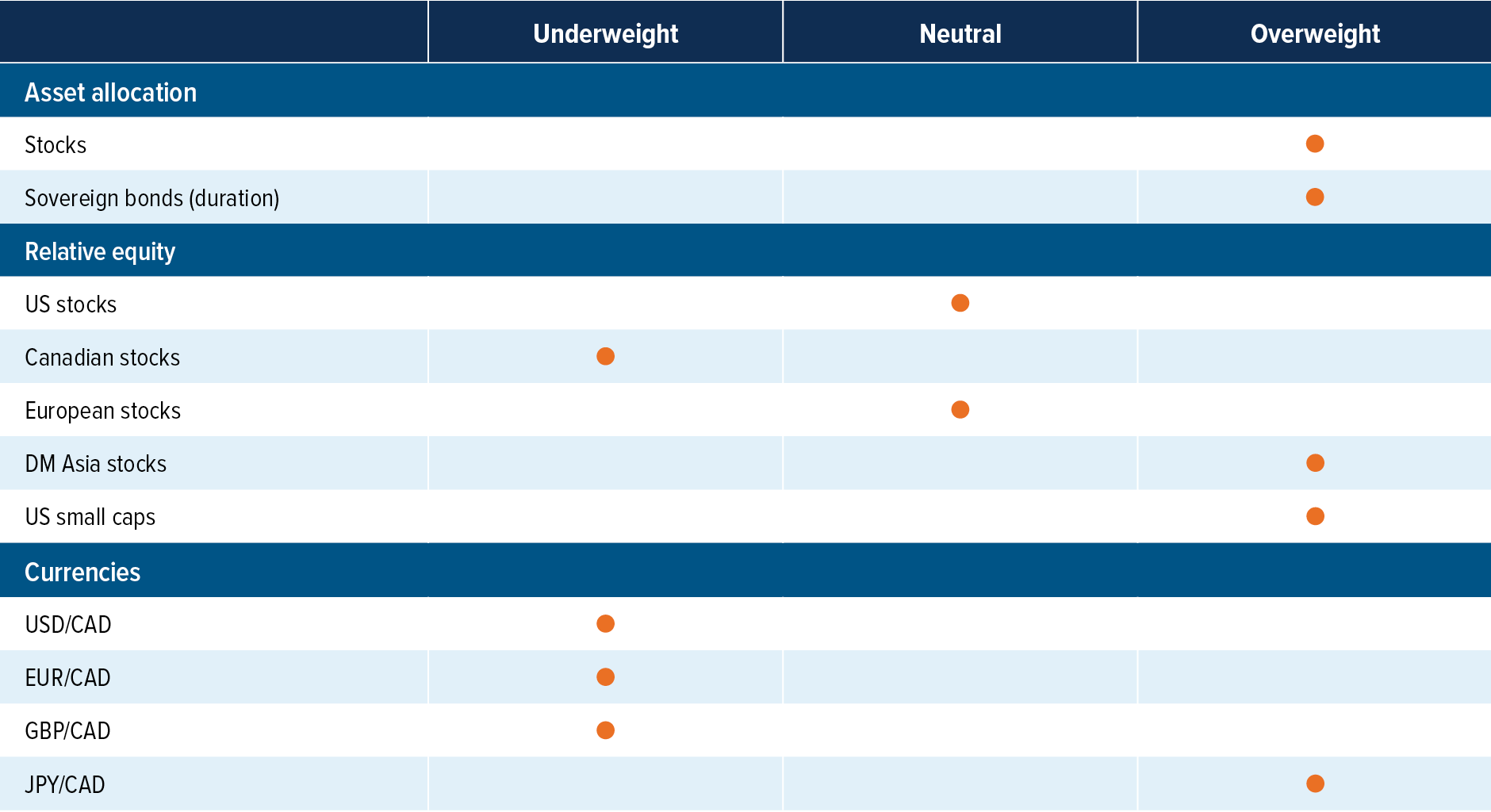
Equities are the best of major asset classes: High oil and yields have not been a big enough drag to earnings yet, so until we see that in hard data, equities remain attractive.
Yields high enough to buy duration: Yields have increased across the globe due to higher real yields rather than long-term inflation expectations. As investors are being offered more yield for holding bonds we think they are finally attractive enough to own.
Slightly overweight in US small cap and overweight Europe vs. Canada: Uncertainty around the US trade war with Canada combined with high valuations for financials supports our view in a tactical underweight to Canadian stocks while Japan looks attractive from a value perspective as it benefits from higher AI hardware spend which we see no signs of slowing down. US small caps remain overweight as a robust US economy is supportive of small caps, but we trimmed our overweight compared to June’s peak given the strong outperformance in small cap which has reduced their attractiveness from a valuation perspective.
Currencies: With the recent sell-off in CAD, it looks attractive from a valuation perspective vs. USD and should also be supported by elevated oil prices. We continue to like JPY as it remains the most undervalued G7 currency.
Commissions, trailing commissions, management fees and expenses all may be associated with mutual fund investments. Please read the prospectus before investing. Mutual funds are not guaranteed, their values change frequently, and past performance may not be repeated. The content of this material (including facts, views, opinions, recommendations, descriptions of or references to, products or securities) is not to be used or construed as investment advice, as an offer to sell or the solicitation of an offer to buy, or an endorsement, recommendation or sponsorship of any entity or security cited. Although we endeavour to ensure its accuracy and completeness, we assume no responsibility for any reliance upon it. This material contains forward-looking information which reflects our or third party current expectations or forecasts of future events. Forward-looking information is inherently subject to, among other things, risks, uncertainties and assumptions that could cause actual results to differ materially from those expressed herein. These risks, uncertainties and assumptions include, without limitation, general economic, political and market factors, interest and foreign exchange rates, the volatility of equity and capital markets, business competition, technological change, changes in government regulations, changes in tax laws, unexpected judicial or regulatory proceedings and catastrophic events. Please consider these and other factors carefully and not place undue reliance on forward-looking information. The forward-looking information contained herein is current only as of September 30, 2026. There should be no expectation that such information will in all circumstances be updated, supplemented or revised whether as a result of new information, changing circumstances, future events or otherwise. Index performance does not include the impact of fees, commissions, and expenses that would be payable by investors in the investment products that seek to track an index.