.svg)
.svg)
The space economy

About the author
IN THIS ARTICLE
Select Section
Key points
- Reusable launch technology is rapidly lowering costs and transforming space into an accessible economic frontier.
- Expanding satellite networks may well revolutionize global connectivity while enabling powerful new space-based computing infrastructure.
- Space-based manufacturing could unlock entirely new industries, products and investment opportunities previously considered impossible and/or economically unfeasible.
Introduction
It is incredibly exciting to be at a point in time when humanity stands on the cusp of advancements that could lead our species toward outcomes once confined to science fiction.
If that sounds like aggrandizement or unwarranted hyperbole, consider the developments explored in this month’s economic commentary. Rapid advances in space transportation, satellite connectivity and computing infrastructure are beginning to transform space from an opportunity for exploration into a new economic frontier. What was once almost exclusively the domain of governments is increasingly becoming accessible to private enterprise, capital and innovation.
This month’s economic commentary is by no means intended to represent a bullish investment case for SpaceX. The reality, however, is that the company has emerged as the clear leader in space commercialization, with capabilities in launch, satellite communications and reusable rocket technology that are currently unmatched at scale.
More importantly, its progress provides a useful lens through which to consider how rapidly declining launch costs and improving technology could transform space from a largely government-funded endeavour into a meaningful commercial economy.
Whether or not SpaceX ultimately captures the economic value implied by these developments, the broader implications for communications, computing, manufacturing and human activity in space are becoming increasingly difficult for investors to ignore.
Figure 1 - Launch cadence gap (2026): actual output is the competitive test
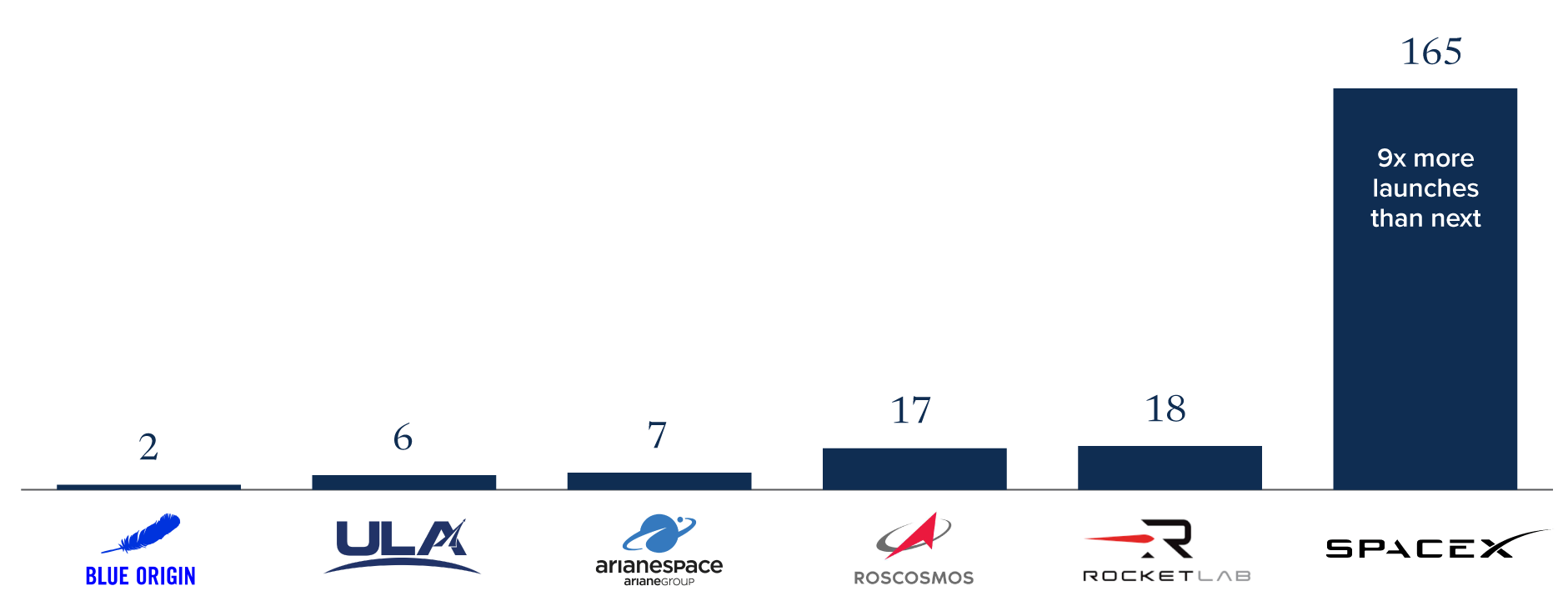
Source: SpaceX, Raymond James.
At the foundation of this fledgling industry is a revolution in transportation. Reusable launch vehicles are dramatically reducing the cost of reaching orbit, while larger payload capacities and increasingly frequent launches promise to make access to space more routine. As launch costs fall and reliability improves, the economics change profoundly: activities that were previously impractical or prohibitively expensive can become commercially viable.
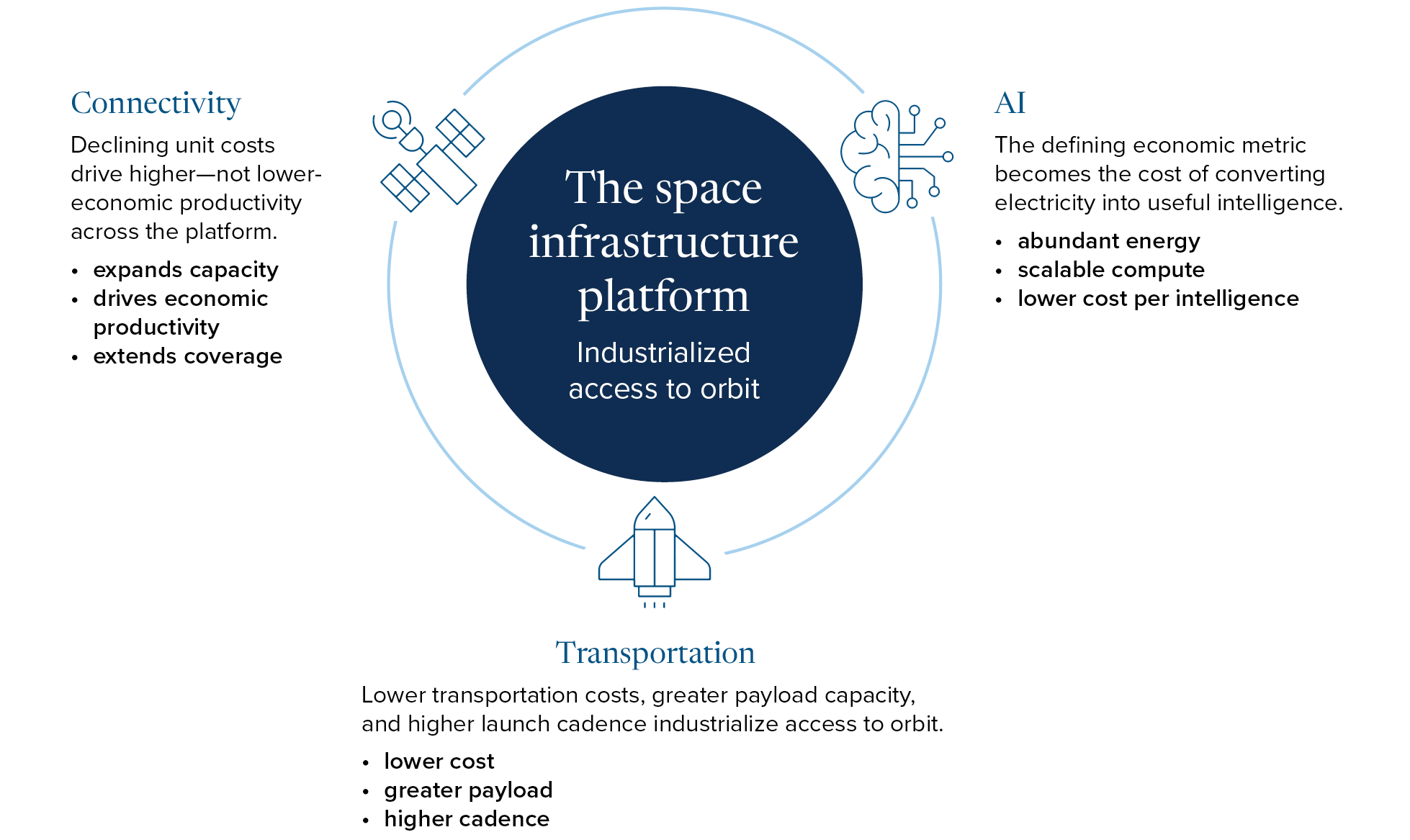
Figure 2 illustrates the interaction between space transportation, communications and applications.
Figure 2 – The three economic engines of the SpaceX platform
Source: Raymond James financial.
Extra-terrestrial transportation
SpaceX has emerged as the pre-eminent launch provider and space enabler, flying over 650 launches to date with a 98%+ mission success and delivering 80%+ global mass to orbit in recent years. The combination of proven reusable hardware, vertical integration and high launch cadence has enabled material reductions in launch-to-orbit cost while rapidly scaling activity in space and delivering reliability of orbital access.
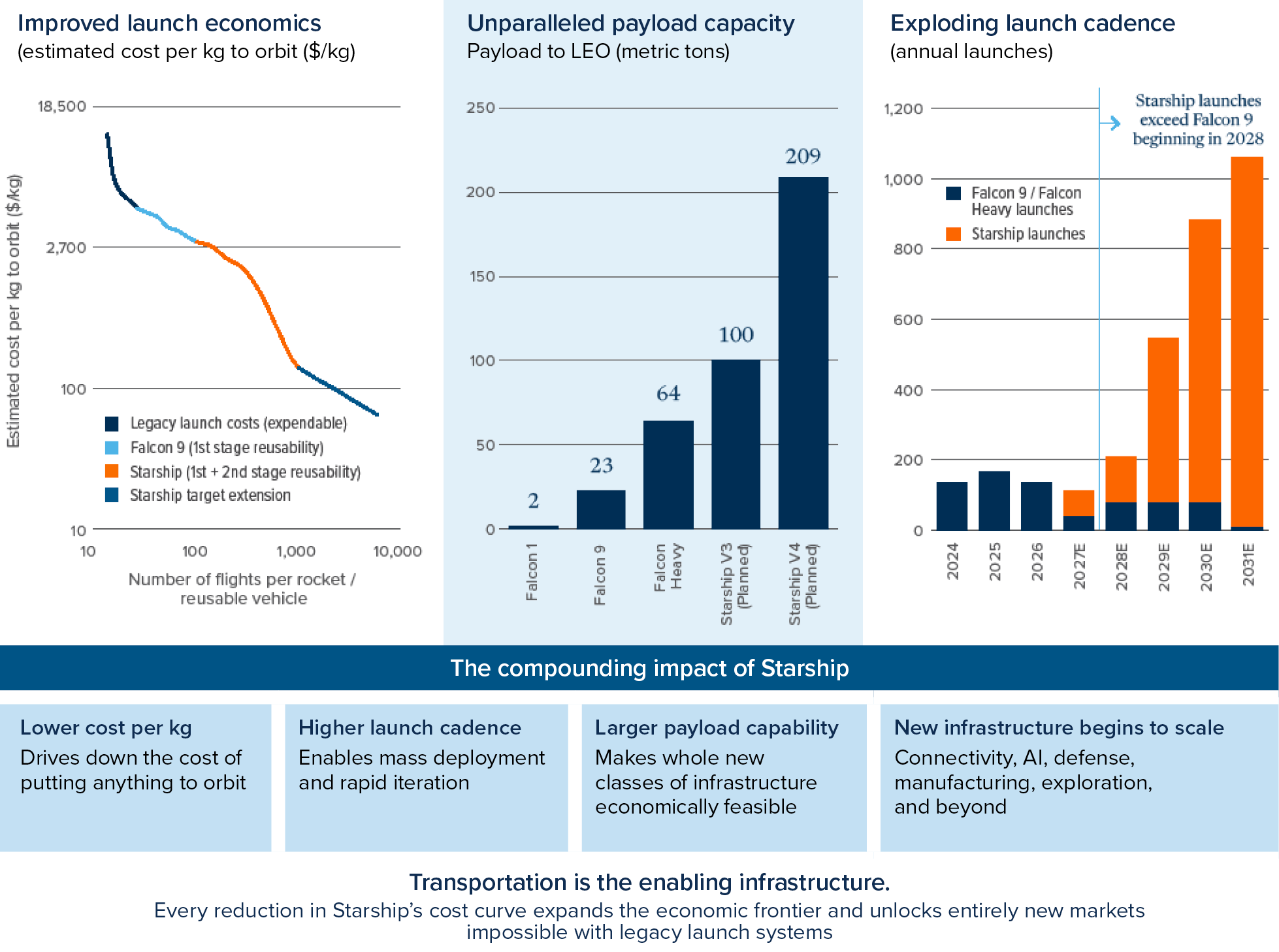
Next generation (Starship) rocket technology would represent a further paradigm shift in space access if it were successfully commercialized at scale. Full reusability of both booster and upper stage could deliver a dramatic decrease in per-kg launch costs while enabling increased flight cadence. These dynamics are shown in the chart below (see Figure 3 below).
Figure 3: Transportation economics
Source: Raymond James research.
Take, for instance, the capacity of the proposed “Starbase Louisiana”, a massive new Starship launch complex. The roughly 125,000-acre site is expected to become SpaceX’s largest spaceport, with five launch complexes and 10 launch pads, supported by propellant production and storage, power generation, vehicle-processing facilities and employee housing. At full buildout, SpaceX expects that the facility could support thousands of launches per year, potentially more than 30 per day, representing a dramatic increase in the scale and cadence of commercial spaceflight.
In terms of direct economic impact, the project is striking. SpaceX has outlined an investment of up to $100 billion, with construction beginning in 2027 and the first launch targeted as early as 2029. The company expects to create at least 3,000 direct jobs over the next decade, while Louisiana estimates another 8,100 indirect jobs, potentially generating more than 11,000 jobs across the region.
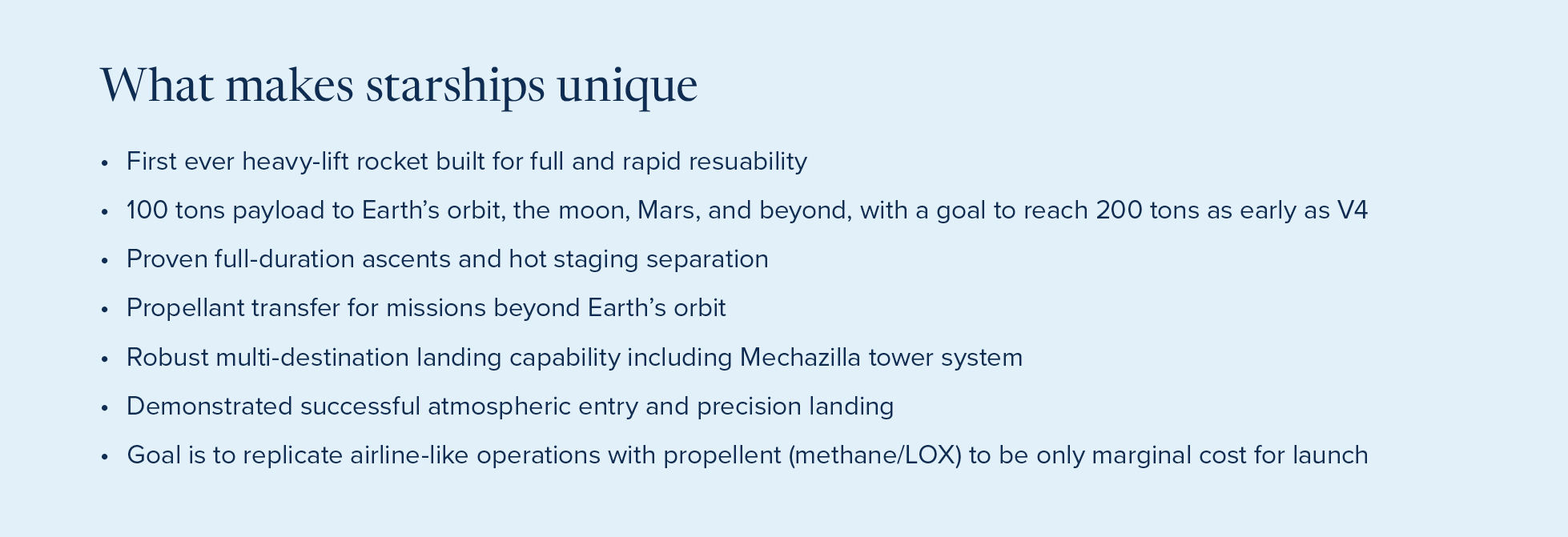
Reusability is key in bringing costs down. The last point on the following list speaks to the transition of space transportation to an airline-like regularly scheduled launch cadence (see Figure 4 below).
Figure 4 – A new logistics system
Communications connectivity
The combination of dramatically lower launch costs, the ability to deploy roughly four times more satellite mass per launch, next-generation V3 satellites capable of delivering nearly 10 times the download capacity of today’s V2 Mini constellation, and significantly lower-cost user terminals could transform Starlink from a niche broadband provider into a truly global communications platform. Its addressable market would extend well beyond residential broadband to include enterprises, governments, aviation, maritime transportation, mobile connectivity and direct-to-device services.
Enabled by Starship’s transportation economics and the substantially greater capabilities of V3 satellites, Starlink’s aggregate network capacity could expand from approximately 705 Tbps today to nearly 10 Pbps (petabytes are 1,024 terabytes) by the end of the decade. By some estimates, that would be enough to support roughly 250 million broadband subscribers. This increase in capacity would be accompanied by continued expansion of the satellite constellation, creating a communications network with increasingly broad coverage, greater bandwidth and substantially improved economics per unit of data delivered.
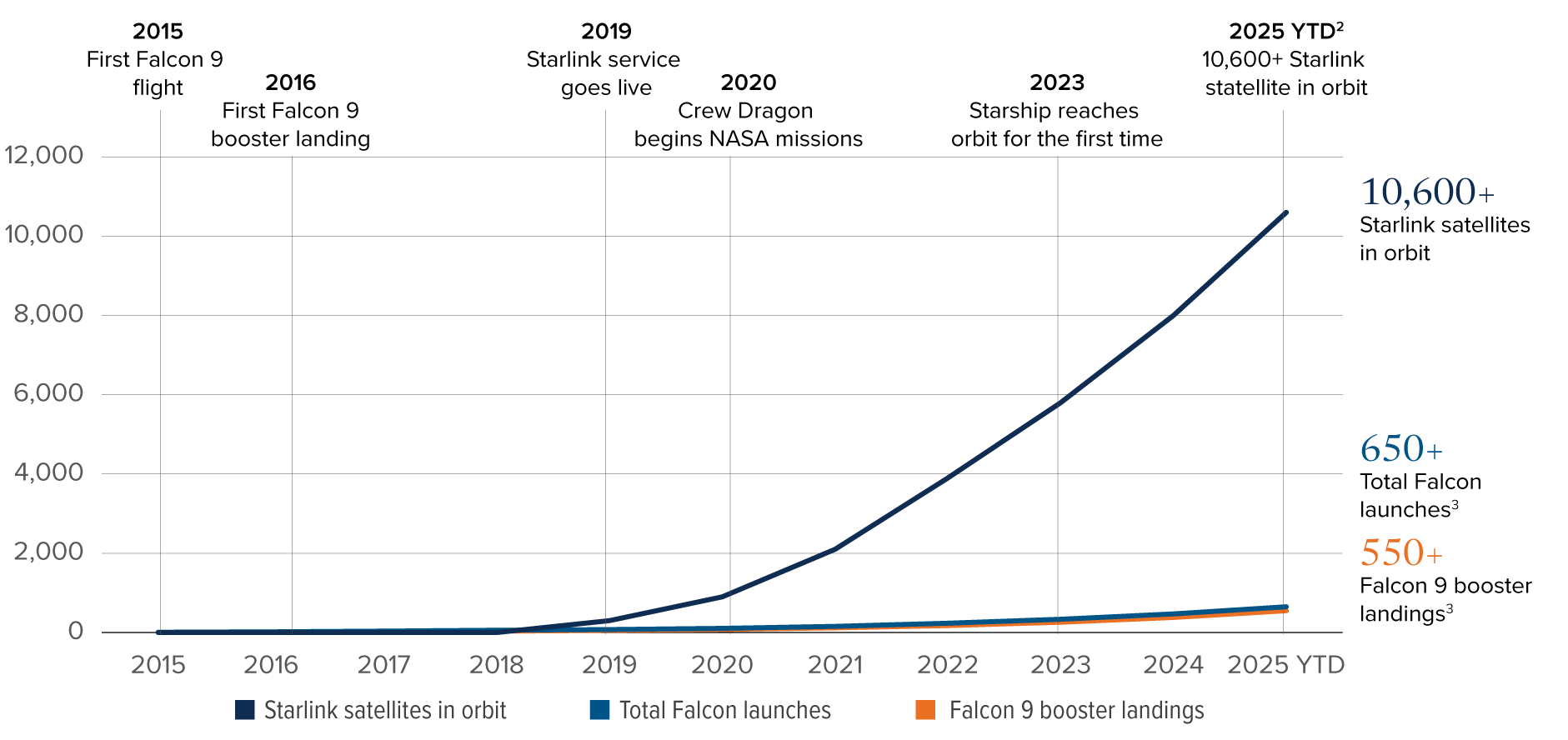
Figure 5 below shows how the advance in rocket capabilities has driven the build-out of the Starlink satellite network.
Figure 5: Starlink buildout and SpaceX milestones
Source: SpaceX, Raymond James research
Ubiquitous, high-speed satellite connectivity could bring broadband to regions where terrestrial infrastructure remains uneconomic, while creating greater competition for traditional telecommunications providers in established markets. It could also provide the communications backbone for autonomous transportation, connected devices, defence applications and global logistics, while eventually supporting a growing ecosystem of orbital computing and AI infrastructure. In this sense, Starlink may represent more than a telecommunications network: it could become a foundational layer of the emerging space economy, much as fibre-optic networks and cloud computing became foundational infrastructure for the digital economy.
The space economy - the applications
As the cost of reaching orbit declines and launch frequency increases, the commercial opportunity in space should broaden well beyond satellites and telecommunications. Space could increasingly become a location in which economic activity itself takes place, supporting computing, research, manufacturing, energy production and eventually resource extraction. Much as cheaper transportation helped open new geographic markets on Earth, lower-cost access to orbit could create entirely new industries while expanding the addressable markets of existing ones.
Importantly, the foundations are already being laid; private companies are developing orbital computing infrastructure, commercial space stations and autonomous vehicles capable of manufacturing products in orbit and returning them to Earth.
One of the most intriguing opportunities is AI data centres in space. Artificial intelligence requires enormous amounts of electricity and increasingly strains terrestrial power grids.
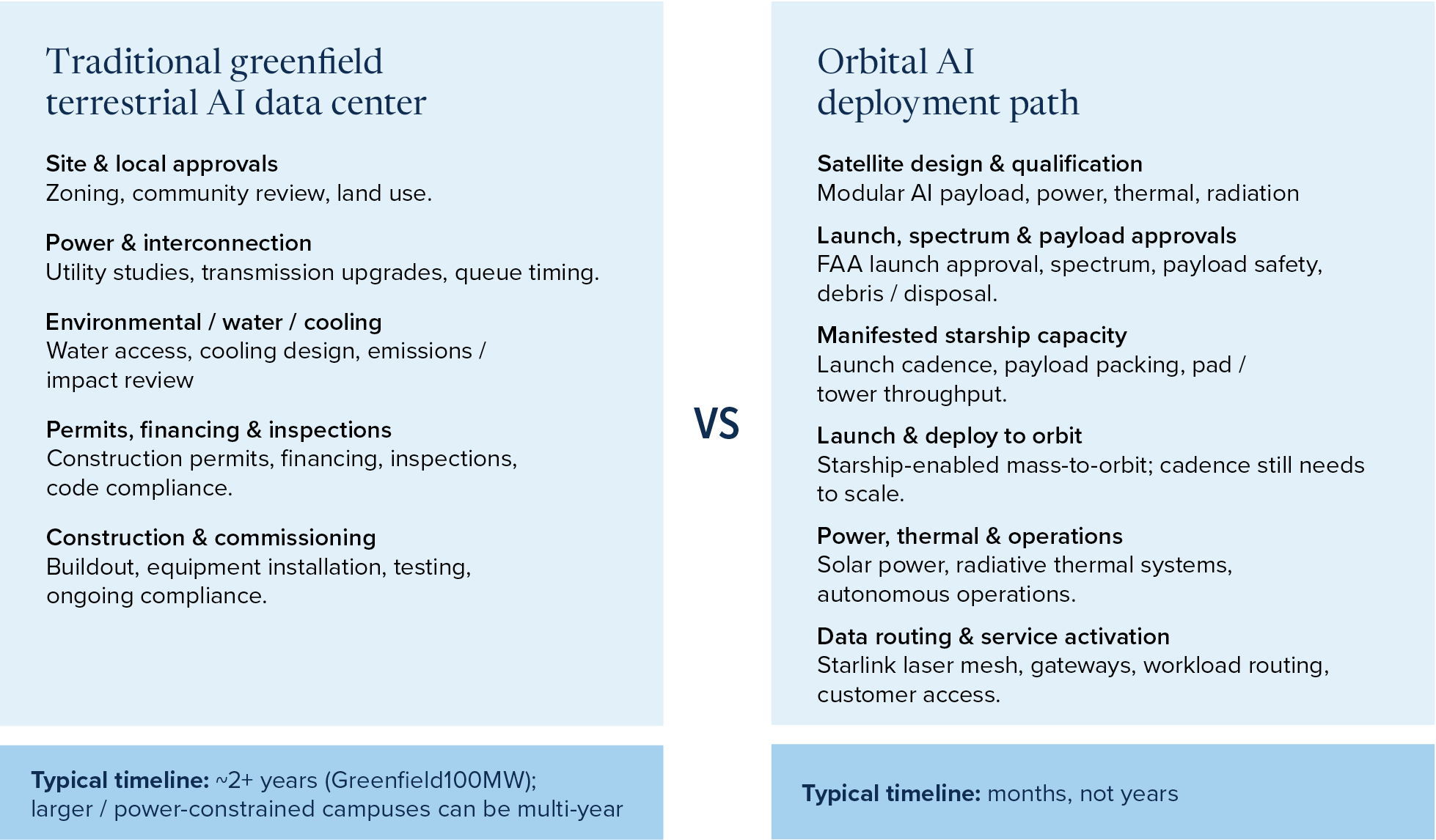
Conventional data centres require substantial land, cooling infrastructure and lengthy permitting processes — no one wants an AI data centre in their back yard.
Orbital data centres offer a radically different model: abundant solar energy, enormous potential scalability and the ability to process information generated by satellites directly in orbit rather than transmitting all raw data back to Earth.
Companies are already developing orbital computing systems capable of running AI models, with Axiom Space having launched dedicated data-centre nodes in early 2026 and Starcloud raising substantial capital to develop larger AI-computing satellites.
Significant technical and economic challenges remain (particularly launch costs, radiation protection and thermal management) but if those hurdles are overcome, space could eventually become an important new location for the enormous computing infrastructure required by AI.
Some of the advantages of orbital AI data centres are presented in the Figure 6.
Figure 6 – Orbital data centers attack the deployment bottleneck
Manufacturing in space could prove equally transformative. Microgravity creates physical conditions unavailable on Earth: materials can form without gravity-driven convection, sedimentation and buoyancy, potentially enabling purer crystals, novel materials and more precise manufacturing processes.
NASA has identified pharmaceuticals, semiconductors, specialized optical fibres, advanced materials and biomanufacturing among the promising applications.
Commercialization is already beginning; Varda Space Industries is developing pharmaceuticals in autonomous orbital factories and returning them to Earth, while it recently entered an agreement aimed at producing semiconductor materials in orbit. As transportation costs continue to fall, the critical question may shift from “what can we send into space?” to “what can we economically do and produce there?” That change in perspective could ultimately define the emergence of a genuine space economy.
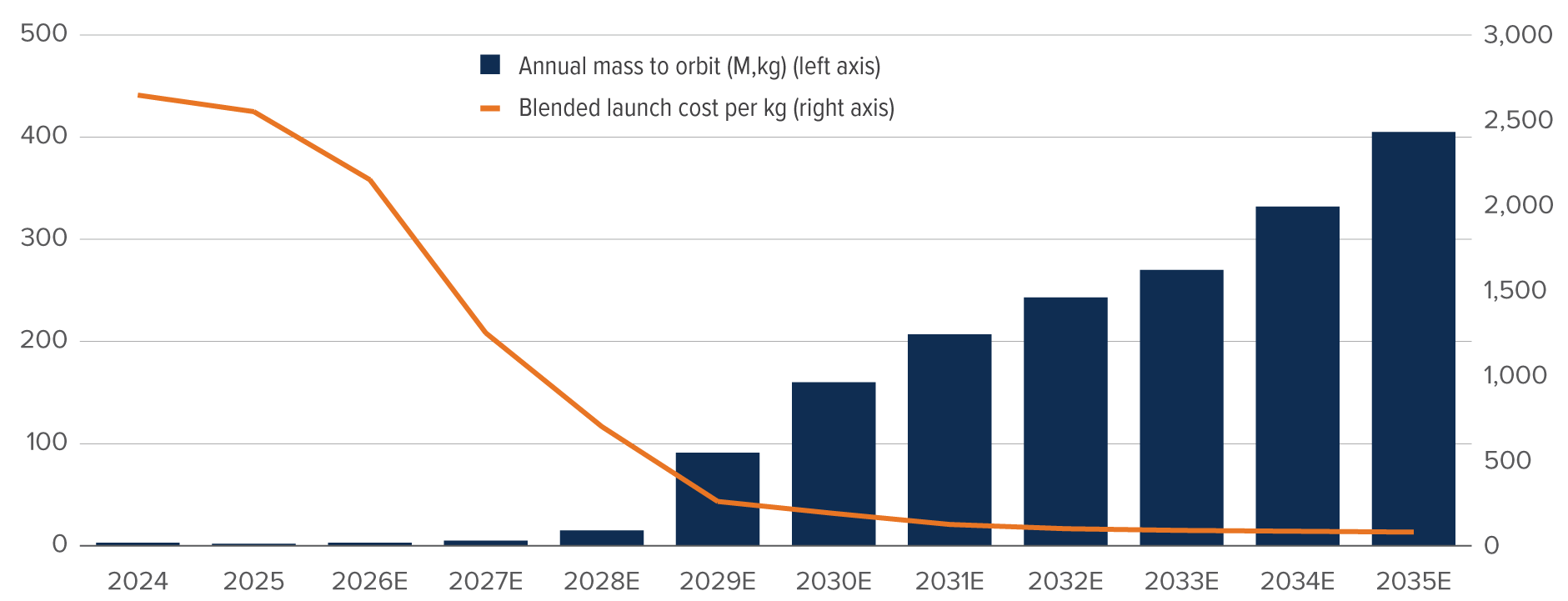
In Figure 7, we show how the falling cost per kg of mass is expected to continue sharply as launch frequency ramps up.
Figure 7 – Annual mass to orbit and cost per kg
Source: SpaceX, Raymond James research.
Conclusion
Reusable rockets are fundamentally changing the economics of space by dramatically reducing launch costs while increasing payload capacity and launch frequency. Next-generation vehicles could make access to orbit increasingly routine, allowing the deployment of far more satellites, infrastructure and equipment. The result could be a transition from spaceflight as an occasional mission to an industrial-scale transportation network.
Rapidly expanding satellite constellations, such as Starlink, are creating a new layer of global communications infrastructure. Greater satellite capacity, cheaper terminals and lower launch costs could extend high-speed connectivity to hundreds of millions of users while supporting governments, enterprises, transportation and direct-to-device communications. Over time, these networks could become foundational infrastructure for an increasingly connected global and space-based economy.
Falling launch costs are opening space to commercial activities that extend far beyond communications, including AI computing and advanced manufacturing. Orbital data centres could harness abundant solar energy to support AI workloads, while microgravity could enable novel pharmaceuticals, semiconductors, optical fibres and advanced materials. As these technologies mature, the question may shift from what we can send into space to what we can economically build, compute and produce there.
Multi-Asset Strategies Team’s investment views
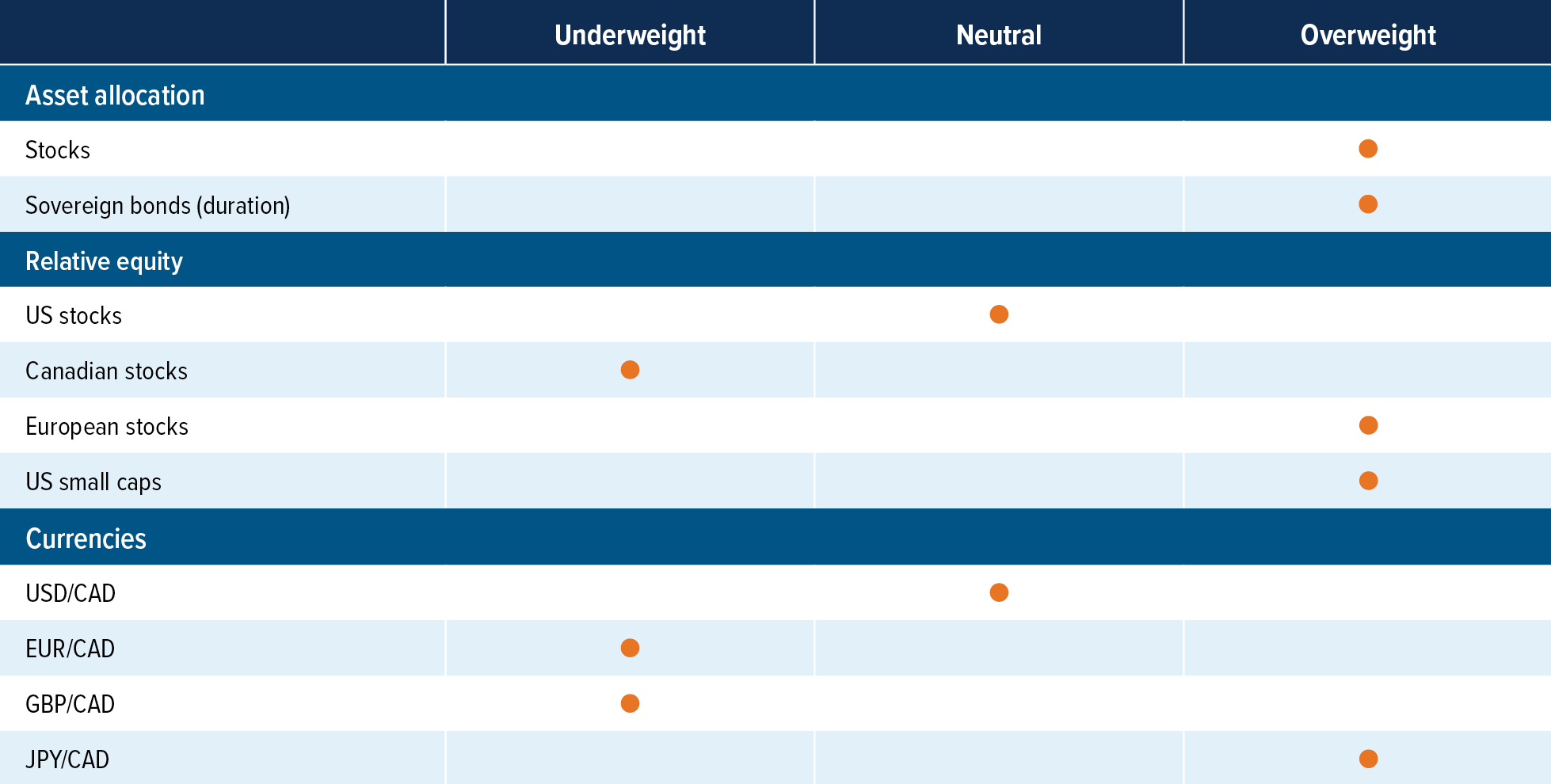
Tactical summary
Source: Mackenzie Investments.
Note: The opinions expressed in this piece reflect short-term tactical views, which inform the positioning of some of the funds managed by the Multi-Asset Strategies Team.
Positioning highlights
Equities look attractive again: As the Q2 earnings season is coming to an end, earnings increased more than stocks did in reaction to those announcements making equities look more attractive. Economic data also remains robust and flows have come back into US equities. This creates a positive environment for equities going forward.
Yields high enough to buy duration: We initiate a long duration view on bonds as bond yields have increased to sensible valuation levels over the past few months. Falling US inflation data is attractive for bonds while the markets have calmed down in the short term over worries about fiscal and monetary policy.
Reduced US small cap overweight and overweight Europe vs. Canada: Uncertainty around the US trade war with Canada combined with high valuations for financials supports our view in underweighting Canadian stocks, while Europe looks attractive from a value perspective. US small caps remain overweight as a robust US economy is supportive of small caps, but we trimmed our overweight compared to June’s peak given the strong outperformance in small cap which has reduced their attractiveness from a valuation perspective.
Currencies: We remain neutral USD/CAD given strong US data and uncertainty around Canada’s economy with the US trade war. However, the USD remains overvalued, and our long-term view is for the USD to depreciate versus most developed countries. We continue to like JPY as the best play for this view.
Commissions, trailing commissions, management fees and expenses all may be associated with mutual fund investments. Please read the prospectus before investing. Mutual funds are not guaranteed, their values change frequently, and past performance may not be repeated. The content of this material (including facts, views, opinions, recommendations, descriptions of or references to, products or securities) is not to be used or construed as investment advice, as an offer to sell or the solicitation of an offer to buy, or an endorsement, recommendation or sponsorship of any entity or security cited. Although we endeavour to ensure its accuracy and completeness, we assume no responsibility for any reliance upon it. This material contains forward-looking information which reflects our or third party current expectations or forecasts of future events. Forward-looking information is inherently subject to, among other things, risks, uncertainties and assumptions that could cause actual results to differ materially from those expressed herein. These risks, uncertainties and assumptions include, without limitation, general economic, political and market factors, interest and foreign exchange rates, the volatility of equity and capital markets, business competition, technological change, changes in government regulations, changes in tax laws, unexpected judicial or regulatory proceedings and catastrophic events. Please consider these and other factors carefully and not place undue reliance on forward-looking information. The forward-looking information contained herein is current only as of August 31, 2026. There should be no expectation that such information will in all circumstances be updated, supplemented or revised whether as a result of new information, changing circumstances, future events or otherwise. Index performance does not include the impact of fees, commissions, and expenses that would be payable by investors in the investment products that seek to track an index.