

Systematic investing: where research meets discipline


Highlights
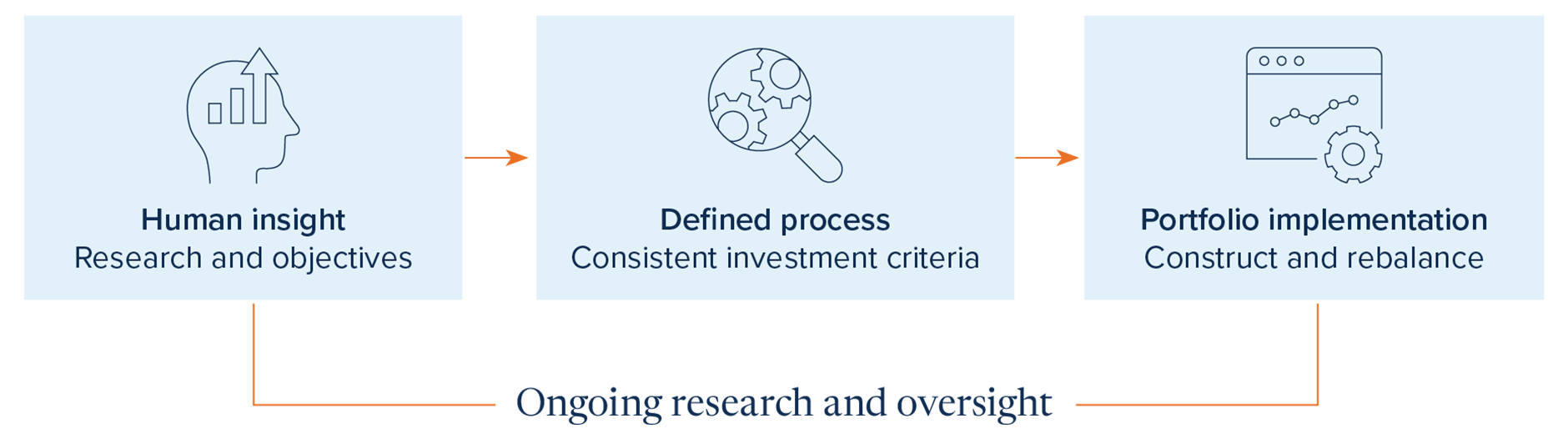
Human insight shapes the framework
Investment opportunities rarely come without trade-offs. An attractive valuation may coincide with weakening fundamentals, while a promising source of income may introduce exposures already present elsewhere in a portfolio. Evaluating these trade-offs consistently across hundreds or thousands of securities becomes increasingly complex. Systematic investing provides a disciplined framework for assessing opportunities, balancing competing considerations and translating research into portfolio decisions at scale.
Investment teams begin by defining a strategy’s objectives and identifying the information most relevant to achieving them. Depending on the approach, this may include company fundamentals, valuations, income characteristics, market behaviour, economic conditions or alternative sources of information.
Research and judgment determine which relationships are meaningful, how different inputs influence decisions and how opportunities should be balanced against risk. These insights become explicit investment criteria that guide portfolio construction and implementation.
The process extends beyond the initial design. Investment teams monitor portfolio characteristics, evaluate the assumptions underpinning their strategies and refine methodologies when supported by new research. Human expertise remains central to the development and ongoing oversight of the investment framework.
Figure 1: From investment research to portfolio implementation
Rules bring consistency to execution
Financial markets are dynamic. New information emerges, sentiment shifts and economic conditions evolve. A defined framework provides a disciplined way to respond to these developments while maintaining alignment with a strategy's investment objectives.
As relevant inputs change, portfolio positioning can adjust according to established criteria. Consistency does not mean standing still: portfolios can evolve as new information becomes available while the underlying decision-making process remains disciplined.
Consider a holding whose investment characteristics change. Improving fundamentals or more attractive valuations may support an increased allocation, while deteriorating characteristics or rising risk exposures may warrant a reduction. In either case, adjustments follow the established investment criteria rather than short-term market sentiment.
This structured approach helps reduce the influence of behavioural biases, limiting the pressure to chase recent performance or react to short-term market sentiment. Clearly defined criteria also provide greater transparency into what drives portfolio decisions.
Portfolio construction with purpose
An attractive investment does not automatically contribute to an efficient portfolio. Securities from different industries can be exposed to the same economic forces, while an appealing growth or income opportunity may add risks already represented among existing holdings.
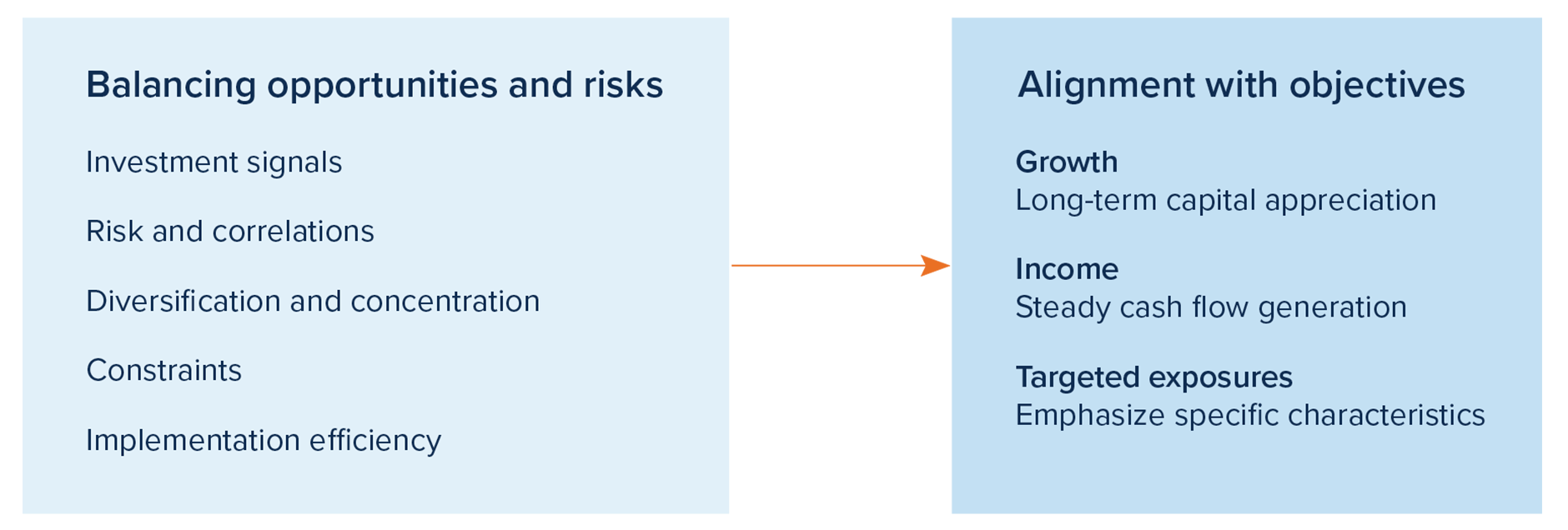
Systematic portfolio construction considers these relationships by combining research-driven investment signals with portfolio-level risk considerations. Opportunities are evaluated in the context of the portfolio as a whole, balancing their potential contribution against diversification, correlations, existing exposures and the strategy's objectives.
Portfolio optimization can also incorporate practical constraints such as liquidity, turnover and trading costs into investment decisions. This integrated approach helps manage unintended concentrations while allocating capital toward opportunities aligned with the strategy's objectives, whether emphasizing growth, income or targeted market exposures.
Applying the methodology consistently across broad investment universes allows investment teams to assess hundreds or thousands of opportunities, monitor evolving risks and implement portfolio decisions efficiently at scale. This can support consistent implementation while maintaining the strategy’s underlying investment philosophy.
Figure 2: Portfolio optimization targeting defined outcomes
Where systematic investing fits in a portfolio
Systematic investing provides investors a disciplined way to pursue intentional portfolio exposures and clearly defined objectives. Depending on the strategy, it may seek differentiated sources of potential return, emphasize particular market characteristics or generate income.
Traditional passive strategies can provide efficient, broad market exposure. Systematic strategies can build on that foundation by using research-driven criteria to deliberately emphasize or reduce specific exposures. This creates the potential for value add relative to a traditional market-cap-weighted approach while retaining a transparent and repeatable process.
Alongside discretionary active strategies, systematic investing offers a complementary way to express investment insight. The scalable nature of a rules-based process can also support fee-efficient implementation relative to more resource-intensive fundamental active approaches, while preserving the role of research, portfolio construction and ongoing investment oversight.
These approaches can serve different purposes within a portfolio. For investors with broad market holdings, systematic strategies can introduce targeted exposures that help shape the overall portfolio. Alongside discretionary active strategies, they provide another research-driven framework for pursuing specific investment objectives.
The value of systematic investing lies in translating investment research into deliberate, repeatable, portfolio decisions. By combining human expertise, disciplined execution and purposeful portfolio construction, systematic strategies offer investors a transparent and scalable way to pursue specific investment objectives while complementing existing portfolio allocations.
To learn more about this strategy, contact your Mackenzie Sales Team.

Commissions, management fees, brokerage fees and expenses may all be associated with Exchange Traded Funds. Please read the prospectus before investing. Exchange Traded Funds are not guaranteed, their values change frequently and past performance may not be repeated.
This document may contain forward-looking information which reflects our or third party current expectations or forecasts of future events. Forward-looking information is inherently subject to risks, uncertainties and assumptions that could cause actual results to differ materially from those expressed herein. Please consider these and other factors carefully and not place undue reliance on forward-looking information. The forward-looking information contained herein is current only as of October 30, 2026. There should be no expectation that such information will in all circumstances be updated, supplemented or revised whether as a result of new information, changing circumstances, future events or otherwise.
The content of this article (including facts, views, opinions, recommendations, descriptions of or references to products or securities) is not to be used or construed as investment advice, as an offer to sell or the solicitation of an offer to buy, or an endorsement, recommendation or sponsorship of any entity or security cited. Although we endeavour to ensure its accuracy and completeness, we assume no responsibility for any reliance upon it.