.svg)
.svg)
The ETF Lab
ETF spotlight: The quality foundation for global equity portfolios
Why quality matters at the core?
High-quality companies tend to share characteristics that can support long-term growth and provide resilience when market conditions become more challenging:
- Durable competitive advantages that can help sustain long-term growth
- Attractive returns on invested capital that support value creation
- Healthy balance sheets that provide financial flexibility
- Consistent cash flows that support reinvestment and shareholder return
For investors, a quality tilt can provide exposure to the long-term growth potential of global equities while emphasizing financially resilient businesses.
The quality tilt in global equity - Stronger returns and smoother ride
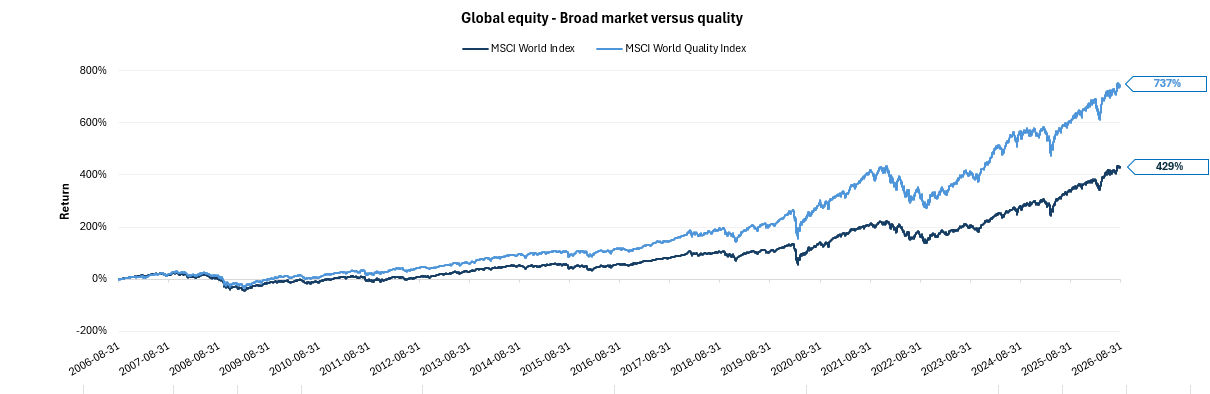 Source: Morningstar. 20-year period ending in August 31, 2026.
| Return | Std Dev | Sharpe Ratio | Max Drawdown |
MSCI World Index | 10.17 | 14.64 | 0.46 | -54.03 |
MSCI World Quality Index | 11.65 | 14.34 | 0.56 | -44.87 |
Source: Morningstar. 20-year period ending in August 31, 2026.
Dividends can be a sign of quality, not just a source of income
Dividend investing is often associated with income, but dividends can also provide insight into the health of a business. Companies that consistently generate excess cash, reinvest for future growth and return capital to shareholders may possess the durable economics investors value in a core holding. Consistent or growing dividends can therefore be an indicator of financial discipline and business quality.
This does not mean simply targeting the highest yields. An unusually high yield can sometimes signal deteriorating fundamentals or expectations of a dividend cut. Instead, a quality-oriented approach focuses on strong businesses capable of growing their underlying value and dividends over time.
MGDV: looking beyond the dividend label
Mackenzie Global Dividend ETF (MGDV) seeks long-term capital growth and current income by investing globally, primarily in dividend-paying businesses. The Mackenzie Global Equity & Income Team looks for industry-leading companies with sustainable competitive advantages, predictable long-term economics and the ability to compound shareholder value.
As a result, MGDV looks different from a traditional high-yield strategy. It can invest across the growth and value spectrum and across sectors including technology, financials, industrials, health care and consumer businesses. Information technology is currently its largest sector exposure, illustrating an opportunity set that extends well beyond traditional income-oriented sectors.
MGDV takes a quality-oriented approach to global equities, combining dividend-paying companies with an emphasis on businesses with sustainable competitive advantages and long-term growth potential.
TICKER | Product Name | Inception Date | Mgmt. Fee |
MGDV | Mackenzie Global Dividend ETF | 2024-06-06 | 0.80% |
ETF news & notes
Tax-aware ETFs drawing scrutiny from US policymakers
US Treasury and IRS officials have actively escalated their scrutiny of some "tax-alpha" strategies, explicitly labeling several of them as "potentially abusive". While they have stopped short of issuing immediate restrictions, they are heavily reviewing the tax-exempt status of the underlying mechanics for the following strategies:
Strategy | Primary mechanism | Tax advantage exploited | Key regulatory target |
Section 351 conversions | In-kind contribution of concentrated stock into an ETF wrapper | Diversification without triggering immediate capital gains | Expected to be labeled as "transactions of interest" |
Box-spread ETFs | Offsetting options pairings that mimic risk-free Treasury yields | Converts highly taxed interest income into deferred capital gains | Misuse of Section 852(b)(6) for options strategies |
ETF-rotation / Dividends | Rapidly trading out of funds before ex-dividend dates | Eliminates ordinary dividend income tax liability | Lack of economic substance / manufactured tax positioning |
ETF flows update
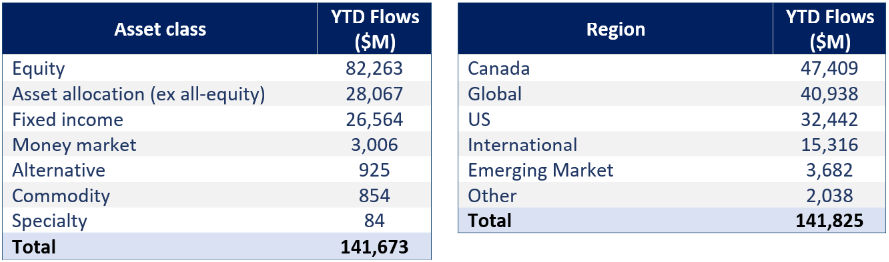
- YTD ETF inflows reached $142 billion as of September 8, led by equity ETFs ($82.3 billion), followed by asset allocation ETFs ($28.1 billion) and fixed income ETFs ($26.6 billion).
- The strongest regional momentum remains in international and global regions, where inflows outpaced those of the US and Canada relative to their asset bases. The Ex-North America (combined international and global) are in the lead with $56.3 billion YTD.
- The total AUM for Canadian ETFs reached $924 billion on net basis and $1,065 billion on gross basis.
- The number of listed ETFs: 2,069
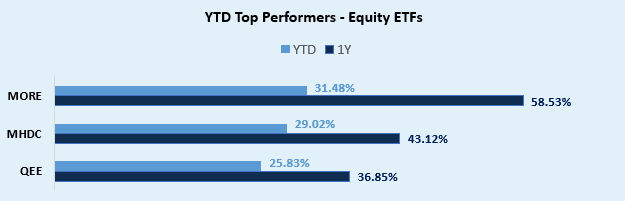
Mackenzie ETF top performers
Equity ETFs
Fixed Income ETFs
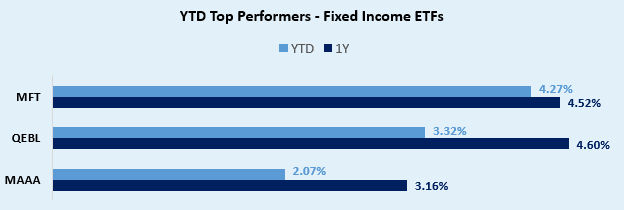
Source: Bloomberg and TD. As of September 4, 2026.
FOR ADVISOR USE ONLY. No portion of this communication may be reproduced or distributed to the public as it does not comply with investor sales communication rules. Mackenzie disclaims any responsibility for any advisor sharing this with investors.
Commissions, brokerage fees, management fees, and expenses all may be associated with Exchange Traded Funds. Please read the prospectus before investing. The indicated rates of return are the historical annual compounded total returns, including in share or unit value and reinvestment of distributions and does not take into account sales, redemption, distribution, or optional charges or income taxes payable by any securityholder that would have reduced returns. Exchange Traded Funds are not guaranteed, their values change frequently, and past performance may not be repeated.
The content of this article (including facts, views, opinions, recommendations, descriptions of or references to, products or securities) is not to be used or construed as investment advice, as an offer to sell or the solicitation of an offer to buy, or an endorsement, recommendation or sponsorship of any entity or security cited. Although we endeavour to ensure its accuracy and completeness, we assume no responsibility for any reliance upon it.
This should not be construed as legal, tax or accounting advice. This material has been prepared for information purposes only. The tax information provided in this document is general in nature and each client should consult with their own tax advisor, accountant and lawyer before pursuing any strategy described herein as each client’s individual circumstances are unique. We have endeavored to ensure the accuracy of the information provided at the time that it was written, however, should the information in this document be incorrect or incomplete or should the law or its interpretation change after the date of this document, the advice provided may be incorrect or inappropriate. There should be no expectation that the information will be updated, supplemented or revised whether as a result of new information, changing circumstances, future events or otherwise. We are not responsible for errors contained in this document or to anyone who relies on the information contained in this document. Please consult your own legal and tax advisor.
This article may contain forward-looking information which reflect our or third party current expectations or forecasts of future events. Forward-looking information is inherently subject to, among other things, risks, uncertainties and assumptions that could cause actual results to differ materially from those expressed herein. These risks, uncertainties and assumptions include, without limitation, general economic, political and market factors, interest and foreign exchange rates, the volatility of equity and capital markets, business competition, technological change, changes in government regulations, changes in tax laws, unexpected judicial or regulatory proceedings and catastrophic events. Please consider these and other factors carefully and not place undue reliance on forward-looking information. The forward-looking information contained herein is current only as of September 8, 2026. There should be no expectation that such information will in all circumstances be updated, supplemented, or revised whether as a result of new information, changing circumstances, future events or otherwise.
Index performance does not include the impact of fees, commissions, and expenses that would be payable by investors in the investment products that seek to track an index.
The Mackenzie ETFs are not sponsored, promoted, sold or supported in any other manner by Solactive nor does Solactive offer any express or implicit guarantee or assurance either with regard to the results of using the Indices, trademarks and/or the price of an Index at any time or in any other respect. The Solactive Indices are calculated and published by Solactive. Solactive uses its best efforts to ensure that the Indices are calculated correctly. Irrespective of its obligations towards the Mackenzie ETFs, Solactive has no obligation to point out errors in the Indices to third parties including but not limited to investors and/or financial intermediaries of the Mackenzie ETFs. Neither publication of the Solactive Indices by Solactive nor the licensing of the Indices or related trade mark(s) for the purpose of use in connection with the Mackenzie ETFs constitutes a recommendation by Solactive to invest capital in said Mackenzie ETFs nor does it in any way represent an assurance or opinion of Solactive with regard to any investment in these Mackenzie ETFs.