.svg)
.svg)
How infrastructure can strengthen diversified portfolios

IN THIS ARTICLE
Highlights
Why are advisors revisiting infrastructure?
Today's investment landscape is increasingly shaped by technological disruption, elevated market concentration and the rapid growth of intangible assets. As a result, many investors are reassessing the value of owning the tangible assets that underpin the global economy.
Why Infrastructure?
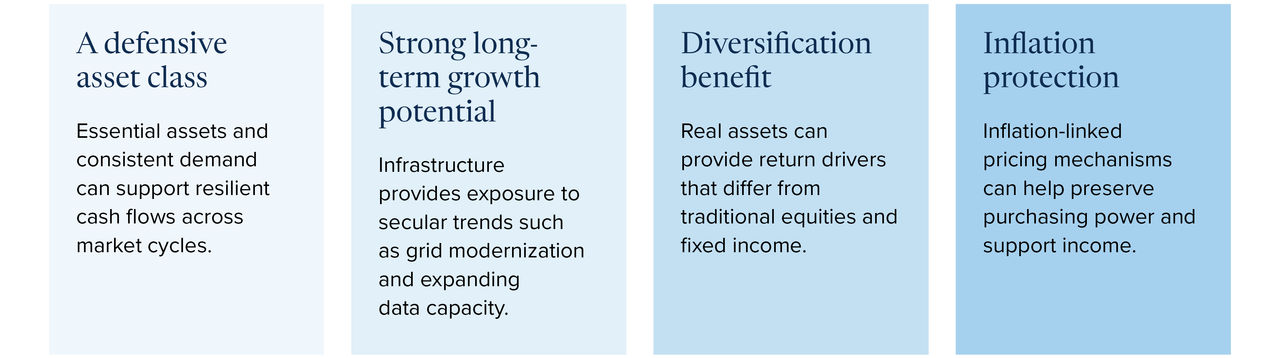
HALO (heavy assets, low obsolescence) investments focus on assets with enduring utility, limited risk of technological obsolescence and the potential to generate long-term cash flows. Infrastructure exemplifies this investment framework through ownership of essential assets that support everyday economic activity and may contribute to portfolio resilience.
Several long-term structural trends continue to support investment in infrastructure:
- Urbanization and population growth.
- Supply-chain reshoring.
- Infrastructure modernization and renewal.
- Energy transition.
- Electrical grid and data storage.
Together, these trends require significant investment in transportation, utilities, communications and energy networks, creating opportunities for infrastructure owners over the long term.
How can infrastructure strengthen portfolio construction?
Infrastructure provides exposure to essential physical assets that are difficult to replace, expensive to replicate and critical to the functioning of the global economy. These characteristics can contribute to resilient cash flows and differentiated return drivers relative to traditional equities and fixed income.
Potential portfolio benefits include:
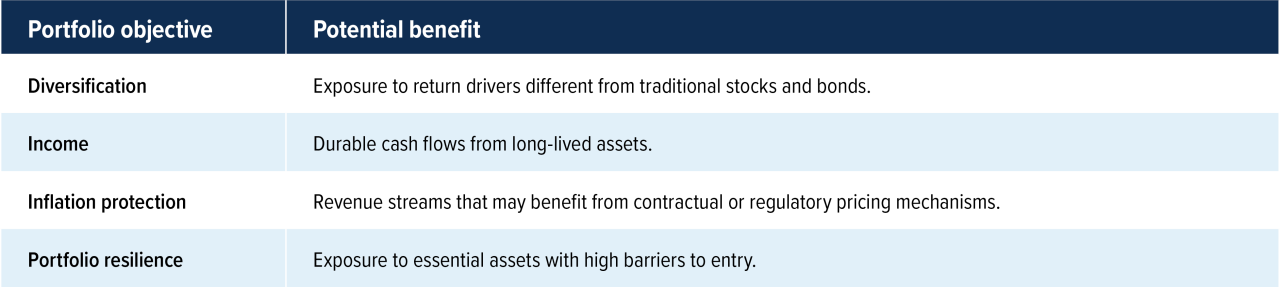
Infrastructure has long been a strategic allocation for institutional investors. Large public pension plans typically allocate 5% to 15% of their portfolios to the asset class, while leading Canadian pension funds often maintain allocations in the 10% to 20% range. These allocations underscore infrastructure's role as a core portfolio building block and highlight its importance in modern portfolio construction.
While portfolio allocations should reflect individual investment objectives and risk tolerance, an infrastructure allocation may offer retail investors access to many of the same potential benefits sought by institutional investors, including diversification, inflation resilience and differentiated sources of return.
What's the difference between public and private infrastructure?
Infrastructure can be accessed through either public or private markets. While both provide exposure to many of the same underlying assets and long-term investment themes, each offers distinct characteristics.
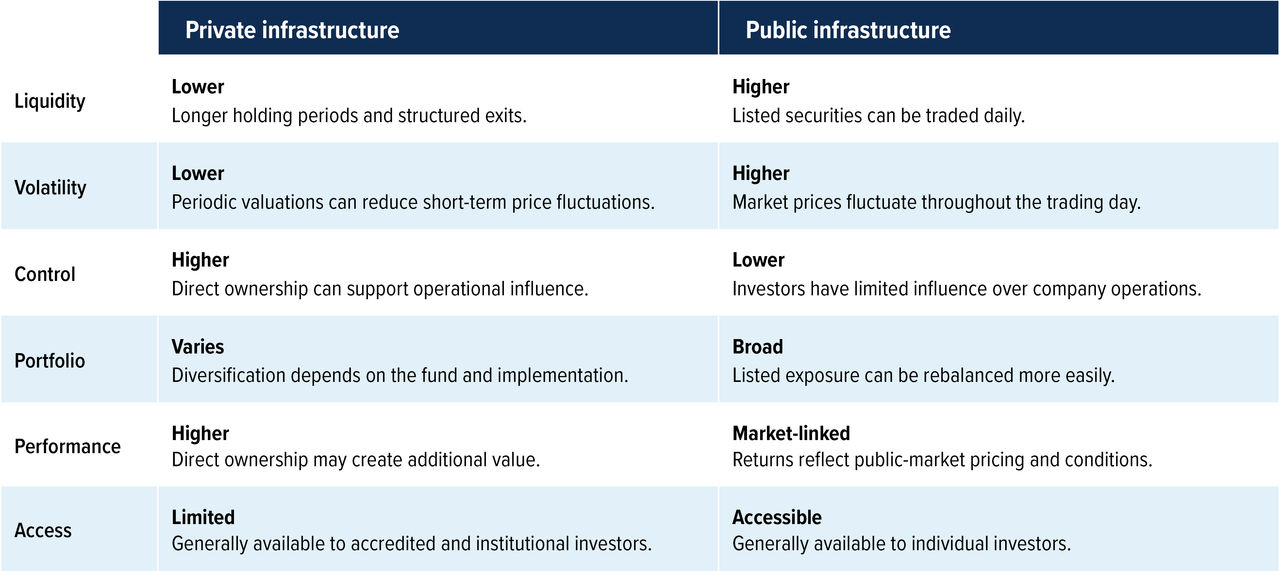
Public infrastructure strategies invest in publicly traded infrastructure companies and offer many of the same underlying economic exposures, but with daily liquidity, greater transparency, lower investment minimums and lower costs.
How can investors access infrastructure?
Accredited investors seeking private market exposure can access essential mid-market infrastructure assets through the Mackenzie Northleaf Private Infrastructure Fund, which invests across sectors such as renewable power, communications infrastructure and transportation. The strategy focuses on essential assets with high barriers to entry, predictable revenue streams and long-term capital appreciation and income.
For investors seeking liquid exposure, the Mackenzie Global Infrastructure Index ETF (QINF) provides diversified access to approximately 100 global infrastructure companies across utilities, energy infrastructure, transportation and communications. The ETF offers low-cost, pure-play infrastructure exposure without the inclusion of REITs.
Key takeaways
Infrastructure can play a strategic role in diversified portfolios by providing exposure to tangible, essential assets with long economic lives and differentiated return drivers. Supported by structural trends such as electrification, infrastructure renewal and data storage expansion, the asset class continues to offer long-term investment opportunities through both public and private markets. As part of a broader allocation to alternatives, infrastructure aligns with the HALO (heavy assets, low obsolescence) investment framework by emphasizing ownership of assets with enduring utility and limited risk of technological obsolescence. The appropriate implementation will depend on each investor's objectives, liquidity needs, risk tolerance and investment eligibility.
Commissions, management fees, brokerage fees and expenses may all be associated with Exchange Traded Funds. Please read the prospectus before investing. Exchange Traded Funds are not guaranteed, their values change frequently and past performance may not be repeated.
The content of this article (including facts, views, opinions, recommendations, descriptions of or references to, products or securities) is not to be used or construed as investment advice, as an offer to sell or the solicitation of an offer to buy, or an endorsement, recommendation or sponsorship of any entity or security cited. Although we endeavour to ensure its accuracy and completeness, we assume no responsibility for any reliance upon it.
There can be no assurance that the Fund’s return or volatility targets will be met, or met over any particular time horizon. Targeted returns and volatility should be evaluated over the time period indicated and not over shorter periods. Targeted returns are not actual performance and should not be relied upon as an indication of actual or future performance.
This material is not intended to constitute an offer of units of Mackenzie Northleaf Private Infrastructure Fund (the “Fund”). The information contained herein is qualified in its entirety by reference to the Offering Memorandum (“OM”) of the Fund. Units of the Fund are generally only available to “accredited investors” (as defined in NI 45-16). The OM contains information about the investment objectives and terms and conditions of an investment in the Fund (including fees) and will also contain tax information and risk disclosures that are important to any investment decision regarding the Fund.
This article may contain forward-looking information which reflect our or third-party current expectations or forecasts of future events. Forward-looking information is inherently subject to, among other things, risks, uncertainties and assumptions that could cause actual results to differ materially from those expressed herein. These risks, uncertainties and assumptions include, without limitation, general economic, political and market factors, interest and foreign exchange rates, the volatility of equity and capital markets, business competition, technological change, changes in government regulations, changes in tax laws, unexpected judicial or regulatory proceedings and catastrophic events. Please consider these and other factors carefully and not place undue reliance on forward-looking information. The forward-looking information contained herein is current only as of August 6, 2026. There should be no expectation that such information will in all circumstances be updated, supplemented or revised whether as a result of new information, changing circumstances, future events or otherwise.