.svg)
.svg)
Navigating the debasement trade


IN THIS ARTICLE min read
Highlights
Global equity concentration is rising
Global equities have long provided investors with diversification across countries, sectors and companies. Yet beneath that broad exposure, portfolio concentration has increased.
Today, 72% of the MSCI World Index is represented by US companies, up from roughly 44% three decades ago.1 This reflects years of strong corporate performance, technological leadership and deep capital markets, but it has also changed the nature of global equity diversification.
While many US companies generate revenues globally, their valuations remain influenced by US monetary policy, fiscal conditions, interest rates and the US dollar. As their index weight has increased, so has investors’ exposure to these shared drivers.
At the same time, persistent structural deficits, rising national debt and expansive monetary policy have increased attention on currency debasement—the gradual erosion of fiat currency purchasing power.
What is the debasement trade?
Historically, currency was debased by reducing the precious metal content of physical coins. Today, debasement can occur as governments issue debt and central banks expand the money supply, reducing the purchasing power of each currency unit.
The debasement trade involves shifting exposure from paper-backed liabilities, such as cash and government bonds, toward scarce assets such as gold. Gold carries no credit risk and cannot be created at will by governments, giving it distinct characteristics as a store of value.
For investors, however, adding gold creates a portfolio trade-off. Selling equities to fund a gold allocation reduces exposure to companies that can contribute to long-term capital growth. Managing separate gold positions, futures and collateral can also add complexity.
A capital-efficient approach
The Mackenzie Global Equity & Gold Overlay ETF (MGEG) addresses this implementation challenge by pairing 100% active global equity exposure with a 50% systematic gold futures overlay.
Its equity allocation is invested in the Mackenzie GQE Global Equity ETF (MGQE), managed by Mackenzie’s Global Quantitative Equity team. MGQE uses a disciplined process to identify high-quality, undervalued global companies with attractive growth profiles.
Rather than selling equities to fund its gold exposure, MGEG uses securities-collateralized borrowing against its MGQE holdings to post cash margin for US gold futures. The margin is typically about 5% of net asset value, although requirements can change over time.
Figure 1: How the gold overlay works
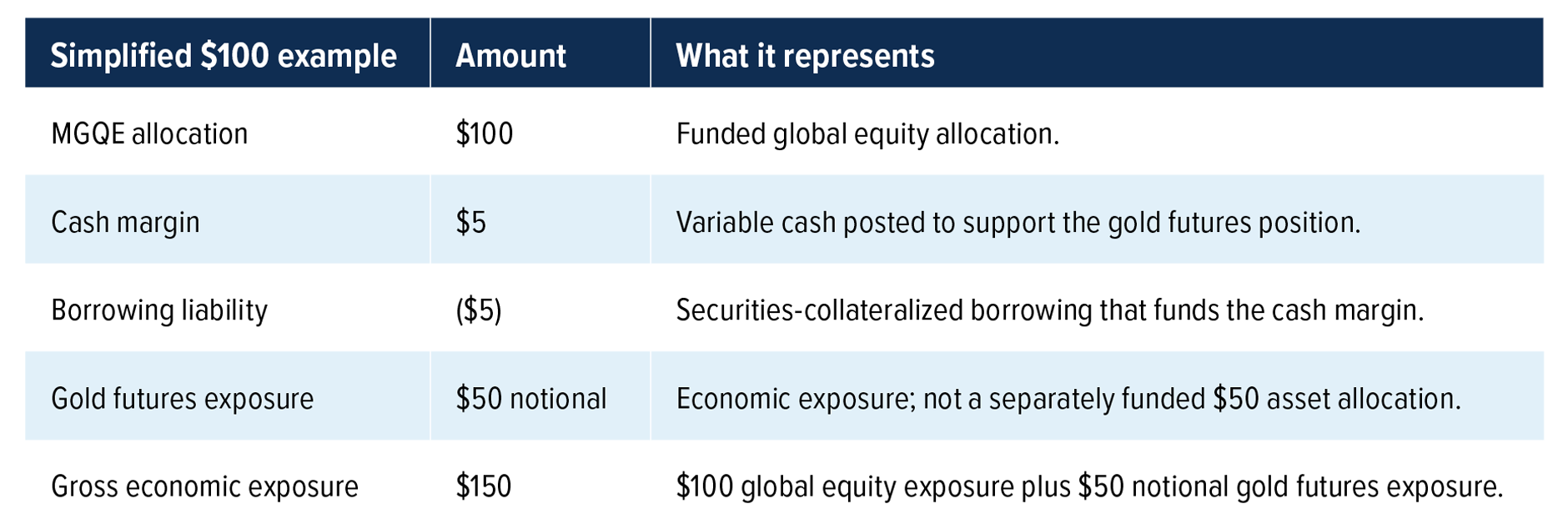 Illustrative only. The 5% cash-margin estimate is based on exchange margin requirements. Actual margin and financing requirements may change over time. Gross economic exposure is not the same as invested capital or NAV; it includes the notional exposure created through futures.
As a result, every $100 invested provides $150 of gross economic exposure: $100 of active global equity exposure plus $50 of notional gold futures exposure.
Combining growth and diversification
This structure allows capital to remain fully invested in active global equities while adding systematic gold exposure as a diversifier against inflation and currency dilution.
MGEG also manages the operational requirements—including futures contracts, margin, collateralized borrowing and contract rolls—within a single ETF.
For Canadian investors concerned about global equity concentration and currency debasement, MGEG provides a way to maintain global equity participation while adding gold exposure without requiring a separately funded allocation.
1 Source: Bloomberg, as at June 30, 2026.
Commissions, management fees, brokerage fees and expenses may all be associated with Exchange Traded Funds. Please read the prospectus before investing. Exchange Traded Funds are not guaranteed, their values change frequently and past performance may not be repeated.
Index performance does not include the impact of fees, commissions and expenses that would be payable by investors in the investment products that seek to track an index.
The content of this article (including facts, views, opinions, recommendations, descriptions of or references to, products or securities) is not to be used or construed as investment advice, as an offer to sell or the solicitation of an offer to buy, or an endorsement, recommendation or sponsorship of any entity or security cited. Although we endeavour to ensure its accuracy and completeness, we assume no responsibility for any reliance upon it.
This article may contain forward-looking information which reflect our or third-party current expectations or forecasts of future events. Forward-looking information is inherently subject to, among other things, risks, uncertainties and assumptions that could cause actual results to differ materially from those expressed herein. These risks, uncertainties and assumptions include, without limitation, general economic, political and market factors, interest and foreign exchange rates, the volatility of equity and capital markets, business competition, technological change, changes in government regulations, changes in tax laws, unexpected judicial or regulatory proceedings and catastrophic events. Please consider these and other factors carefully and not place undue reliance on forward-looking information. The forward-looking information contained herein is current only as of September 8, 2026. There should be no expectation that such information will in all circumstances be updated, supplemented or revised whether as a result of new information, changing circumstances, future events or otherwise.
The TSX has conditionally approved the listing of the Units of the Mackenzie ETFs. Listing is subject to the Mackenzie ETFs fulfilling all of the requirements of the TSX on or before August 4, 2028. Subject to satisfying the TSX’s original listing requirements, the Units of the Mackenzie ETFs will be listed on the TSX.