Value styles explained: Choosing the right manager for your portfolio

IN THIS ARTICLE min read

Select Section


    Written by: Barrow Hanley Global Investors

    How well do you know your value manager?

    While value investors share a philosophy of buying companies trading at a discount to fair value, their portfolio characteristics and performance can differ considerably depending on market conditions and each manager’s definition of value. Thus, even if you have an allocation to value, do you know which style it follows? Does it behave as expected in different market environments — does it defend a portfolio when needed and outperform in difficult conditions?

    Not all value investing strategies are created equal: some outperform in growth-led markets but lag in value rallies. Correlations with the value index also vary, raising another question: when value leads the market again, will your chosen strategy benefit?

    A review of recent performance

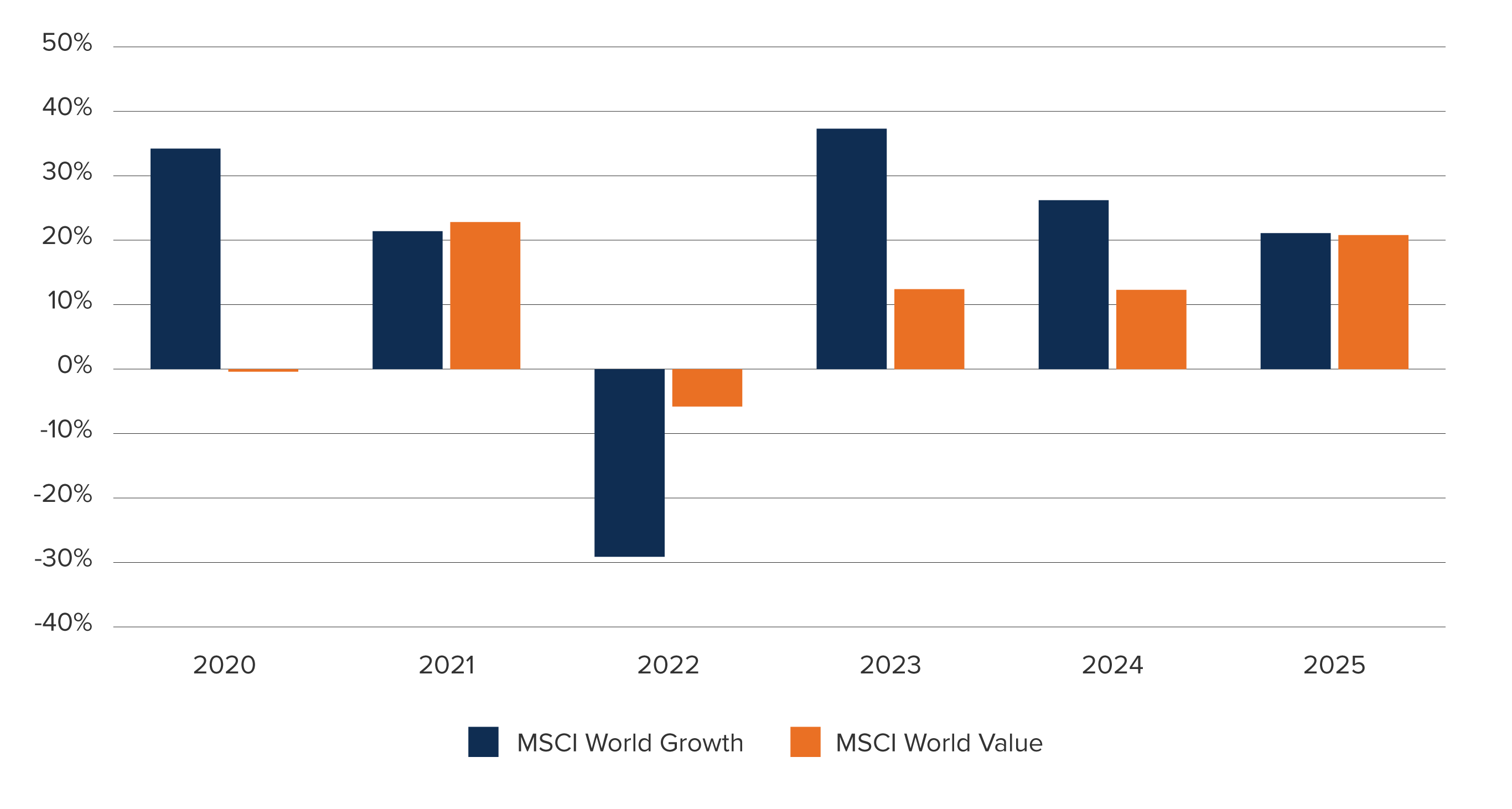
    Growth investing massively outperformed value through 2020, when the MSCI World Growth Index beat the MSCI World Value Index by nearly 35% — the largest divergence in any calendar year since the inception of these indices (see Figure 1).

    Value regained its footing in 2022, as inflation and higher-for-longer rates pressured growth stocks, and the World Value Index outperformed by 23%. Yet only ~35% of value managers beat the index. In contrast, 2023 and 2024 brought renewed growth stock strength, fueled by AI and easing rate expectations; market breadth in 2024 meant fewer value managers outpaced the index.

    Figure 1 – Calendar year performance (gross) of MSCI World Growth and MSCI World Value indices, 2020 - 2025

    Source: MSCI, as at June 1, 2026. Performance in USD.

    These shifts prompt key questions: did your value manager perform in line with their stated style; and are they positioned for a value regime similar to 2022?

    Value styles defined

    Value investors’ assumptions about growth, quality and leverage vary widely, driving distinct portfolio characteristics and performance. To examine biases, Barrow Hanley categorized 61 strategies into three value styles: traditional (sometimes called deep value), defensive and relative value. Most managers fit into one of these groups, even if their portfolios might blend elements of each.

    Defensive and traditional value managers are easier to define by valuation metrics, beta, sector positioning and capture ratios. Relative value strategies are more difficult, sometimes resembling benchmarks or leaning toward either defensive or traditional.

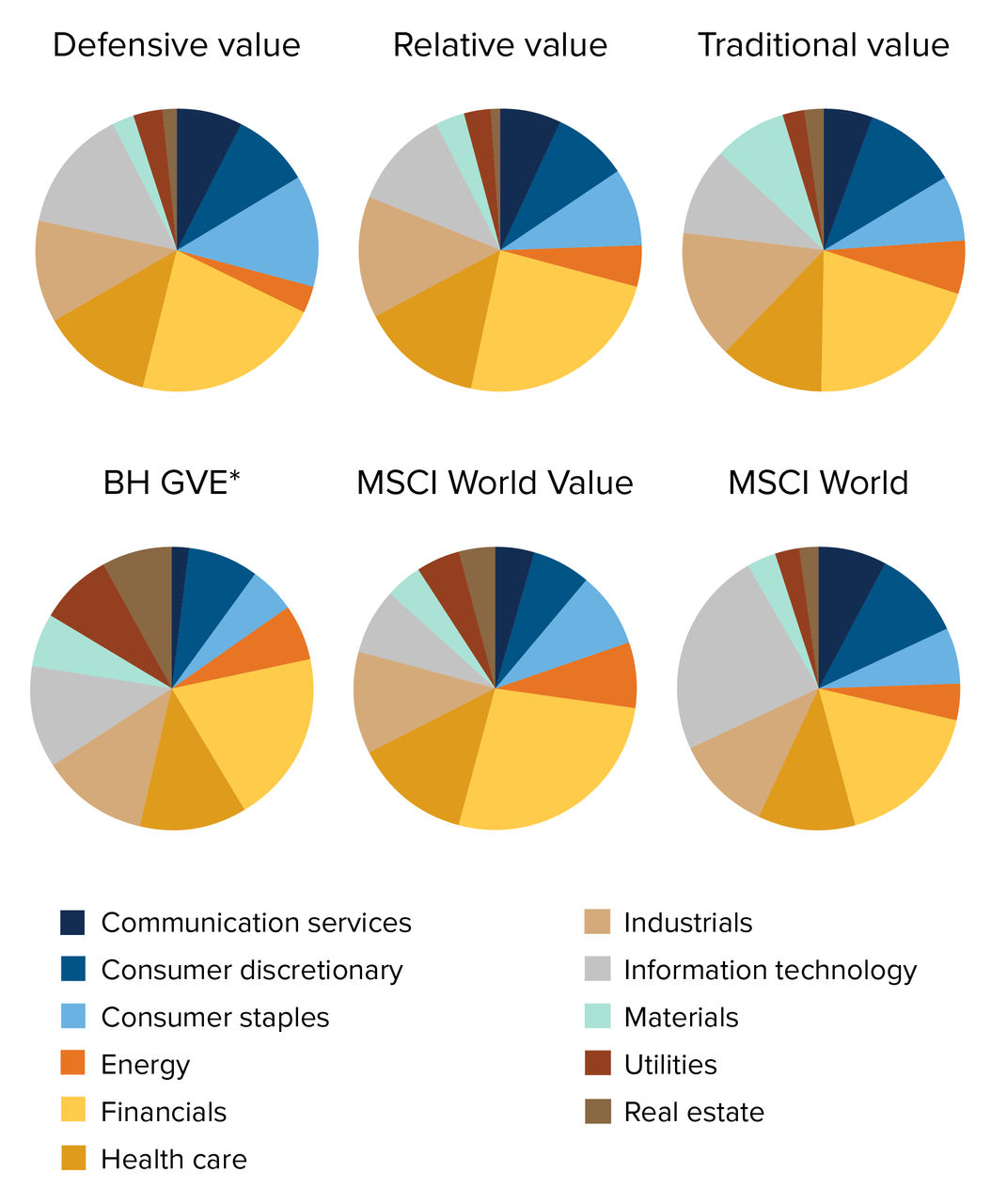
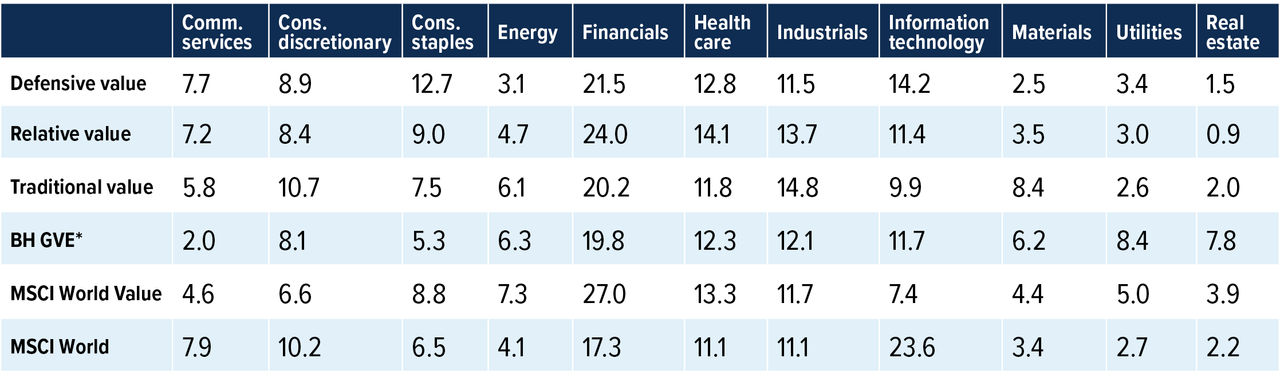
    Inspecting sector positioning illustrates distinctions:

    1. Defensive value managers tend to overweight consumer staples, health care, communication services and utilities, while underweighting cyclical sectors like energy, financials and materials.
    2. Traditional value managers conversely tend to hold more cyclical exposure.
    3. Relative value managers have historically favoured the information technology, communication services and consumer discretionary sectors, lagging peers in value-driven environments.

    Table 1: Average sector weighting (as at March 31, 2025)

    *Barrow Hanley Global Value Equity.

    Sources: eVestment, FactSet. Material presented is based on the BH GVE composite and not an individual account.

    These preferences affect valuations: traditional strategies trade at deeper discounts, while their defensive and relative peers appear more expensive.

    Table 2: Average valuation fundamentals (as at March 31, 2025)


    Price-to-earnings
    (12-month
    forward)*

    Price-to-book*

    Dividend yield

    Defensive value

    18.0

    3.3x

    3.0%

    Relative value

    13.8

    2.5x

    2.9%

    Traditional value

    12.2

    1.6x

    2.9%

    BH GVE

    12.7

    1.9x

    2.6%

    MSCI World Value

    14.4

    2.2x

    2.8%

    MSCI World

    18.1

    3.4x

    1.8%

    *Weighted harmonic average on forward price.

    Sources: eVestment, FactSet. Material presented is based on the BH GVE composite and not an individual account.

    Performance in up and down markets

    Distinctions are clearer when observing capture ratios and beta. Defensive value strategies defend well in down markets but lag in rallies, while traditional strategies excel in up markets but may struggle in down markets. Relative strategies fall in between, capturing less upside than traditional peers but protecting more on the downside. Beta trends are linear: defensive strategies show lower beta, traditional higher and relative value are more in line with overall market risk.

    The Mackenzie Global Value Fund (the “Fund”) is sub-advised by Barrow Hanley Global Investors and replicates the Barrow Hanley Global Value Equity strategy (the “Barrow Hanley Strategy”). In the tables that follow, we present past performance of the Barrow Hanley Strategy in US dollars. Actual performance of the Fund may vary. The presented performance is for illustrative purposes only. It should not be interpreted as an indication or guarantee of future results.

    The portfolio of the Fund will generally include securities that are included in the Barrow Hanley Strategy, which was launched on September 1, 2010. The historical performance of the Barrow Hanley Strategy does not include the impact of fees, commissions and expenses that would be payable by investors of the Fund.

    The performance of the Barrow Hanley Strategy is not an exact illustration of how the Fund will perform, due to slight differences stemming from timing of subscriptions and redemptions, and trading considerations regarding lots and transaction costs, which may impact position weights between the two. As such, the Fund will slightly differ from the Barrow Hanley Strategy, and no representation is being made that an actual investment in the Fund is likely to achieve similar returns to the historical returns of the Barrow Hanley Strategy.

    Table 3: Average up/down capture and beta vs. MSCI World Value (as at March 31, 2025)


    5-year up market capture

    5-year down market capture

    3-year beta vs. MSCI World Value

    5-year beta vs. MSCI World Value

    Defensive value

    85.8%

    89.7%

    0.86

    0.84

    Relative value

    100.6%

    97.0%

    0.97

    0.98

    Traditional value

    120.5%

    100.3%

    1.06

    1.10

    BH GVE

    109.0%

    95.5%

    0.93

    1.00

    Sources: eVestment, FactSet. Material presented is based on the BH GVE composite and not an individual account.

    Market environments determine style success. Defensive strategies outperformed in fearful markets (2001, 2015, 2018), traditional in recoveries (2012–2017), and relative value in growth-leaning periods (2019–2021). More recently, in 2022, traditional value outperformed as tech multiples compressed. In 2023–2024, growth returned, but narrow pockets of value enabled selective managers to perform well.

    Correlations also matter. Defensive and relative value strategies historically showed lower correlations to the MSCI World Value Index, but recent years showed greater alignment. Traditional strategies remain the most correlated.

    How Barrow Hanley navigates today’s markets

    We are once again in unprecedented times, with global politics, tariffs and lingering post-COVID-19 policy impacts driving volatility. Despite these challenges, disciplined adherence to value styles is critical, as chasing market shifts can risk missing early phases of a value rally. Barrow Hanley’s traditional value approach balances cyclical and defensive exposure to capture dislocations.

    Table 4: Barrow Hanley Global Value Equity performance (as at March 31, 2026)


    1 Year

    3 Year

    5 Year

    10 Year

    BH GVE (gross of fees)

    18.60%

    15.48%

    10.21%

    11.96%

    MSCI World Value

    16.60%

    14.59%

    9.58%

    9.35%

    Source: eVestment, MSCI. Material presented is based on the BH GVE composite and not an individual account. The Mackenzie Global Value Fund is sub-advised by Barrow Hanley Global Investors and replicates the Barrow Hanley Global Value Equity strategy. The benchmark for the Mackenzie Global Value Fund is the MSCI World Value Index.

    After more than four decades of investing, we maintain a consistent value style and discipline. With valuation gaps between growth and value still meaningful and with economic catalysts favouring growth, we believe value is positioned for strong performance ahead and our approach is well positioned to benefit.


    For advisor use only. No portion of this communication may be reproduced or distributed to the public as it does not comply with investor sales communication rules. Mackenzie disclaims any responsibility for any advisor sharing this with investors.

    Commissions, trailing commissions, management fees, and expenses all may be associated with mutual fund investments. Please read the prospectus before investing. The indicated rates of return are the historical annual compounded total returns as of June 1, 2026 including changes in unit value and reinvestment of all distributions and do not take into account sales, redemption, distribution, or optional charges or income taxes payable by any securityholder that would have reduced returns. Mutual funds are not guaranteed, their values change frequently and past performance may not be repeated.

    The presented past performance is of a portfolio that approximates the investment strategy of the Mackenzie Global Value Fund (the “Fund”). Hypothetical performance is for illustrative purposes only. It should not be interpreted as an indication or guarantee of future results. Actual performance of the Fund may vary significantly. The portfolio of the Fund will generally include securities that are included in the Barrow Global Value Equity (the “Barrow Hanley Strategy”) which was launched on September 1, 2010. The Barrow Hanley Strategy’s historical performance does not include the impact of fees, commissions and expenses that would be payable by investors of the Fund. The Barrow Hanley Strategy’s performance is not an exact illustration of how the Fund will perform, due to slight differences stemming from timing of subscriptions and redemptions, and trading considerations regarding lots and transaction costs, which may impact position weights between the two. As such, the Fund will slightly differ from the Barrow Hanley Strategy, and no representation is being made that an actual investment in the Fund is likely to achieve similar returns to the historical returns of the Barrow Hanley Strategy.

    This document may contain forward-looking information which reflect our or third-party current expectations or forecasts of future events. Forward-looking information is inherently subject to, among other things, risks, uncertainties and assumptions that could cause actual results to differ materially from those expressed herein. These risks, uncertainties and assumptions include, without limitation, general economic, political and market factors, interest and foreign exchange rates, the volatility of equity and capital markets, business competition, technological change, changes in government regulations, changes in tax laws, unexpected judicial or regulatory proceedings and catastrophic events. Please consider these and other factors carefully and not place undue reliance on forward-looking information. The forward-looking information contained herein is current only as of April 30, 2026. There should be no expectation that such information will in all circumstances be updated, supplemented or revised whether as a result of new information, changing circumstances, future events or otherwise.

    The content of this article (including facts, views, opinions, recommendations, descriptions of or references to, products or securities) is not to be used or construed as investment advice, as an offer to sell or the solicitation of an offer to buy, or an endorsement, recommendation or sponsorship of any entity or security cited. Although we endeavour to ensure its accuracy and completeness, we assume no responsibility for any reliance upon it.